

When Munetaka Murakami walked into Rate Field and took the podium, the moment was framed as more than a standard free agent introduction.
Chris Getz called it “a significant moment,” positioning Murakami not just as an acquisition but as an opportunity to “tell our story” on a global stage and welcome Japanese fans into it. He later described Murakami as “one of the most prolific power hitters on the planet.”
Chicago views the signing as a marker of where the rebuild is heading and a signal that the White Sox are willing to pursue talent through any avenue that fits the organization.
Getz admitted the move “hasn’t really sunk in,” but said once it became real last week, the takeaway was simple. “If we can get this guy in our lineup,” the upside is obvious.
Contract Details for White Sox
The Murakami sweepstakes never resembled a typical MLB free agency. The posting system imposed a fixed window and a hard deadline. Getz described it as its own market category. “There’s a time frame that’s set,” he said. He added the deadline creates “an urgency to get a deal done.” He called the process “unique” because it lacks the open-ended leverage of a normal winter.
The White Sox checked in early but were priced out as the market formed. As interest cooled and teams grew uneasy with the swing-and-miss profile, the front office identified an opening. Getz said the call came “around midnight,” and that he immediately called Jerry to say Murakami was “coming our way.”
Getz acknowledged that strikeouts are part of the profile, but pointed out that recent Japanese imports arrived with “pretty similar” rates and still succeeded once they were acclimated.
David Keller framed scouting as “evaluate properly, and then assign value.” He said “a lot of market factors” shaped the final number. Getz told Murakami’s representatives, “We definitely want this player,” while setting a firm boundary. “For it to make sense… this is what it’s got to look like.” It was a deliberate move.
There was no prolonged winter of leverage plays. Chicago stayed close enough to act if the structure made sense. As the window narrowed, the stance became clearer. They wanted the player but only on terms that fit. Getz credited relationships alongside evaluation, citing a “strong relationship” with Casey Close and Bobby Barad of Excel Sports Management, then adding, “You really don’t know to the end, oftentimes.”
Some fun Munetaka Murakami notes.
Murakami’s agent also represents Andrew Benintendi. That relationship was key to getting the contract done.
From 2024-2025, Murakami faced #WhiteSox LHP Anthony Kay in seven official NPB games, slashing .400/.526/.467 over 15 ABs.
— Sam Phalen (@Sam_Phalen) December 22, 2025
The deal is a two-year, $34 million contract. That figure includes roughly $6.5 million owed to the Yakult Swallows as a posting fee. The total commitment sits near $40 million.
Keller emphasized the White Sox were not only buying what Murakami already is. They were buying what they believe they can unlock. The focus was on identifying strengths, being “critical” of the gaps, and determining whether player development can “tap into” growth.
The structure reflects that hedge. Murakami received a modest $1M signing bonus and will earn $16 million in 2026 and $17 million in 2027 before returning to free agency. If he performs and the club is competitive, extension talks remain possible. A strong two-year run would give Chicago the option to pursue a longer-term deal rather than treating the contract as a pure rental.
Getz framed it as an opportunity for Murakami to “go out there, be himself,” get comfortable, and let performance dictate what comes next. He called it “a clean two-year deal,” and said the simplicity mattered.
The structure offers “only upside in this,” while Murakami adjusts and the roster continues to evolve. He gets time without the pressure of a long-term contract, and Chicago avoids locking itself into a corner if the transition is uneven. “Support him correctly, let him get comfortable, and just play baseball,” Getz said.
If the adjustment happens quickly, Murakami reaches free agency again, still squarely in his prime. By all accounts, the makeup checks out, which has been a consistent point of emphasis under Chris Getz.
Murakami said the decision was made late. He declined to name teams, but confirmed he spoke with multiple clubs. In the CHSN interview, he said the final group was “three” or “four” teams.
Player Profile That Attracted the White Sox
Munetaka Murakami’s reputation in Japan is built on outcomes that require little projection. He has already done historic things.
At 22-years-old, Murakami hit 56 home runs and won the Triple Crown. Getz repeatedly returned to the same foundation when describing the player. He called Murakami “an offensive force,” and said Chicago believes he is going to “be a star in this game.” When asked why, Getz did not hesitate. “He already is,” pointing to Murakami’s stature in Japan and describing the “starter kit” of talent and conviction that makes his major league future real.
An oblique injury cost him time, yet Murakami still hit 22 home runs in 56 games (on pace to reach his 56 HRs) with a .273/.379/.663 slash line with a 211 wRC+. The impact is undeniable when he makes contact. From an analytical standpoint, that production reflects why the market viewed him as an extreme outcome bet rather than a finished product.
Murakami’s raw power is not theoretical. His hardest contact and launch characteristics align with the most dangerous left-handed hitters in the game. When he squares the baseball, it leaves the bat with rare speed and lift that turns routine mistakes into no-doubt home runs. Evaluators have long used top-of-scale language to describe the power for that reason.
Early batted-ball translations suggest the output could translate immediately, with exit velocities projecting near the top of the league if the contact holds. Early modeling places Murakami near the 90th percentile in projected exit velocity, with batted-ball outputs that would rank among the league’s elite and translate to a top-tier hard-hit rate if contact holds.
In Japan, Munetaki Murakami hit a ball 117 mph (would be top ~6% in US) and made zone contact at a 72.6% rate (bottom 1%). Using Statcast zone contact rates on FanGraphs, here are comparable career batters (minimum 450, just to get Nick Kurtz on there for some sunshine). pic.twitter.com/SnMS5IjFDV
— Eno Sarris (@enosarris) December 18, 2025
The question has always been access. Murakami’s contact rate hovered around 73% last season, a level that would place him among the lowest marks for everyday major league hitters, with the gap most evident against fastballs in the strike zone and spin moving away from him. His strikeout rate sits closer to 28%. That risk is well understood internally and defines the profile. Models built around bat speed and contact tend to surface high-variance slugger outcomes, where a few percentage points of contact separate a productive regular from a frustrating roster piece.
There are also reasons for caution in the trend line. Murakami’s strikeout rate climbed late in his Japanese tenure, and scouts have noted a growing vulnerability to elevated fastballs. That context helps explain why clubs treated him as a shorter-term bet rather than a long-term cornerstone.
The counterweight is that hitters with this level of bat speed often live on the edge of contact by design. Extreme power swings naturally come with more misses, and some of the best sluggers in the sport operate in that space. For Chicago, the bet is not whether Murakami will strike out. It is whether he can raise his contact rate just enough for the power to fully translate against major league velocity and sequencing on a nightly basis.
There is a quieter part of his offensive profile that tends to be overshadowed by the strikeout discussion. Murakami controls the strike zone. His on-base ability in Japan was not a byproduct of passive pitching, and his walk rates consistently ranked among the best in NPB. For teams projecting the transition, that matters. Plate discipline has a stronger track record of carrying over than pure batting average.
Keller’s description of the NPB context fits here. The league can “look like a Major League game” because of the “quality of arms,” even if the environment is more “contact-driven” and “less power-oriented.” Keller joined Inside the Clubhouse on 670 The Score this past weekend.
When asked directly what makes him dangerous during the CHSN sit-down, Murakami gave the scouting report in English in two words. “I have power.” He outlined the version of himself he believes can exist in the majors. A prolific home run hitter.
He acknowledged there will be strikeouts along the way. “I will strike out,” he said, while emphasizing that he wants to preserve the foundation of his Japan swing and make only small adjustments to handle MLB pitching.
Strikeouts remain the fulcrum of Murakami’s evaluation. His totals in Japan were elevated, and the trend has long been part of the scouting conversation. The White Sox are not expecting that to disappear once he changes uniforms. They are betting their infrastructure can help him manage it.
In the CHSN sit-down, Getz framed the evaluation around two “buckets” the organization values most: “swing decisions” and “damage.” Murakami checks the damage box at a level few hitters in the world can reach. Swing decisions are the developmental challenge, particularly how he handles major league velocity and learns the shape of MLB pitching.
Getz pointed to Ryan Fuller overseeing the department and Derek Shomon’s arrival. An infrastructure that is “strong” and “only getting better” because it is more aligned, positioning that support system as central to closing the gap.
Munetaka Murakami 2025 NPB Ranks (min. 200 PA, out of 121 total players)
199 OPS+ (2nd)
.390 ISO (1st)
.988 xSLG on BIP (1st)
28.6 K% (111th)
14.3 BB% (2nd)
64.8 AIR% (13th)
73.4 Z-Con% (120th)
52.7 TTO% (1st)
47 HardHit% (1st)pic.twitter.com/lqkfyEkyE4
— Yakyu Cosmopolitan (@yakyucosmo) December 21, 2025
Chicago believes it can accelerate that learning curve. Getz said the club believes it can “tap into another level” because the underlying tools are loud. His confidence was not that the transition would be easy, but that this is “the best place for him,” and that the organization can “get him up to speed with our people” as he adapts to major league velocity and pitch shapes.
Murakami has not previously had access to the scale of training methods and alignment Chicago believes it can provide. He also stressed the internal wiring matters just as much. Murakami is “very prideful,” and the goal is to build the support system that keeps him engaged in daily improvement, the same approach the club has applied to other young players.
Defensively, Murakami spent most of his time at third base in Japan. The expectation in Chicago is first base or DH. Getz framed defensive flexibility as a feature rather than a limitation, calling it “valuable” and noting Murakami has already been “working on his defense” since arriving in the United States.
Murakami did not pretend that defense is his calling card. He said he is “not really confident” there and framed it as part of why he wanted MLB, the challenge, and the commitment to “do whatever it takes to get better.”
Murakami has played both corners, but the plan is to deploy him primarily at first base. If it requires a first base or DH-heavy deployment early, the White Sox are comfortable with it. He remains eligible for American League Rookie of the Year.
There are ripple effects. Adding Murakami compresses first base and DH opportunities, leaving Lenyn Sosa without a clear path to everyday at-bats.
That narrow margin is where the White Sox believe the opportunity exists. This signing is not about polishing a finished product. It is about identifying whether mechanical tweaks and approach refinement can close a small but meaningful gap. Even modest gains could materially change the outcome. Without them, the floor becomes clearer.
This is why the contract landed where it did. The market acknowledged both realities. Murakami is young enough that improvement remains plausible, but established enough that blind projection no longer works. Two years gives him time to adapt without forcing a club to live indefinitely with the downside.
In that sense, the deal reflects exactly what the data says. Both the upside and the risk are real, and the distance between them is narrow enough to justify the gamb
Why Choosing the White Sox Matters
It was not a “slam dunk.” His framing was direct. “He chose us.” Getz said Murakami wanted to be in Chicago with “this young group” and be part of what they are building. Once Murakami learned “who we were and where we’re headed,” Getz said, he “wanted to be a part of it.” He framed that decision as validation of recent momentum and the substance behind the pitch.
That distinction matters because it speaks to what the White Sox are trying to re-establish. Credibility in the pitch. Getz said the sales conversation is “becoming easier” because it is no longer built only on vision. Chicago can point to “more tangible evidence now,” including the No. 1 pick and a lineup core that is starting to take shape.
Getz pointed to the second half as proof of traction. Young players began to settle in. The club started to “win some baseball games.” The goal now is to use that momentum to “attract even more talent.” The broader idea was simple. The picture is clearer, and free agents can feel where it is going.
Murakami echoed that belief from his side. He said he saw “exciting young players” and compared the situation to his experience in Japan, joining a young team that eventually reached the “promised land” of a championship. He added that he felt “destined to be here.” The message was not that Chicago has arrived. It was that he believes in the path.
Entering his age-26 season, Murakami fits the type of upside play the organization has been working toward. The environment also mattered. He spent much of his prime carrying an NPB club that rarely contended and often faced opposing game plans without lineup protection. Chicago offers a cleaner runway with fewer external expectations. He has a defined role that does not require him to carry a contender immediately. That runway was a meaningful part of the fit.
White Sox Expanding into the Pacific Rim
The White Sox have not been a frequent destination for Japanese position players in recent decades. Chicago’s recent ties to Japan have been driven more by pitching, with arms rebuilding value overseas and returning in defined roles.
White Sox have had Tadahito Iguchi (2005-07), Shingo Takatsu (2004-05) and Kosuke Fukudome (2012) on their Major League roster.
They also had RHP Tetsu Yofu in their Minor League system from 2003-05.
— Scott Merkin (@scottmerkin) December 21, 2025
Getz described this area of the market as new territory for him personally. The club wants to remain open to any market that can help add talent. He framed Murakami as a move that could matter beyond one player, both in reputation and in future conversations.
It is not a promise of a pipeline. It is a signal that the Sox are willing to operate creatively, and that a player of Murakami’s profile was comfortable betting on their environment.
Murakami’s manager in Japan was Shingo Takatsu, a former White Sox reliever, which created a quiet organizational connection as Chicago returned to the Japanese market. Murakami called Takatsu a “father figure” and said he spoke with him “slightly before” deciding to come to Chicago.
That background work extended beyond surface evaluation. Keller said their makeup process was “exhaustive,” spanning conversations with translators and trainers while closely observing how Murakami handled adversity. He called Murakami “a high character guy” who “cares a lot about winning” and is “willing to put in the work.” Multiple evaluators echoed that view, emphasizing preparation and accountability alongside the power.
Murakami reinforced that perspective himself. He said, “Trust is really important” to him, and that he wants to work hard, connect with his teammates, and build that trust daily. When asked what winning means to him, he called it “the happiness of the game” and said it remains a priority.
Beyond the on field fit, the signing carries broader implications. The White Sox have reopened a lane into the Asian market, not only for players but for visibility. Getz treated that exposure as part of the value, describing Chicago’s story reaching “another part of the planet” and allowing the organization to speak to Japan as a new audience.
Murakami brings international media attention and expanded fan reach. It can also bring sustained visibility during the season. That matters for a franchise seeking relevance beyond domestic borders. Getz also pointed to Murakami’s city facing holiday donation as an early signal of fit, saying it “speaks to the person that he is.” Keller had an extensive history of scouting the player and the league while he was employed by the New York Mets.
Keller said the build up to Murakami was not isolated. The organization had a plan to “expand our presence internationally,” and leadership approved hiring a Japan based scout to maintain consistent coverage. He credited Satoshi Takahashi as “boots on the ground,” saying he built relationships and gathered background information that cannot be replicated from afar.
Getz again called this approach “uncharted territory” for him personally, but framed the intent clearly. The Sox want to be “creative” and willing to “cross any avenue” to add talent, and he suggested Murakami choosing Chicago “signals” that approach may resonate in future conversations. A move that will ultimately benefit ticket revenue as well.
Reason Behind Number Choice and WBC Involvement
Murakami is expected to represent Japan in the World Baseball Classic after starring on the 2022 championship team. “It’s a big part of who he is,” Getz said. “We’ll make it work.”
Murakami is wearing No. 5.
It was not a fan service choice or an attempt to borrow a legacy. “I wore No. 55 in Japan, and I wanted to start my new journey with a new number. And it was close to my old number, 55, so I chose No. 5.” The decision allowed him to carry a piece of his past while beginning something new.
Garfien noted the same idea. Murakami wore 55 in Japan and chose 5 to maintain that identity while starting over in Chicago. The number is a quiet acknowledgment of where he came from without clinging to it. Cutting it in half is a nod to where he came from while stepping into something new.
That choice mirrors the broader theme of the signing. The White Sox see this moment as a bridge from Japan to Chicago and from rebuild to relevance.
What Success Looks Like with the White Sox
For Murakami, success does not require perfection in year one.`
If he becomes a 30 home run bat with on base ability and enough adaptability to survive the hardest parts of the transition, the deal works. If he anchors the middle of the order and forces opposing teams to pitch differently while the young core develops, the deal works. On CHSN’s podcast, Getz pointed to Colson Montgomery, Kyle Teel, and Edgar Quero and said the group is starting to look like one “opposing teams are going to have to think twice on.” If Murakami becomes a player the club extends and builds around, the move reshapes the franchise.
Getz framed it as a “clean” deal with “only upside,” noting that even a strong two-year run benefits the roster and development environment while Murakami controls his own timeline. Nothing meaningful is committed beyond 2027, preserving flexibility if the rebuild accelerates and allowing the club to pursue retention from a position of strength. If Murakami reaches free agency again, the White Sox would also be positioned to issue a qualifying offer and potentially recoup a second-round draft pick.
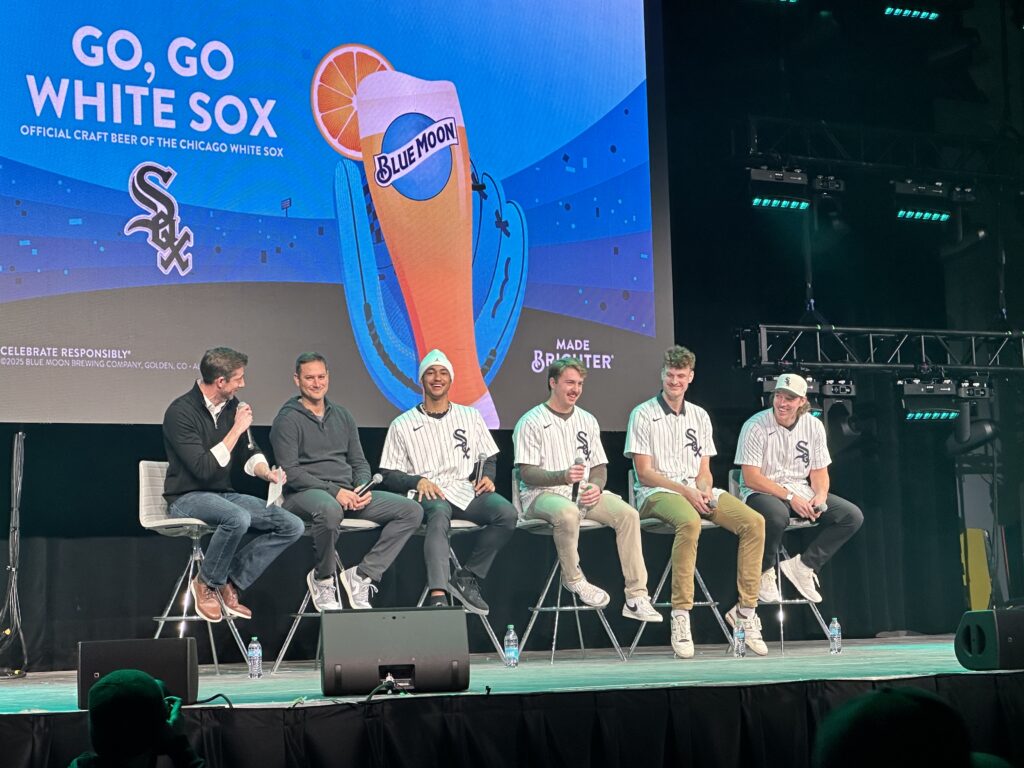 SoxFest Live Prospect Showcase : Braden Montgomery, Kyle Teel, Noah Schultz, and Hagen Smith
That is the point of the two-year bet. Chicago gains upside without sacrificing flexibility. Murakami gains opportunity without needing to justify a long-term contract immediately.
The move also reopens a market the franchise largely stepped away from. That matters for visibility and long-term revenue. The front office identified a tangible market and acted once the window opened. That level of patience has not always defined the organization. Over the past year, it has.
Around the league, the move has also been viewed as an early signal that ownership may be willing to spend opportunistically as control transitions, reinforcing that financial restraint will not prevent action when the fit aligns.
Keller summed it up well, and the budget fit aligned with the talent fit. The White Sox believe they are getting a player who can be “impactful during his time on the South Side.”
Post Navigation