
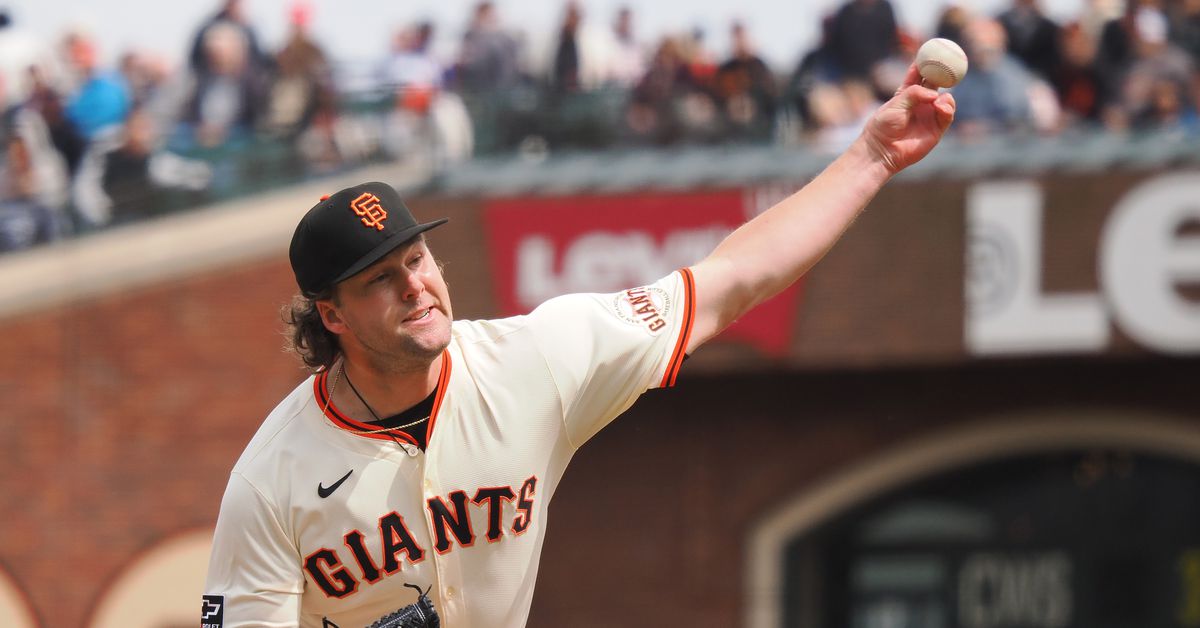
I’ll conclude my impromptu Mission: Impossible week with a look at the most volatile reliever in the San Francisco Giants bullpen: Erik Miller. He is as close to an Ethan Hunt as they can have in their relief corps.
His 1.65 ERA is among the best in the sport, but given that the sample size is just 16.1 innings, it shouldn’t be viewed as the final word on his performance. Fielding Independent Pitching (FIP) is, I think, an even more important stat for a reliever because of their playing time. Relievers who walk guys and give up home runs aren’t really valuable, even if they strike out a lot of guys.
Miller has avoided the home run ball like Ethan Hunt avoiding a pressure-sensitive floor —
But 11 total walks (2 intentional, 9 unintentional) is a difficult number to ignore.
There is the Blake Snell model of walking guys to avoid giving in, and having seen that strategy work pretty well last season, I’m not against it if the pitcher has electric stuff. It’s a risky strategy, akin to jumping on an airplane just as it’s about to takeoff in hopes of getting inside it, but if it works, who’s to argue?
Miller’s 97+ mph fastball and high spin slider is a good start, but I don’t think that that’s been his strategy and the walks are simply a flaw in his game.
The walks alone give him a FIP of 3.32, a difference of 1.67. Think of FIP as ERA and you can see he’s due to see that ERA balloon — which, yeah, makes sense. 16.1 innings is such a small sample. You know, if he realized that FIP as an ERA and soft landed around 3.32, that would be good. He ended last season at 3.88 (3.67 FIP). Being in the 3.60s for ERA & FIP is basically middle of the pack in the league. That’s a great outcome for Miller, to be honest. People shouldn’t forget how difficult it is to be even a decent major league pitcher.
The problem right now is that batted ball profile against Miller’s pitch arsenal is rather alarming from an analytics perspective. xFIP (expected Fielding Independent Pitching) “finds a pitcher’s FIP, but it uses projected home-run rate instead of actual home runs allowed. The home run rate is determined by that season’s league average HR/FB rate.” Right now, that number stands at 4.56. It’s a good thing he pitches at Oracle Park a lot.
So, just following the stat progression, we’ve tracked Miller from great (1.56 ERA) to good (3.32 FIP) to bad (4.56 xFIP). That’s like trying to outrun a slow motion train wreck:
Statcast tags Miller with a 3.78 xERA as well. The small sample could very well be wreaking havoc on these expected numbers, but given the volatility of relievers, I have concerns. Am I being unreasonable? Maybe. Relievers are relievers because they have flaws that prevent them from being starters, so Miller having a chronic control issue is understandable. Even the best relievers can have a soft spot. And, Miller has been okay in high leverage spots already here in 2025 (with a couple of exceptions). We know he can dominate —
— but! There’s regression to the mean leaking into the foundation. The quality of contact coupled with the walks are creating a perfect storm of badness. While the contact issue could just be a sample size issue, the walks have always been a part of Miller’s game (5.8 BB/9 in the minors); som hoping he sorts it out or pitches well in spite of them seems like a longshot. Hope is not a strategy, unless you’re Ethan Hunt.