
‘Biased game calling’ suggested a Yonsei University player got no love from his parents
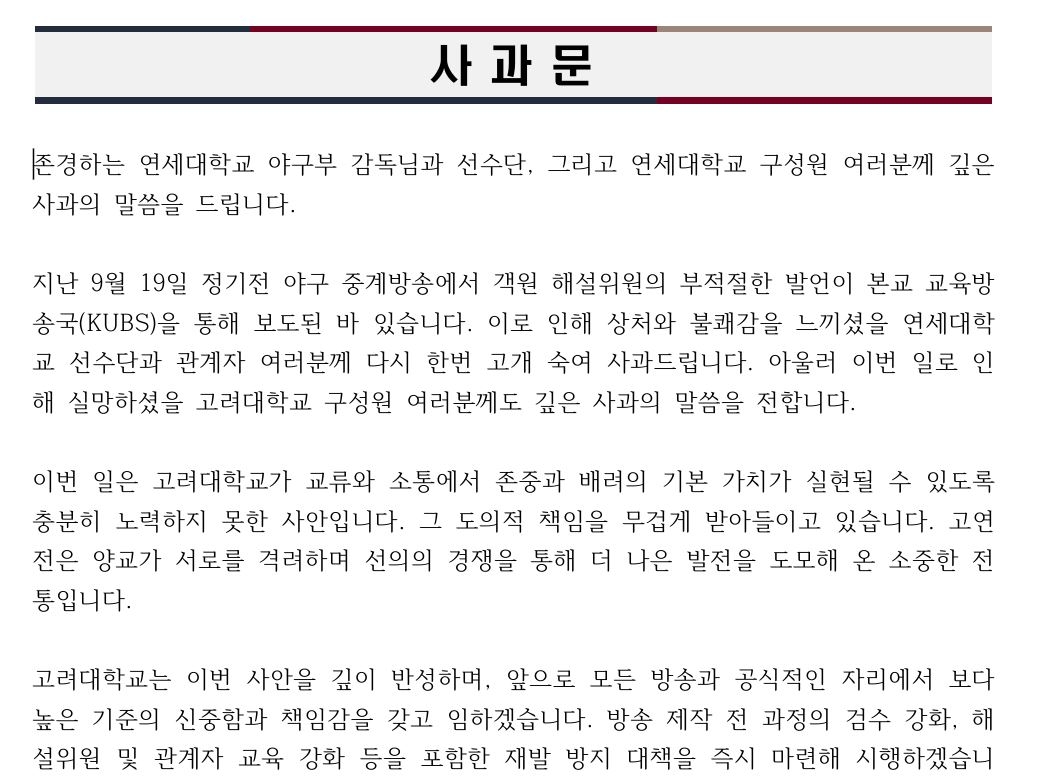 An official apology by Korea University posted online by Yonsei University (Yonsei University)
Yonsei University said Monday it will accept an apology from Korea University over an inappropriate remark made by a commentator during an exhibition baseball game between the two long-time rivals in September.
The comment was made during the Sept. 19 game at Jamsil Baseball Stadium, when the commentator described a Yonsei player as someone who appeared to have been unloved by his parents, adding that this was why he had “ended up at Yonsei.” The remark was broadcast during coverage produced by the Korea University Broadcasting Station for a student audience.
The comment was part of a trend known as “biased game calling,” a style of commentary popular within closed fan communities that openly favors one side. However, the personal nature of the remark drew criticism, even by the standards of the schools’ famously sharp rivalry.
Some members of the Korea University community said invoking a player’s parents crossed a line.
Korea University later issued a formal apology, saying it was “deeply sorry to the Yonsei University players and all those who were hurt or offended by the inappropriate comment,” and also apologized to its own community, pledging steps to prevent a recurrence.
Yonsei said in a statement Monday that it accepted the apology and would use the incident as an opportunity to reflect on the meaning of the schools’ historic exhibition matches.
“The regular exhibition is more than competition. It has traditionally been a space for friendship and cooperation,” the university said. “We hope the two schools will foster a dignified and wholesome sports culture through this incident.”
Yonsei and Korea University share the most prominent university rivalry in South Korea, with the origins of their annual athletic competition dating back to the 1920s, during Japan’s colonial rule, when both institutions operated under different names.
Their standing at the top tier of both academics and athletics has long fueled comparisons and rivalry.
The annual event consists of exhibition matches in baseball, basketball, soccer, rugby and ice hockey held over two days. While the results do not count toward official collegiate tournaments, the competition is widely regarded by both schools as the most important sporting event of the year.
Student rivalry peaks during the matches, even extending to the name of the event itself. Korea University students refuse to call it the “Yonsei-Korea Games,” with the school names in that order, while Yonsei students reject the reverse. After years of dispute, the schools agreed that Korea University would be listed first in odd-numbered years and Yonsei University in even-numbered years.
minsikyoon@heraldcorp.com