

When Jacob Misiorowski reached the big leagues in June, it was fair to assume that the Brewers would avoid overcomplicating things and tell him to let his signature fastball eat. Since the start of 2024, no team has had its starting pitchers throw fastballs a greater percentage of the time than the Brewers. Misiorowski’s four-seamer just might be the best among starters, leading all non-openers in Stuff+ (121) and StuffPro (-1.2) in 2025.
That wasn’t how it played out. Misiorowski threw his fastball less as a Brewer than he did in Triple A. During his electrifying performance as a long reliever in the postseason, he threw it less than 50% of the time.
.png.e07680e62bd593a355c90bdfe995e532.png)
Misiorowski and the Brewers replaced those four-seamers with more sliders, even though his power curveball is arguably his best secondary pitch and proved tougher for hitters to barrel up in his rookie season.
Pitch Type
Stuff+
Whiff%
Chase%
xwOBA
SL
118
24.1%
21.8%
.309
CU
127
33.3%
34.3%
.255
This wasn’t Milwaukee’s pitching coaches abandoning their affinity for fastballs. What Misiorowski calls his slider is effectively a cutter. There is not always a clear line between those two pitch types, but in this case, the distinction matters. The Brewers want most of their starters to throw multiple fastball variants, and thinking of Misiorowski’s slider as a cutter checks that box. They consistently kept his overall fastball usage around 80%, and only changed how he played those two heaters off one another.
Misiorowski’s so-called slider had the mid-90s velocity of a cutter, leading all qualified sliders in average velocity by more than 2 mph. It also spun like a cutter; a relatively high spin efficiency means it had a cutter’s offset backspin instead of a bullet slider’s true football spin, and fewer spin units means it spun less than a typical slider would at that velocity. That combination of velocity and spin made it move like a cutter; it didn’t drop much and had less glove-side break.
Metric
Misiorowski SL
MLB RH SL
MLB RH CT
MPH
94.1
86.1
89.7
Spin Efficiency
45.5%
33.0%
46.9%
Spin Units
26.4
28.3
26.9
iVB
6.4
1.8
8.2
HB
3.0
4.5
2.1
If it has the velocity of a cutter, spins like a cutter, and moves like a cutter, it’s probably a cutter. On a graph of velocity and spin, Misiorowski’s pitch lands in its own unique space, but it’s much closer to the brown cutter cluster than the yellow slider one.
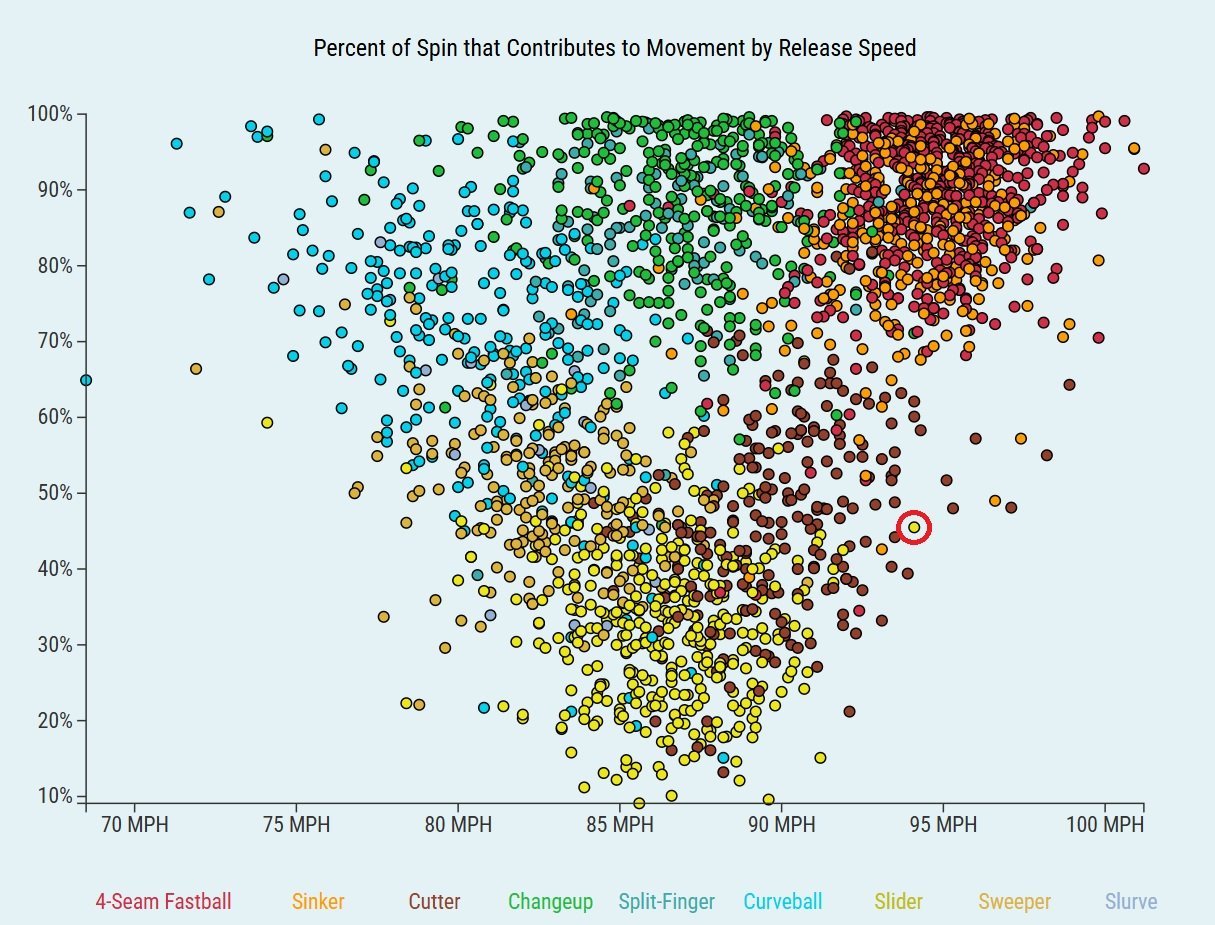
Most importantly, he and the Brewers used it like a cutter. A traditional slider is often a chase pitch thrown around the edges of the plate, but Misiorowski threw 59.5% of his cutters in the zone. That was the highest in-zone rate of any pitch in his arsenal, and it would have ranked 20th among 405 sliders thrown at least 50 times. He often threw it up and in to righties, a target location similar to his four-seamer.
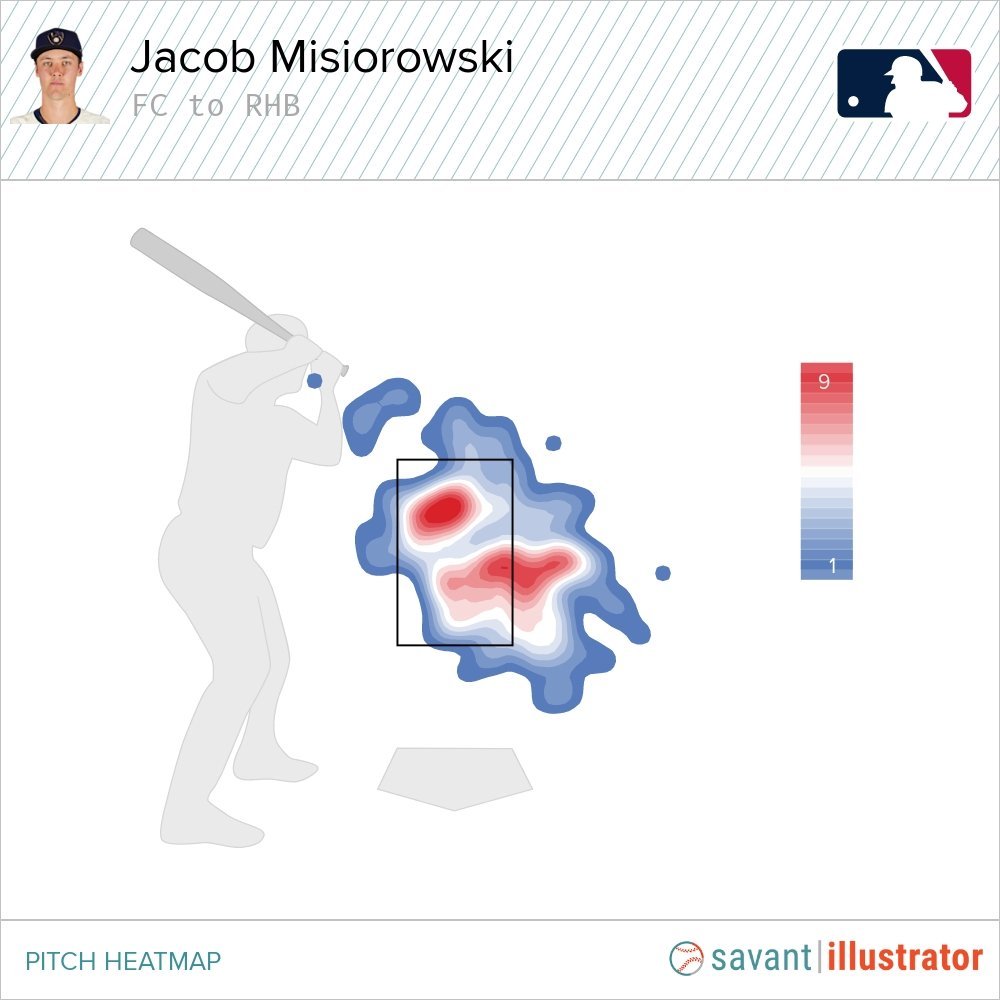
The Brewers believe mixing different kinds of fastballs improves pitch masking. It’s easier to make a four-seamer, two-seamer, and cutter look alike out of hand than other pitch types. Their spin is similar enough to keep a hitter from differentiating them early in the ball’s flight, and the pitcher doesn’t need to change his release to get on top of or in front of the ball, as he does to throw a sweeping breaking ball.
Misiorowski is no exception. Look at how tightly his four-seamer (the red tracer) and cutter (the yellow tracer) mirror each other during a right-handed hitter’s decision window, while his curveball (the blue tracer) pops above them immediately.
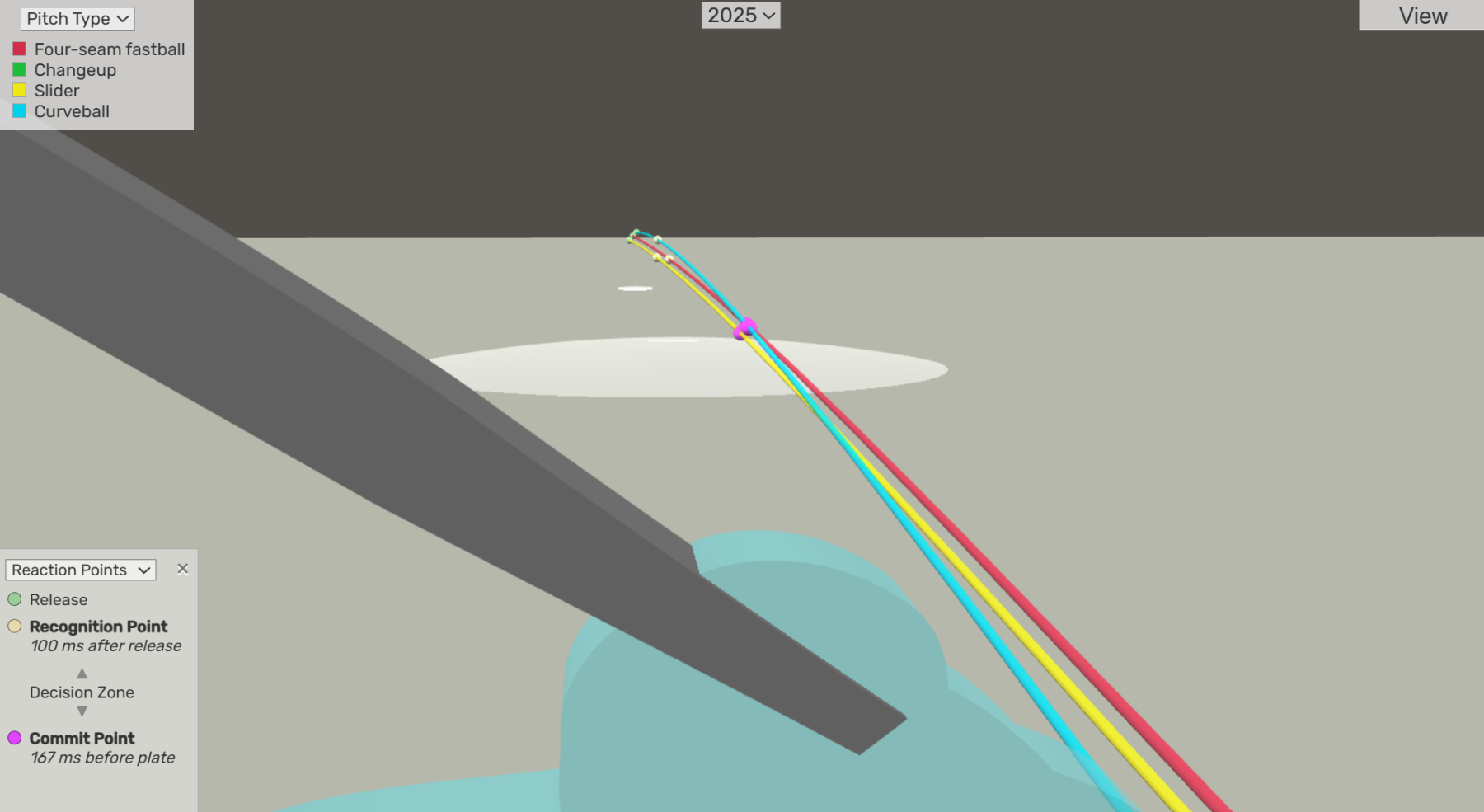
Baseball Prospectus attempts to quantify pitch masking using tunneling metrics, which measure the probability that a hitter will correctly identify a pitch by the time he must decide whether to swing or take. According to this model, hitters were likely to recognize Misiorowski’s curveball, but they could easily mistake a cutter for a four-seamer.
Pitch Type
FA Probability
CT Probability
CU Probability
CH Probability
FA
79.3%
15.7%
2.7%
2.4%
FC
38.2%
57.2%
1.6%
2.9%
CU
18.3%
4.7%
72.4%
4.6%
CH
32.2%
17.6%
8.6%
41.7%
That’s not to say Misiorowski’s curveball is not a weapon. Its strong results demonstrate that it has sufficient velocity and movement to generate off-balance swings without great deception. However, the Brewers are often more focused on how a starter’s arsenal comes together as a whole than how each of his pitches plays individually. Through that lens, Misiorowski’s four-seamer and cutter are his best pairing, with the curveball remaining a put-away pitch and an extra tool against left-handed hitters.
His postseason sample showed how effective that combination can be when properly sequenced. Opponents managed only a .277 wOBA against Misiorowski’s four-seamer in October, while his cutter yielded just a .147 wOBA and a 41.9% whiff rate. It’s safe to assume the Brewers will keep him on some version of the multi-fastball plan until further notice, even if he labels that second fastball as a breaking pitch. As the guy throwing it, Misiorowski reserves the right to call it whatever he wants, but you and I know what we’re seeing.