
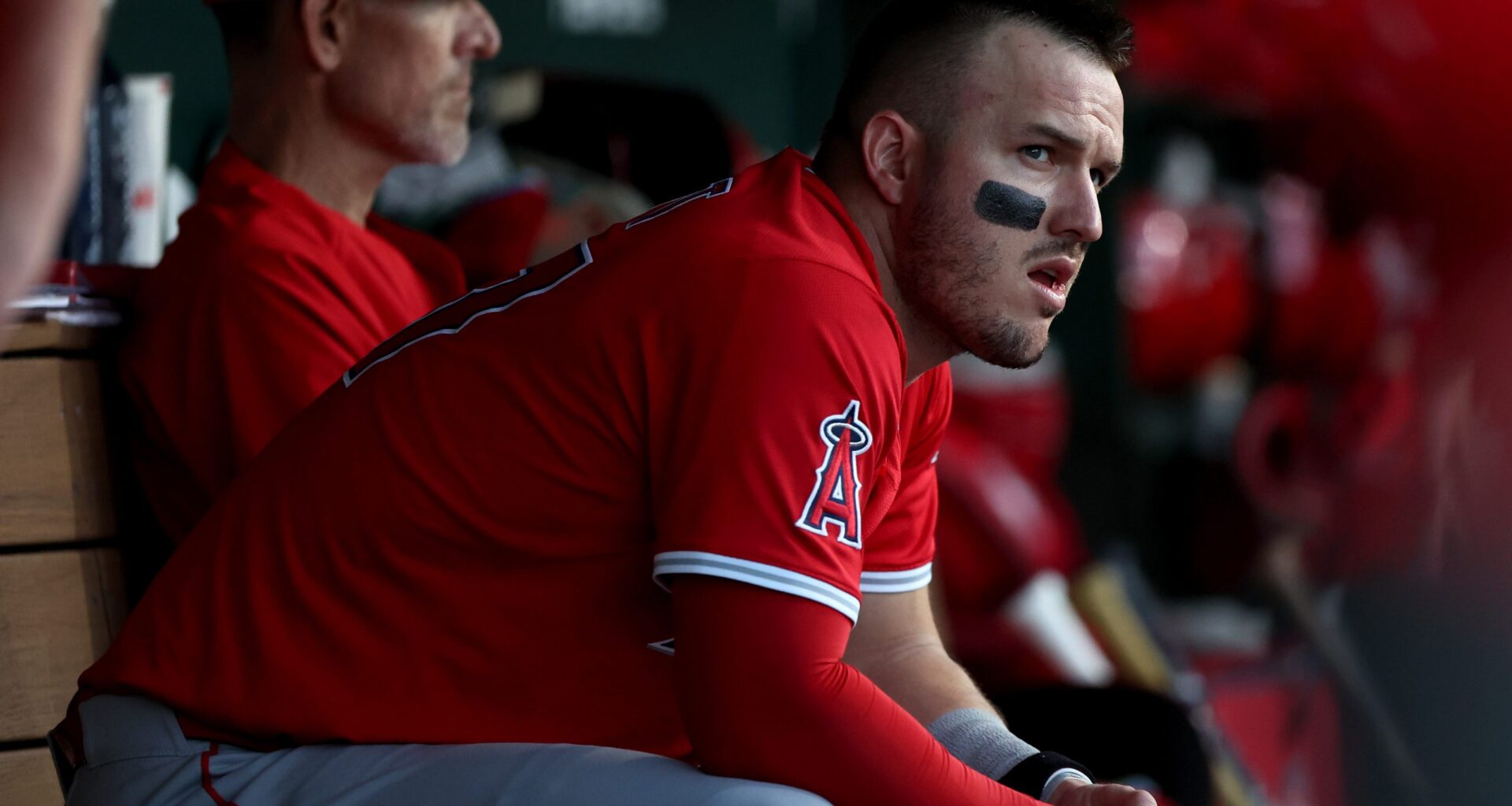

Image credit: © Dennis Lee-Imagn Images
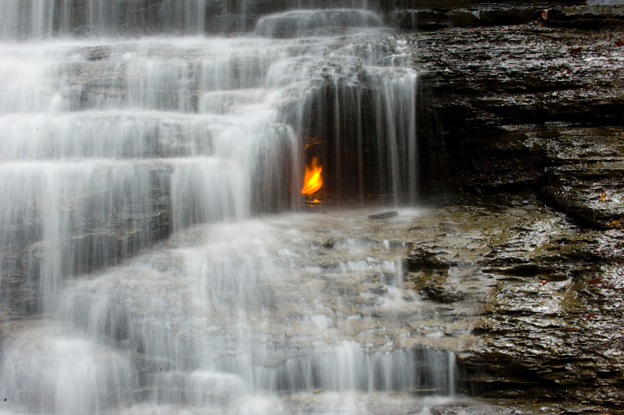
There’s a fire that never goes out in upstate New York. Tucked away in Shale Creek Preserve within Chestnut Ridge Park, Eternal Flame Falls is a 35-foot, cascading waterfall, which is to say the waterfall is not all that striking on its own, except for that water is its own ceaseless flame, too alive not to alter what it touches. Depending on one’s receptivity to the piquant beauty of the natural world, the flame itself might be seen as something of a letdown.
I’ve been a Mike Trout fan since the very beginning. That’s not exactly an exclusive club, being that the outfielder’s physical, whizzing play on both sides of the ball has made fans of basically everyone who’s watched him throughout his career. Angels fans at the time had grown used to telling themselves, of a prospect, “this one is special,” only for that reality to never materialize; nevertheless, to watch Trout even in his abortive 2011 season was to know that this one was special in manner unprecedented.
Trout sits on 398 home runs. Presuming health endures throughout the season, nos. 399 and 400 should come sometime in the next few weeks. When Trout notched his 200th home run, he was the seventh player to do so in his age-26 season. By the time of his 300th home run in 2020, he was the 11th-youngest player to do so. All that despite that Trout really couldn’t be accurately regarded as a home-run-focused batter until right around that 300th home run—note that Trout reached 100 career steals before he did home runs, and when he reached 200 steals in 2019 he became the youngest member of the career 200/200 club by almost a full year. Trout certainly isn’t a runner anymore; in 2018 he swiped 24 bases, but the next season he took just 11, and in the six years since he’s added just 14 more. It seems extremely unlikely Trout will join a cohort of seven in the 300/300 club, let alone meet a lonely Barry Bonds by ascending to the 400/400 or 500/500 club. It happens: Players lose speed and the willingness to be reckless that defines youth. But it’s not clear whether Trout is all that much of a power threat anymore, either.
It’s been a somewhat healthful year for Trout, an accomplishment in its own right at this point. The nominal right fielder, having made the shift away from center field permanent over the offseason, missed almost the entire month of May with a bone bruise. After appearing defensively in 22 of the Angels’ first 29 games, Trout has not since logged an inning in the field.
The hope that he will return to the field this season has been put on pause, likely through the offseason at this point, a development that Sam Blum at The Athletic noted has presented numerous problems for the club—Jorge Soler was on-pace to log his most innings in the outfield since 2021 before hitting the IL with back issues near the end of July.
Still, Trout is on the verge of reaching triple-digits games played for just the second time since pre-pandemic; if he can reach 120 games, it’ll be his most prolific season since he grabbed his third and likely final MVP back in 2019. Seventy-four plate appearances would mark his ninth time qualifying, and the first time outside a streak of eight consecutive years between 2012 and 2019. Trout’s pervasive injury issues aren’t the object of disappointment here, however. Rather, it’s the slugger’s performance while he has been available, a complaint that couldn’t be lodged in his last mostly-complete season three years back. For the first time, it seems clear that Mike Trout is getting old.
***
No one really knows what produces the eternal flame. Well, gas, primarily; no one really disputes that. The bedrock of the waterfall is shale, known for its high rate of heat generation, and the assumption had long been that the bedrock was being heated to high temperatures, thus breaking down carbon in the shale and releasing it as a flammable gas. Per professor Arndt Schimmelman at Indiana University, though, “the source rock, about 400 meters deep, is not very warm. It should not even be able to produce much gas at this temperature, yet the gas is coming and it’s not being depleted.” There’s no real certainty about what is actually producing that much gas, except for that it’s a “different mechanism.”
***
Trout doesn’t want to be a DH. That’s always been the case, and despite the courtesy batter role being his only avenue to appearing in games this year, it hasn’t changed. Trout’s statement of intention conveys both longing and resignation, in equal measure: “So about the plan. Still get back in the outfield.” It seems relatively apparent that Trout feels more connected to the game and thus more able to affect it when also playing in the field, and a likely-final career OPS of 1.012 in center field outstrips his performance as the designated hitter by nearly 200 points. It’s just not clear that his wishes in the matter are paramount, anymore. Long gone are the days when Joe Madden floated an intention to move Trout off center field, producing a media controversy and personal apology. If the options are to play a slightly worsened Trout at DH or barely get him in the field at all, it’s obvious what Arte Moreno and his yes-men will do. It’s not that to do so is a bad call, even. It’s obviously justifiable, which is part of what makes this version of the future Hall of Famer more tragic. That, and the Trout we’ve had access to this year has certainly been diminished.
It’s hard to identify the biggest source of disappointment as it relates to Trout’s offensive performance this year. A .812 OPS and 124 DRC+, each career worsts outside of his 39-game debut back in 2011, are obvious enough. Trout has earned those numbers, too: A 16.6% walk rate approaches his best seasons, but a 29.8% strikeout rate is the worst of his career. Arguably worse, for a player whose relationship with contact has waxed and waned over the years, is that the contact Trout does make has been less authoritative and impactful. A .709 SLGCON is a 214-point dip from 2022. Trout’s average exit velocity (90.5 mph) and EV90 (107.9) are both down from that campaign, but each only by about a mile-per-hour and change. Perhaps more pertinent to the massive diminishment in power has been the huge increase in ground-ball rate, to 37.8% this year, and commensurate decline in fly-ball rate. It’s not that Trout hasn’t been here before, however: In 2022 Trout put 43.4% of batted balls on the ground…and notched a .923 SLGCON and 40 home runs without qualifying for the batting crown (making him just one of six players to ever achieve the latter).
One might note, regarding that 2022 season, that it’s not exactly fair to expect Trout to replicate absurd batted-ball outcomes. Can we expect 40% of Trout’s fly balls to go over the fence, as they did that year, any more than we can expect him to recreate his .456 BABIP over 36 games back in 2021? This is baseball, though, so fair doesn’t really factor into the consideration. What Trout has done has never been fair, and was made markedly less so by the fact that he was always doing the same damage differently. Consider one of the original Trout obsessives, former FanGraphs writer Jeff Sullivan:
That makes it seem like Trout has stayed the same player. But remember to consider the force against which he’s worked. When someone posts an elevated wRC+, the expectation should be for that wRC+ to come down. Basic regression to the mean. There’s nothing radical about the principle, and so while Trout hasn’t necessarily improved, he also hasn’t gotten any worse. The adjustments he’s made have been for the purpose of not declining.
I could say that Trout’s having an unlucky season, getting fewer balls over the fence than he should and likely seeing worse outcomes than expected on batted balls that stay in the field. The problem, though, is that everyone gets beat by luck. That’s what luck is. Ask any gambler, the only way to beat luck is a sure thing, and that’s no longer Trout. He isn’t making adjustments to beat regression anymore because he can no longer do the impossible. He can still hit the ball very hard, and quite far, he can still work a walk and he could probably still swipe a bag or two if it didn’t risk grinding his knees into so much fine dust. But oxygen is toxic, too, it’s just a matter of time.
There are, simultaneously, both a lot of ways to quantify Trout’s decline and not enough. One could note that he’s pulling just 40% of fly balls this season, down from 78% as recently from 2022 and an absurd 89% career-high. He’s making less contact in the zone and making slightly worse contact. These are all the things that typically accord with regression. Trout’s SEAGER is in the 91st percentile, though, in line with his second MVP campaign, and his chase and selectivity rates are 98th and 97th percentile, respectively. Perhaps it’s just a lot of small leaks contributing to a slightly less full cup, or that Trout has suffered in one of those minute ways that we’re still working on quantifying. At any other point in Trout’s career when he’s been on the field, this would be the point at which we note that Trout’s latest improvements are countering regression, to wind up in the same place. It’s past the point where we can hope for that.
The hard part for me personally, the real tragedy, is how much Trout drew me to the sport. His ascension and the onset of my interest in sabermetrics are forever inextricably linked, and I know I’m not alone in that. Mike Trout cannot, though, do the one thing that everyone, ultimately, despite hoping against hope, knew that he never could: outrun time. He can’t really run much of anywhere, these days, despite what’s suggested by a sprint speed that still hovers higher than two-thirds of the league. He can still stand in the batter’s box, however. Four hundred is coming, and maybe someday after that, 500. Thirty-four isn’t old for anyone. It’s just not young for a baseball player. Even one named Mike Trout.
***
Depending on one’s definition, the titular flame of Eternal Flame Falls is not eternal. This should not shock: depending on definition, nothing is eternal. Not depending on definition, nothing is eternal. But what I mean to say is that you might, one day, drive to Buffalo, New York. (You won’t take a train, most likely, because Buffalo is a city in decline and one of the most beautiful railroad stations in the country has sat empty therein for nearly 50 years). You could drive into a lesser-trafficked part of Chestnut Ridge Park. You’d see markings of flames along a short trail, and like so many places in nature, see others who aren’t used to the diversion but can feel its pull, chugging along. But perhaps, when you arrived at the falls, you’d find the flame extinguished. It happens all the time, actually: it’s a waterfall, and no matter how awe-inspiring the juxtaposition, water and fire don’t mix. The fuel remains, though. If you grab a lighter, or wait around for the next person with a spark by their heart to bring one, the flame roars back. And that’s eternal.
Thank you for reading
This is a free article. If you enjoyed it, consider subscribing to Baseball Prospectus. Subscriptions support ongoing public baseball research and analysis in an increasingly proprietary environment.