
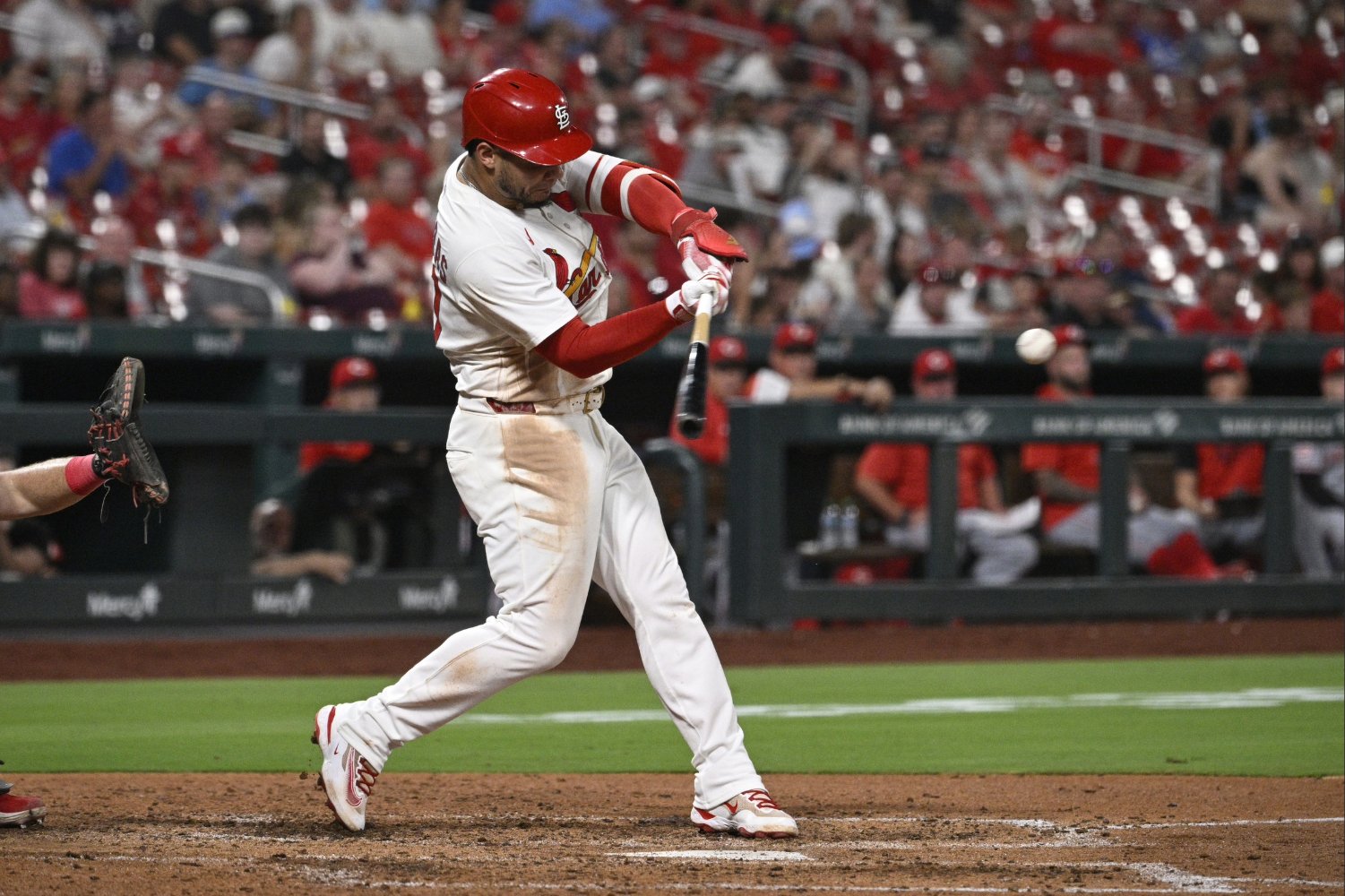
On a recent episode of the Baseball Isn’t Boring podcast, Alex Cora spoke with Rob Bradford about recruiting Willson Contreras and what the Boston Red Sox hope he can contribute in Boston. Cora mentioned that Contreras needed to be convinced to void his no-trade clause to play for the Red Sox, and the Boston skipper guessed one feature of his new home park helped sway him:
“Probably there’s the other part of it, you know, like he has a chance to play for the Red Sox and make an impact and, you know, pull the ball in the air, you know, and hit more homers, and demolish that Monster.”
The “pull the ball in the air” phrase caught my attention. Traditional coaching often preaches going up the middle or the opposite way. Hitters are rarely encouraged to pull the ball, even though the data shows it is clearly more beneficial to do so. This is seen in exit velocities and significantly better results for hitters.
A stat called PullAir% can help us understand why Breslow may have targeted a hitter like Contreras, who can pull the ball at an above-average level. PullAir% is simply the percentage of baseballs a hitter puts in play that are pulled in the air.
A ball pulled in the air, even without factoring in exit velocity or launch angle, has a greater than 50% chance of resulting in a hit. According to Baseball Savant, “From 2022–24, while only 17.5 percent of batted balls were pulled airballs, that subset was responsible for 66 percent of all home runs. Pulled airballs during that span produced a .547 batting average, 1.227 slugging percentage, and .733 wOBA, making them an extremely valuable outcome. Airballs that were not pulled, by comparison, had a .319 average, .527 slugging percentage, and .353 wOBA, making them considerably less valuable.”
It is no surprise, then, that league-wide PullAir% has continued to trend upward since the introduction of Baseball Savant in 2015.
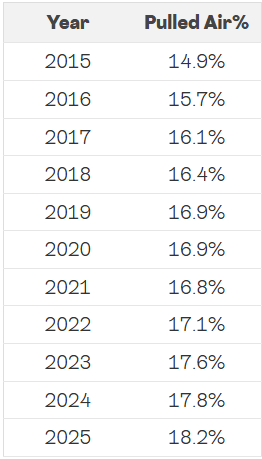
Table via RotoWire.com
A brief look at Willson Contreras’ stats might indicate that pulling the ball, either in the air or on the ground, is no longer part of his game. After all, he ranked 89th out of 145 qualified hitters in Pull% at 39.4. But an essential factor to consider is the environment where Contreras played half of his games, Busch Stadium.
The Cardinals’ home park is one of the worst hitting environments in baseball. Statcast’s park factors show Busch Stadium ranks 25th in the MLB with a park factor of 97 and a home run factor of 77. This indicates that Busch Stadium suppressed home runs by 23% compared to league expectations, based on exit velocity and launch angle. (Fenway Park, by contrast, has one of the best park factors in baseball at 104, trailing only the notoriously hitter-friendly Coors Field.)
The year before signing with the Cardinals, Contreras posted a Pull% of 44.4, a number that dropped by 7% the following season. That may well reflect changes in approach Contreras made in response to playing at Busch.
Seasoned veterans like Contreras can quickly adjust their batted-ball approach, especially those with minimal swing-and-miss in their profile. If Contreras can return to his 2022 tendencies, he’s well-positioned to maximize the Green Monster, a right-handed hitter’s dream.
Finally, it’s worth noting that some high PullAir% right-handed candidates are still available this offseason.
(Name: PullAir%, rank)
Isaac Paredes: 38.5%, 1st
Eugenio Suárez: 28.6%, 10th
Alex Bregman: 24.4%, 37th
Ketel Marte: 23.5%, 53rd
Pulling the ball in the air is a skill, not an accident. It is also a skill the Red Sox lacked in 2025, with only four hitters pulling the ball at an above-average rate. Only one of those hitters was a true right-handed hitter, that being Alex Bregman. This contributed to a middle-of-the-pack home run output, as Boston finished 15th in the league with 185 home runs.
Contreras provides stability at a corner position, but if he can pull the ball like his golden days in Chicago, he has the potential to be a dynamic and foundational piece of a young, exciting, and more powerful lineup.