
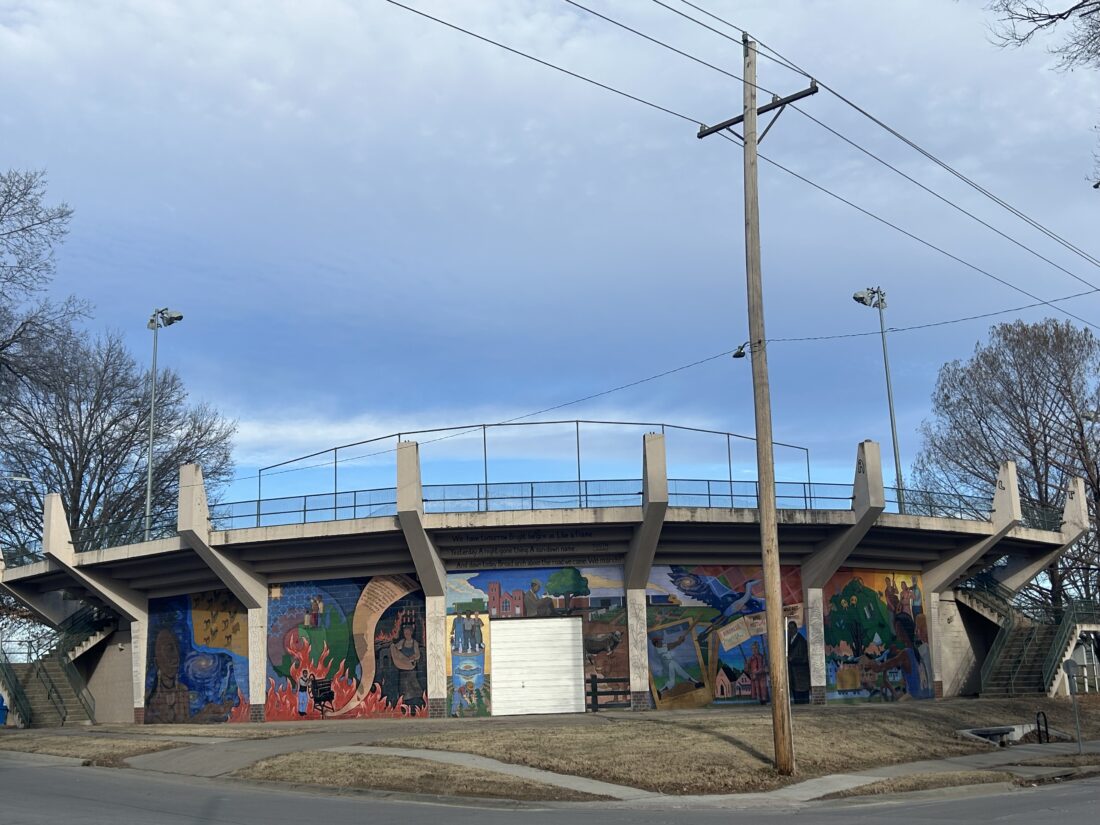
photo by: Bremen Keasey/Journal-World
The exterior of the concrete bowl of what is left of Lawrence’s Municipal Stadium. A local group called The Municipal Stadium in Hobbs Park Legacy Project hopes to get the stadium listed on the National Register of Historic Places so it can work to refurbish the stadium.
An idle conversation during a board meeting for the Watkins Museum of History sparked an idea that could breathe new life into an old stadium.
Andrew Stockmann, the curator of exhibitions for the Watkins, said he overheard Justine Burton, one of the museum’s board members, talking about how Satchel Paige had once played baseball in Lawrence.
As Kansas City-native and amateur baseball historian, Stockmann was intrigued right away about the possibility that the legendary Negro League baseball player, former Kansas City Monarch and Hall of Fame pitcher had come to Lawrence. Immediately after the meeting, he spoke with Burton and sunk his teeth into research.
“I started going down this rabbit hole,” Stockmann said.
His research may not have confirmed that Paige had been here, but Stockmann discovered the Kansas City Monarchs did play at least once at the city’s Municipal Stadium, now located in Hobbs Park.
Digging through box scores in newspaper archives and at the Lawrence Public Library, Stockmann was able to confirm the Monarchs visited the Municipal Stadium for a “barnstorming” game in August 1949 against a semi-professional team called the Lawrence Colts.
While Paige’s name was not in the box score, Stockmann noted some prominent figures in baseball history were there: Buck O’Neil, a future Hall of Famer who became the first Black coach in Major League Baseball, and Elston Howard, a future American League MVP who was the first Black player to play for the New York Yankees.
This discovery helped Stockmann and other local residents form The Municipal Stadium in Hobbs Park Legacy Project, with the aim of getting the stadium listed on the National Register of Historic Places to preserve it. That move could unlock additional funding to help preserve the site and restore it to its former glory — when it played host to hundreds of baseball games every summer for decades.
As historically important as the stadium might have been, Stockmann said through talking with other residents it became clear that the community impact was also hugely significant.
As Stockmann began working on the project a little over a year ago, he reached out to the City of Lawrence, who told him to contact Lee Ice whose father used to coach the American Legion baseball team in Lawrence.
Ice, a lifelong Lawrencian who played baseball at KU and later worked for the city’s parks department, told the Journal-World that Municipal Stadium, which was built in 1947, was one of two main fields in Lawrence before the city built the Holcom Sports Complex in 1974.
Ice said he “basically grew up at Municipal Stadium” doing everything from shagging foul balls — getting paid “a dime” per ball collected — and hanging the numbers on the old scoreboard out in left field. Ice eventually played for the American Legion team as well, but before that he idolized the players on teams who played before him. During the summer, the stadium hosted tournaments during the Fourth of July that brought in teams from four different states, and the games drew a crowd.
“It was incredible,” Ice said.
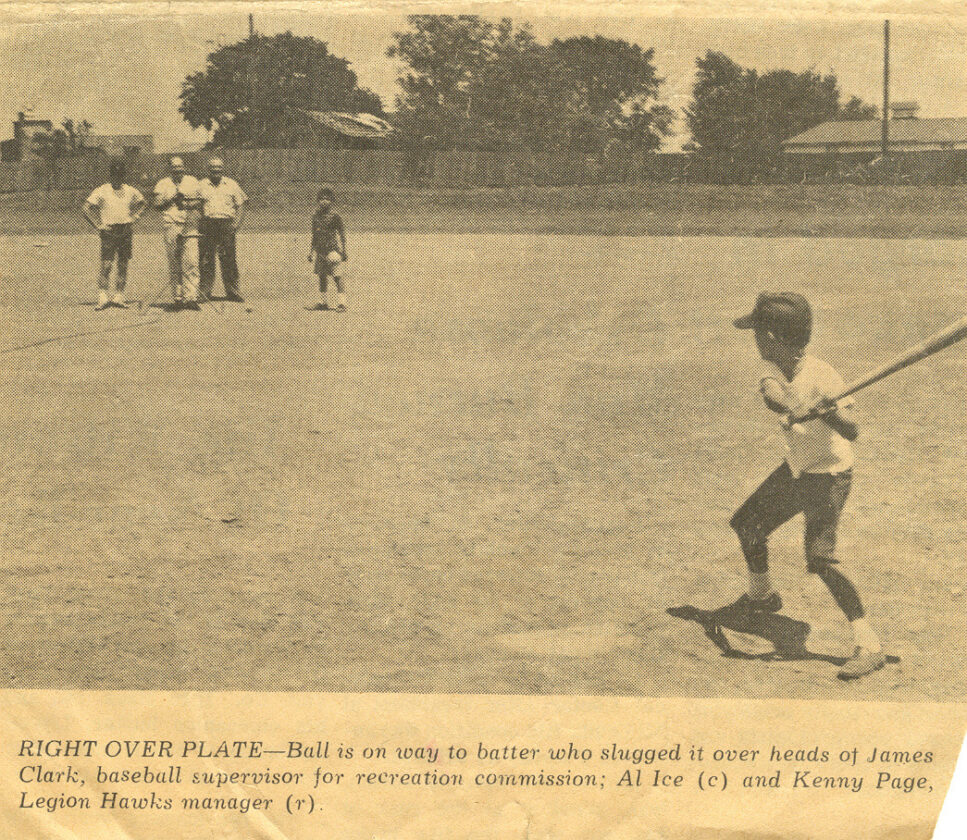
photo by: Contributed/Lee Ice
A newspaper archive from the Journal-World of Lee Ice (right) hitting off of a pitching machine at Municipal Stadium in Lawrence. Ice, who said he basically “grew up” at the stadium, is part of a local effort to get the stadium listed on the National Register of Historic Places
Ice said it wasn’t until 1985 that Lawrence High School had baseball, so most of the high school-aged players would play for the American Legion teams. Those squads included teams that won the state title in 1956 and 1964, Ice said.
But once Holcom Park was built, things gradually shifted away from Municipal Stadium. The American Legion team last played there in 1973, and soon the locker room and dugouts were bricked up once they stopped being used, according to Ice.
Ice had previously explored restoring parts of the field in the 1990s, where he said he was hoping to do something to the field before the city “lost it completely.” He was worried it could wind up like Haskell Memorial Stadium — a site seldom used at Haskell Indian Nations University.
“If they don’t get used, they just deteriorate and people forget about them,” Ice said.
Ice is a member of the Parks and Recreation Advisory Board, which in March 2025 formally voted 5-0 with two members absent to support the project, as the Journal-World reported. Stockmann said Ice helped support the project in other ways as well, bringing over “a shoebox of photos” and clippings that featured some of the players Ice idolized on the American Legion teams — including John Hadl, an All-American football player at KU who played quarterback in the AFL and NFL.
Stockmann said while it was cool to find well-known figures that played in the stadium, Ice’s insight on the community value of the stadium — like the thousands of kids who played softball or baseball there — will be “woven together” with the stadium’s historical importance for why it is worthy of preservation.
“(There are) well-known players who played at the stadium,” Stockmann said. “But we also want to emphasize the community value — the thousands of kids who grew up playing.”
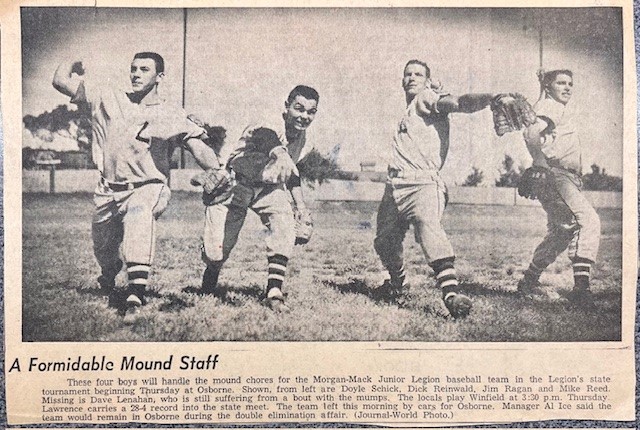
photo by: Contributed/Lee Ice
A Journal-World newspaper clipping from 1956 about a local Lawrence baseball team that won a state title that year. The team played at Municipal Stadium, which is now in Hobbs Park, and a local group is working to get the stadium on the National Register of Historic Places for its community and historic significance.
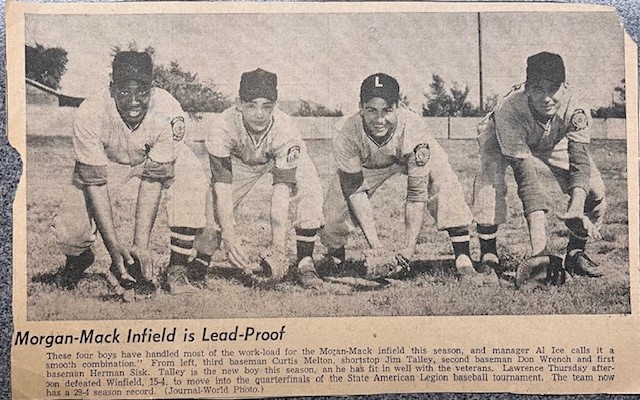
photo by: Contributed/Lee Ice
A Journal-World newspaper clipping from 1956 about a local Lawrence baseball team that won a state title that year. The team played at Municipal Stadium, which is now in Hobbs Park, and a local group is working to get the stadium on the National Register of Historic Places for its community and historic significance.
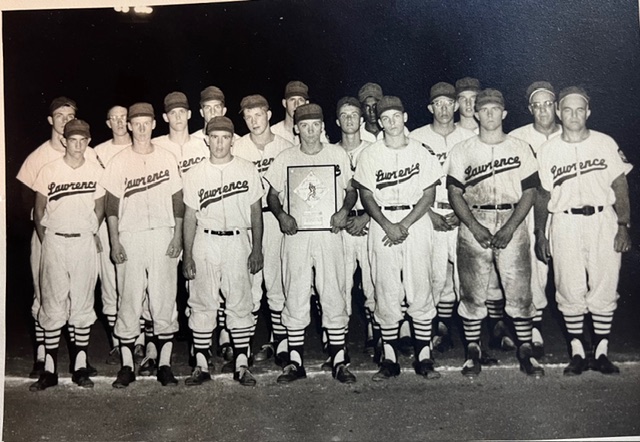
photo by: Contributed/Lee Ice
A photo of the Lawrence Hawks in 1964, an American Legion team that won the state title that year. Hundreds of people would show up to their games at Municipal Stadium, according to Lee Ice.
Stockmann said the project is still working on getting the nomination sent to the state and national register, but once it is submitted, the group would know the status in about nine months. If the stadium is accepted to the register, Stockmann said the next step would be to complete a historic structure report that would analyze the architectural integrity of the stadium bowl and take a look at its possible future uses. The stadium is already used most frequently by the Kaw Valley Kickball League where it hosts its “game of the week” event that can bring in hundreds to the park, but the legacy project has brainstormed improvements like adding a concession stand or restoring the inground dugouts.
There is still a long way to go, but Ice and Stockmann are inspired by projects in other communities that have worked to revitalize old stadiums. Ice said that in Junction City, a group of organizers worked to refurbish Rathert Stadium, which was built in 1937 and also was visited by the Kansas City Monarchs. The stadium was “restored completely,” Ice said, and now has a refurbished turf field that hosts the city’s high school teams and a collegiate team.
Stockmann said he also has spoken with a group from Grand Rapids, Michigan, called Fans of Valley Field that has worked to restore a local stadium that was also built in the 1930s. Stockmann said the group had raised “a ton of dollars” to restore it, and while it has a headstart on the progress for the Municipal Stadium project, it can serve as a guide for Lawrence.
“They are a picture of what this could become through the work and volunteer efforts,” Stockmann said.
Whatever ends up happening for the project, Stockmann is hopeful that the historic story of Municipal Stadium can be shared. He said he has thought about adding historic plaques or signs similar to what the Watkins has provided at the Lawrence Outdoor Aquatic Center or the Burroughs Creek Trail, and he also is thinking of creating an exhibit about Lawrence’s baseball history at the Watkins.
But though the historic record is important, Stockmann feels the most important goal is ensuring it can be used in the future.
“We just want to make sure the structure is there for the active users of the park and the East Lawrence neighborhood,” Stockmann said.
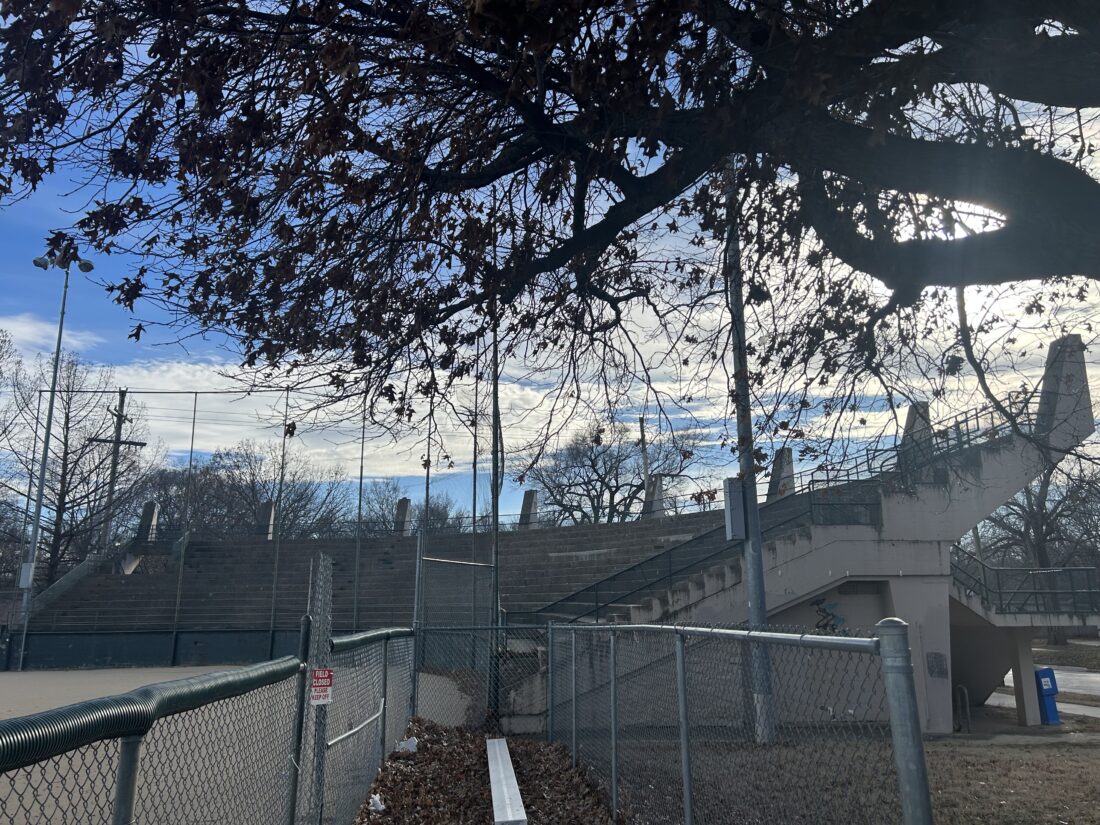
photo by: Bremen Keasey/Journal-World
A photo taken of the remaining stand of Municipal Stadium at Hobbs Park in Lawrence. Lee Ice said the stadium would have hundreds of people come during baseball games in the summer in the 60s and 70s.
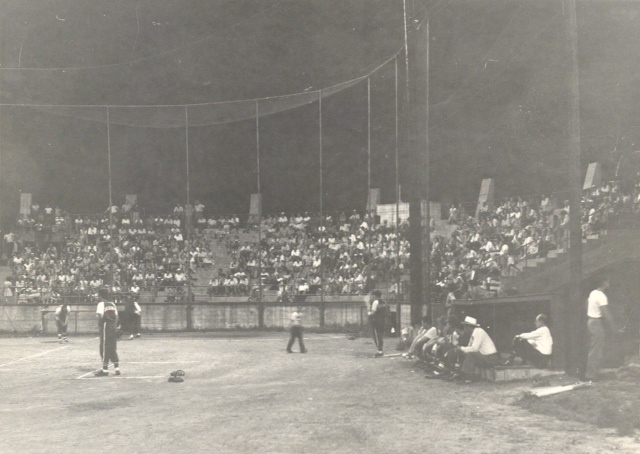
photo by: Contributed/Lee Ice
A photo of the crowd in 1949 at Municipal Stadium for a semi-pro Lawrence Colts baseball game. The team hosted the Kansas City Monarchs during August 1949, and a local group is hoping its historic and community signifigance can get the stadium, located in East Lawrence’s Hobbs Park, on the National Register of Historic Places.