
Baseball is not supposed to be as easy as Byron Buxton made it look at times during the 2025 season. Even the best hitters in the world need a little help from batted ball luck, sequencing, and timing for numbers to truly pop. For the Minnesota Twins, several hitters posted surface-level results that outpaced what underlying metrics suggested should have happened. That does not mean those performances were flukes, but it does provide valuable context as we look ahead to 2026.
To frame the discussion, the league-wide average wOBA in 2025 sat at .313, while the average expected wOBA came in slightly higher at .315. wOBA is designed to measure overall offensive value by weighing the quality of contact alongside strikeouts and walks. Expected wOBA uses batted ball data to estimate what a hitter should have produced based on how hard and at what angles the ball was hit. When wOBA significantly outpaces expected wOBA, it often points toward overachievement that may be difficult to repeat.
Luke Keaschall
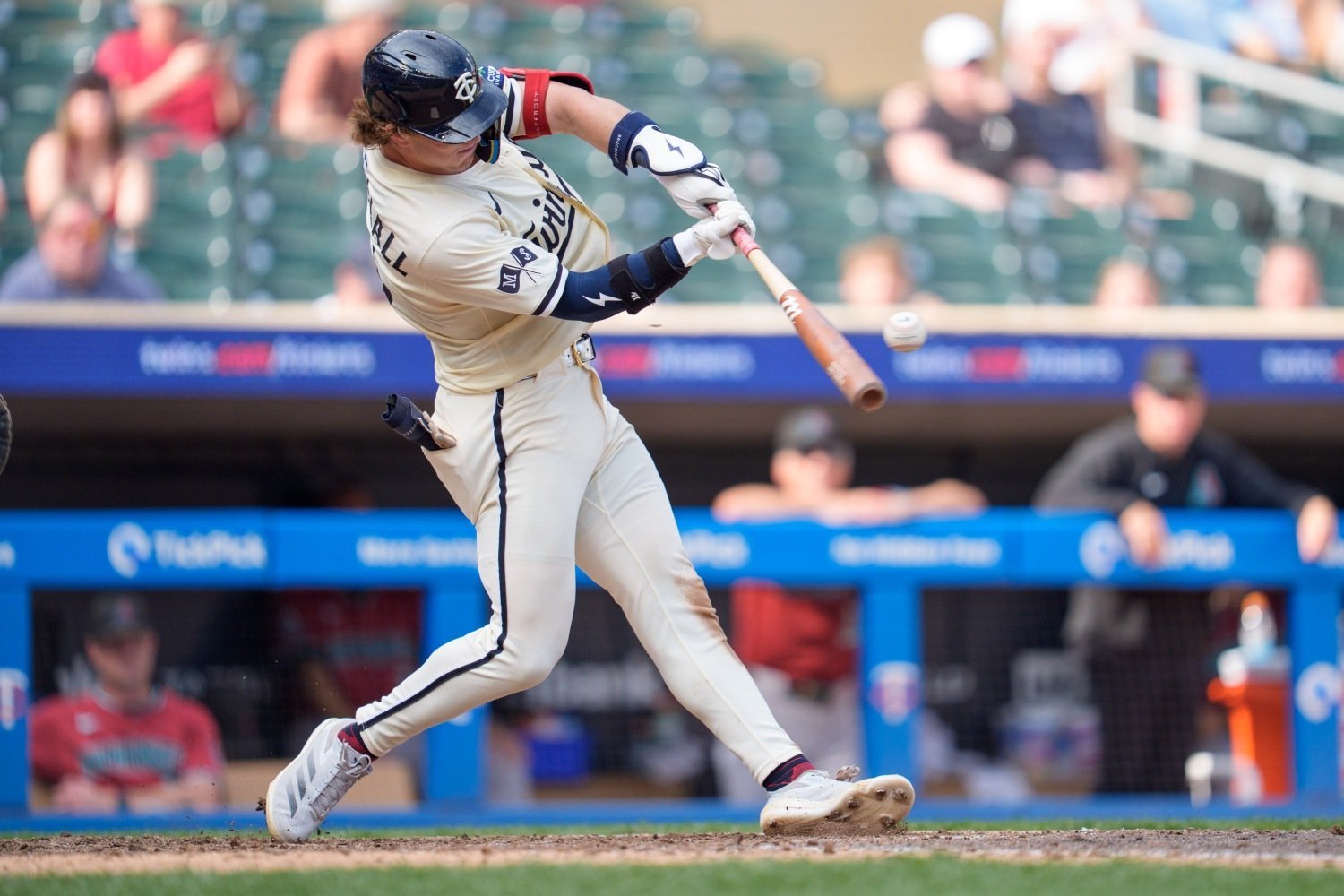
Keaschall posted a .363 wOBA in 2025, despite an expected mark of .323. That gap of roughly forty points stands out quickly. The underlying reasons are pretty straightforward when digging into his batted ball profile. Keaschall did not barrel the baseball often, finishing with a 5.2% Barrel rate. That is well below what you would typically expect from a hitter producing at that level.
Where Keaschall made his money was against offspeed pitches. He slugged .556 against them and actually outperformed his expected numbers by +.122 xwOBA compared to his wOBA in that pitch bucket. That suggests a combination of good pitch recognition and favorable outcomes on balls that weren’t always crushed.
Looking ahead to 2026, some offensive pullback feels likely. Still, Keaschall does not need to repeat a near .360 wOBA to be valuable. If he tightens up the quality of contact even marginally, he can remain a productive bat who helps the lineup reach the next level.
Alan Roden
Roden is an interesting case because the majority of his at-bats came in Toronto. Acquired as part of the Louis Varland trade, Roden appeared in just 12 games for the Twins. For the season, he finished with a .249 wOBA, compared to an expected mark of .225, a gap of about 24 points.
Roden struggled to hit the ball with authority, posting a 2.0% Barrel rate. Much of his contact was on the softer side, which generally caps offensive upside. However, his biggest separation between results and expectations came against breaking pitches. That is where he hit both of his home runs and most of his extra-base hits, outperforming his expected numbers by +.089 in that area.
The 2026 outlook is more optimistic than the Twins sample alone would suggest. Roden profiles nicely as a fourth outfielder and has the defensive ability to back up Buxton in center field. There is also real offensive upside here, as evidenced by his 151 wRC+ at Triple-A last season. If that production translates even partially, Roden could carve out a meaningful role.
Byron Buxton
Buxton’s 2025 season featured a .367 wOBA and a .348 expected mark, a difference of just under twenty points. While smaller than the other gaps on this list, it still qualifies as overachievement given how high the baseline already is.
The reasons are primarily tied to Buxton doing Buxton things. He punishes fastballs, producing a wOBA that was 32 points higher than his expected output against them. He also continues to hit the ball extremely hard, posting a 53.8% Hard Hit rate that places him among the elite in baseball. His expected slugging percentage has topped .500 in each of the last two seasons, which helps explain why his offensive floor is so high.
Replicating his 2025 totals will not be easy. Some dip in production is a reasonable expectation. However, the Twins’ bigger goal is availability. If Buxton can play more than 100 games for a third straight season, something he has yet to do in his career, even a slightly reduced offensive line would be a massive boost to the roster.
Overachieving seasons are not inherently bad things. They often represent players maximizing their strengths and benefiting from favorable conditions along the way. For the Twins, understanding where production outpaced expectations helps set realistic goals for 2026. Keaschall, Roden, and Buxton each bring different skill sets and different risk profiles, but all three showed how impactful things can be when results break the right way.
Which of these hitters do you think is most likely to beat the projections again in 2026, and who worries you the most when it comes to regression? Let us know your thoughts in the comments.