
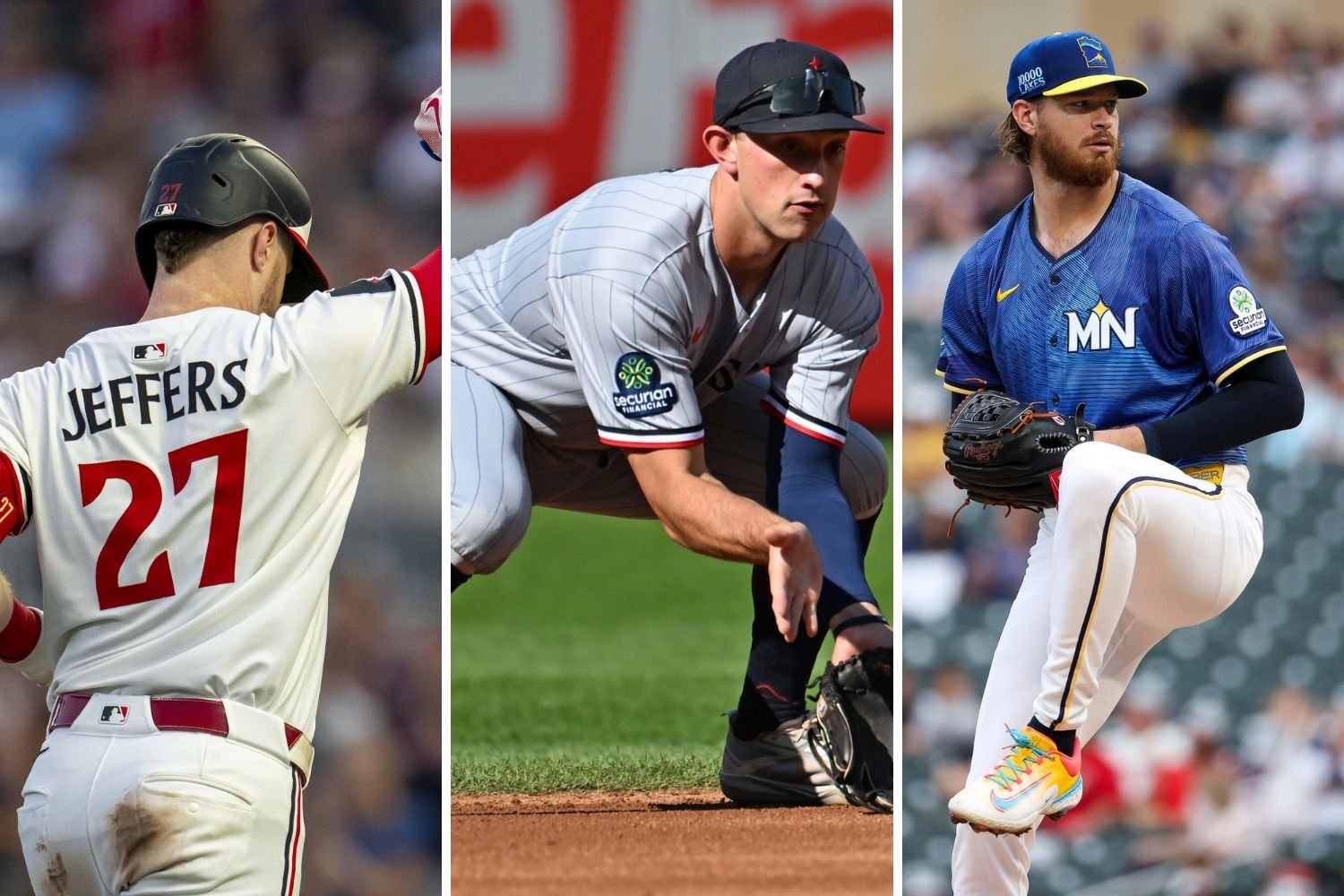
Dating back to 2018, I’ve created these rankings every year in early January. The idea is to take stock of talent throughout the Twins organization to understand what the front office has to work with, and to contextualize how their best players fit in — either as building blocks or trade candidates.
In essence, we’re trying to answer the question, “Which current players in the organization are most indispensable to fulfilling the vision of building a champion?”
We account for age, contract, controllability, upside, etc. It’s not exactly a ranking of trade value, because that would be more team-agnostic, whereas this list aims to capture a very Twins-specific point of view. As such, players at areas of scarcity (i.e. shortstop) get elevated, while those at areas of abundance (i.e. lefty-hitting corner outfielders) get downgraded a bit.
Going back through the lists year by year (linked below) provides a progressive glimpse into Minnesota’s evolving talent landscape. We’ve seen players rise and fall. We’ve seen some young players fulfill their promise while others have fallen far short.
Putting together the rankings this year, in the aftermath of a major talent overhaul at the trade deadline, has proven to be fascinating. One thing to note up-front is that despite the big purge, the Twins actually didn’t trade any of the players who we viewed as most being their most essential (yet). Although Griffin Jax, Jhoan Duran and Carlos Correa were among the team’s best players, the first two are relievers and the second is a 30-year-old underperformer on a huge contract, which are big detractors in this analysis. They ranked 10th, 12th and 18th respectively on last year’s list.
You can review that list, plus the previous seven, below. From there we’ll kick off our 2026 list with a look at the players I chose to rank 16th through 20th.
Past organizational rankings:
Okay, now let’s dive into the 20 Twins players and prospects who are — in my humble opinion — most critical to making this rebuild effort a success, starting with their top draft pick from this past season.
The Top 20 Twins Player Assets of 2026: 16-20
20. Marek Houston, SS
Age: 21
Controlled through: 2031+
2025 Ranking: NR
When the Twins traded Correa and his contract at the deadline, they committed to a new future course at shortstop. Right now it’s not clear exactly how that course will take shape, at least long-term, which is one of the biggest question marks surrounding the team’s outlook.
In terms of pure ability to play the position, Houston is pretty much unparalleled in the organization. His glove was his ticket to being selected in the mid-first round. Many evaluators believe he could play shortstop defensively in the majors right now. Hitting is where the developmental challenge lies for the Wake Forest product.
He held his own at two levels of Single-A, batting .270 in 24 games after being drafted, but posted a .680 OPS with no power. Currently he projects as a light-hitting defensive specialist. That can play at short, but his ceiling will be capped unless he can turn a big corner at the plate.
19. Ryan Jeffers, C
Age: 28
Controlled through: 2026
2025 Ranking: 11
Jeffers is on the opposite end of the spectrum from Houston: his value is all tied up in the short-term, but he is proven and essential. The Twins replaced Christian Vazquez with Alex Jackson, leaving Jeffers as the only catcher in the organization with a modicum of hitting ability or track record as a starter.
Although his production has been unspectacular the past couple years, Jeffers remains a high-end offensive player at the position: Since 2023 his .772 OPS ranks fifth in the majors among catchers with 1,000+ plate appearances. His defense has declined, detracting from his overall value, but Jeffers is so far-and-away the team’s best all-around catching option for the immediate future that losing him would feel like a complete white flag for 2026. There aren’t many other players you can singularly say that about.
18. Brooks Lee, SS
Age: 24
Controlled through: 2030
2025 Ranking: 6
I want to believe. He just hasn’t given us much concrete reason up to this point. Lee’s 12-spot drop in the rankings from last year reflects an extremely discouraging first full season in the majors. The production was lackluster and the underlying metrics were uninspiring. Lee has physical limitations — speed and arm strength chief among them — and has shown no capability of offsetting them in the majors.
At the same time, he’s 24 years old, and a former top draft pick and top prospect. The book is far from closed on him. Lee has shown occasional bursts of power and he can definitely make contact with consistency. He’s a credible shortstop and likely a strong defender at second or third. Those are good ingredients to build around. But his overall game is trending the wrong way.
17. Bailey Ober, RHP
Age: 30
Controlled through: 2027
2025 Ranking: 3
Another free-fall in the rankings from one year ago. The 2025 season saw Ober struggle with mechanics and health, lose precious ticks of velocity, and post an ERA that was 16% below league average. His strikeout rate plummeted and batters teed off for a career-high 30 home runs in just under 150 innings. Now past 30, Ober no longer has youth on his side.
What he does have, though, is a superb track record prior to last year. Ober’s ERA was above average in each of his first four MLB seasons and he had developed into a legit frontline starter heading into 2025, which is why this list had him ranked as a top-three organizational asset at the time. His drop-off is alarming in several ways, but we can’t dismiss the possibility of a turnaround driven by a velocity uptick or arsenal tweak.
16. Connor Prielipp, LHP
Age: 24
Controlled through: 2031+
2025 Ranking: NR
From down-and-out to up-and-coming. Prielipp has yet to make his major-league debut, but it’s likely to come this year (maybe even on Opening Day) if he can stay healthy. That’s the big hitch: Prielipp originally fell in the draft due to concerns over his health, which have been validated. He’s thrown only 113 innings in the minors since joining the Twins org in 2022, after logging just 28 official innings in college at Alabama.
Prielipp turns 25 in a few days, and hasn’t even thrown 85 innings in a season. That puts him on a pretty surefire relief path, which the Twins haven’t really shied away from. But in that role, there seems to be little doubt he can be a major difference-maker, with his explosive fastball/slider combo drawing loose comparisons to Josh Hader. If Minnesota is able to field a capable bullpen in 2026, I believe Prielipp will be a big part of the reason. He just needs to stay healthy.
How important do you view these five players to the future of the Minnesota Twins? Share your thoughts in the comments, and check back tomorrow to find my picks for 11th through 15th in the rankings.