
The calendar has flipped. We’re barely six weeks from pitchers and catchers reporting to spring training. There are a few top-of-the-market free agents still unsigned, but the cupboard is becoming more bare almost every day. The Chicago Cubs have been frustratingly quiet. They are yet to add a frontline pitcher, and the offense still has the hole left by Kyle Tucker‘s departure. Cubs fans are sitting here with burning questions: What is the offseason plan? Is there a plan? Is the inactivity part of the plan? The only thing we have confirmed is that the plan for the bullpen is to hope for the same magic as last season, with veteran arms on cheap deals.
We just saw Japanese starter Tatsuya Imai sign a shorter-than-expected deal with the Astros, which stings, because the Cubs were seen as a great fit. Maybe Jed Hoyer prefers to explore the trade market again, as they have a few big league-ready players without a clear path to playing time. Let’s look at some of the options left on the free-agent market, as well as some trade candidates that could save the Cubs’ offseason.
Free Agents:
The Cubs rotation has some depth, and Justin Steele should return at some point in 2026, so they just need one more top-of-the-rotation arm to make that group an area of strength again. All three of these players come with red flags, but when they’re right, they’re solidly above-average starters. The Cubs have also been linked to all three (at one point or another) this offseason.
Valdez is probably the only one who can be considered a true ace. He earned Cy Young and MVP votes each year from 2022-2024, but was not himself in 2025. His ERA of 3.66 was high, by his standards, but he still made over 30 starts. It’s easy to compare him to Jon Lester and use the six-year deal as a baseline, but many are predicting Valdez to sign for just four or five years. Valdez comes with some postseason concerns, though, largely due to his volatility. He was electric in the playoffs in 2020 and 2022, where he pitched to a sub-2.00 ERA. In 2021, 2023 and 2024, however, he had an average ERA of 7.67. To worry about the playoffs, one must get to the playoffs, and Valdez would likely bolster the team’s odds to do that most. Unlike Lester, though, he’s not an asset in the clubhouse; it’s closer to the opposite. Lester, too, had something much closer to an ace-caliber October track record.
Suárez likely isn’t on any team’s radar as an ace; he profiles best as the second or third hurler in a good rotation. The 2024 All-Star is coming off the best full season of his career as a full-time starter. He finished the season with a 3.20 ERA paired with an impressive 3.21 FIP, suggesting that he wasn’t the beneficiary of a ton of luck. The issues with Suárez are his health and his declining fastball. He has made at least 22 starts per year since 2022, but has spent time on the injured list with back problems in three of the last four seasons. He was never a power pitcher, but his average fastball in 2025 was 91.3 miles per hour, the lowest in his career. These issues will likely scare teams away from a longer-term pact, but a three- or four-year deal would make sense. Before 2023, the Cubs signed Jameson Taillon to a four-year deal worth $68 million. Suárez will probably get more, but not all that much more.
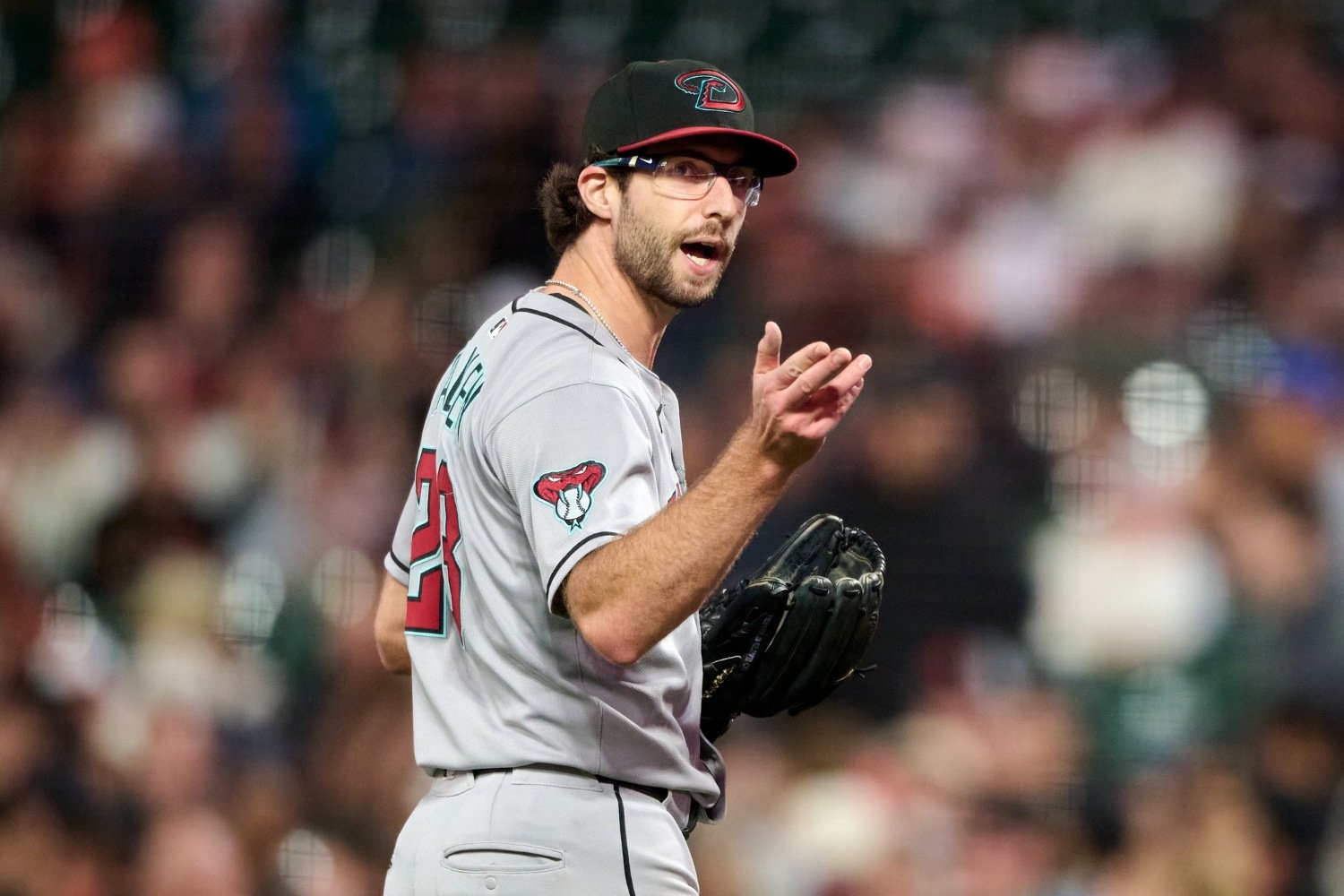
Gallen probably fits the Cubs’ predilections best. Picking up Cy Young votes in 2020, 2022 and 2023, Gallen showed about as much upside as Valdez, but will cost less after a considerably worse 2025 campaign. He’s coming off a rough year, wherein he had a 4.83 ERA, but he was still durable, throwing 192 innings. That ability to eat innings would make a huge impact in the Cubs’ rotation for 2026. Steele will be coming off Tommy John surgery, Matthew Boyd just threw the most innings he has in a single season since 2019, and leaning on sophomore Cade Horton for 200 innings sounds unduly optimistic. The front-line upside from Gallen is what separates him from other innings-eaters available, like Lucas Giolito or Miles Mikolas.
Trade Candidates
The Brewers won’t trade Freddy Peralta to the Cubs, for obvious reasons, and it looks unlikely that Tarik Skubal will be traded at all. It’s unlikely that the Marlins will trade Sandy Alcantara at the kind of price with which the Cubs will be comfortable. Three names that make sense for Chicago on the trade market are MacKenzie Gore, Edward Cabrera, and Nick Pivetta.
The Cubs were linked to Gore at the 2025 trade deadline, but reportedly were not able to come to an agreement because they would not include Cade Horton and Matt Shaw in the trade package. The current asking price should have come down a bit, as Gore did not pitch nearly as well in the second half and ended up finishing the year with a 4.17 ERA, after entering the All Star break with a 3.02 ERA. Many think Gore’s best days are still ahead of him, as he has shown an ability to miss bats at an elite rate throughout his career. He can give up hard contact at times, and also walk more hitters than a true ace should, but this is a former top prospect who has taken strides forward every season since his debut in 2022. Gore will be 27 on Opening Day and is under control via arbitration through 2027, meaning the rebuilding Nationals will likely benefit from moving him sooner, rather than later. Horton and top pitching prospect Jaxon Wiggins should be off the table, but the team’s young, non-established hitters are very much in play.
The Marlins are more likely to move Cabrera than Alcantara this offseason, and he is another arm to whom the Cubs have been linked. Per FanGraphs, Cabrera’s average velocities on his four-seam fastball and sinker were 97 mph and 96.8 mph, respectively, with a changeup touching 95 mph and a slider that can scrape 90 mph. He also comes with major issues with the free pass and durability. Last year was a step in the right direction, as he topped 100 innings for the first time in his career, but he’ll need to keep that up in order to make any real impact for a competing club.
The Yankess are in advanced talks with Miami about Cabrera, so time is short, but if they’re willing to part with their top offensive prospects, Chicago could still storm in with a late bid. The Cubs have Moisés Ballesteros and Kevin Alcántara hanging on the edges of the big-league roster, without a clear path to playing time in 2026. The Marlins have a few quality young catchers, in Agustín Ramírez and prospect Joe Mack, but Ballesteros could fit there at first base.
Pivetta is the oldest player on this list. He will be 33 on Opening Day, but he is coming off a season wherein he generated Cy Young buzz in the first half. Overall, he had a 2.87 ERA in 181 2/3 innings, while striking out 190. All of those marks are career bests. Under the hood, there are some reasons to be concerned. He had a 45% hard-hit rate in 2025. This was also the first season of his career in which he finished with an ERA under 4.00.
Though the Padres are still trying to compete, they’ve made it known they’re willing to sell high on Pivetta in order to add some MLB-ready talent. He does have an opt-out after this season, so if he pitches well again, this will likely turn into a rental deal. The best case for the Cubs would be a situation where Pivetta remains an ace-level pitcher for this season, helps them make a deep playoff run, and opts out, leaving the Cubs free of paying $32 million over the last two years of the deal. One problem is that the Padres would likely want a young pitcher they can expect to contribute in 2026, along with an outfielder. Wiggins is the only Cubs pitching prospect that might catch the attention of GM A.J. Preller, but that will be a non-starter for the Cubs.
The other problem, as illustrated by the team’s unwillingness to grant opt-outs after 2026 in their offers to both Imai and fellow righty starter Michael King earlier this winter, is that the team is set to lose Taillon, Boyd, Imanaga and a bevy of position players to free agency next offseason, so bringing in anyone else who will similarly depart after 2026 is an undesirable outcome for Hoyer.
As we discussed earlier this week, the odds of the Cubs adding a top-flight starter have dwindled in recent weeks. It’s still possible, but it’s certainly not a given. If they do still want to make it happen, though, these are the key names to watch.