
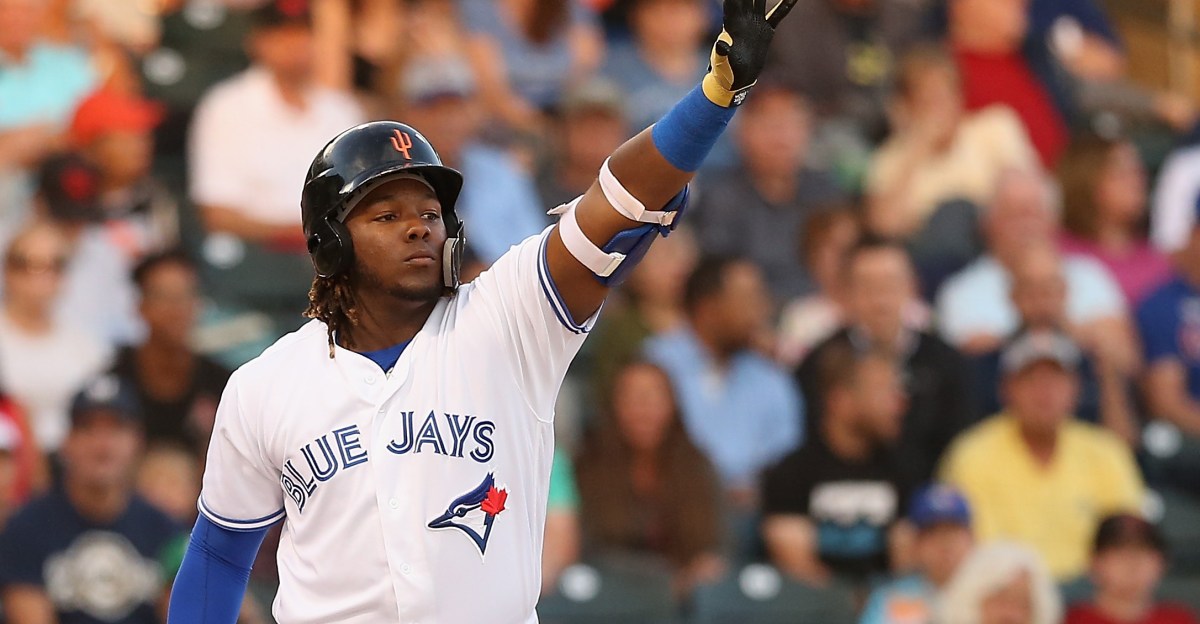
There are some fundamental differences between the A’s and the Blue Jays, beginning with vastly contrasting commitments to payroll. Money can hide flaws a lot better than even a player’s makeup (did you see what I did there?).
But today’s thesis is to look at the rather impressive ascent Toronto made from 2024 to 2025 and then to see how many similarities actually exist when you view the 2025 to 2026 A’s. Bear with me here…
2024 Blue Jays/2025 A’s
The Blue Jays finished the 2024 season in the cellar with just 74 wins, making a division title, let alone coming within an inch of a World Series title, highly improbable in 2025.
The A’s finished the 2025 season with 76 wins, actually clearing the cellar but finishing 4th in the AL West.
Comparing The 2026 A’s To The 2025 Blue Jays
Here’s where it gets kind of interesting. Not that there aren’t some important differences to be noted later, but check out the similarities:
First Base: The Blue Jays have a future Hall of Famer anchored there in Vlad Guererro Jr. Based on his rookie season, Nick Kurtz is on a Hall of Fame type trajectory until further notice.
Shortstop: The Blue Jays were buoyed by their 3.8 fWAR star Bo Bichette. Well, the A’s were anchored by their own All-Star, Jacob Wilson, whose 3.5 WAR also came on the strength of his bat over his subpar SS glove.
Surrounding Hitters: The Blue Jays didn’t just depend on Guerrero Jr. and Bichette to make their lineup go. They also had heavy hitters in George Springer, Alejandro Kirk, and Addison Barger. The A’s will support Kurtz and Wilson with their own heart of the order: Brent Rooker, Shea Langeliers, Tyler Soderstrom, Lawrence Butler, and now Jeff McNeil.
Third Base: The Blue Jays got a surprising breakout season from Ernie Clement, whose big league track record until 2025 was suggestive of an ordinary utility infielder. The A’s have their own potential breakout, who has not yet proven himself to be more than a utility infielder, in Max Muncy.
Corner Outfield: The Blue Jays got an unexpected lift when Addison Barger, who started on the infield, took a big step forward in 2025 (2.2 fWAR) and wound up being a key contributor out of RF in the post-season. Tyler Soderstrom moved from the infield to LF and blossomed both as a hitter and a fielder, winding up with 3.4 fWAR and being a gold glove finalist.
Center Field: The Blue Jays were anchored by a glove first center fielder with some offensive upside but also a high K rate. The A’s have turned CF over to Denzel Clarke, a gold glove caliber center fielder with offensive upside and Ks in his game.
Rotation: The rotation may currently be a very iffy proposition for the A’s in 2026, but it’s worth noting that the Blue Jays were not exactly flush with terrific options throughout 2025. Kevin Gausman was excellent and Chris Bassitt was solid, but behind him you had Jose Berrios having a down year, Max Scherzer and Shane Bieber running on fumes, making few starts and in Scherzer’s case not being effective, and “nice back end pieces” like Eric Lauer.
Eric Lauer “surprisingly good LHP” -> Jacob Lopez, Chris Bassitt “solid #3-#4 SP -> Luis Severino or Jeffrey Springs, Kevin Gausman ”front of the rotation stuff” -> Luis Morales (A’s fans can hope). The parallels are actually there.
Phenom Pitcher For September: The Blue Jays got a big lift when they needed it in September with the call up of Trey Yesavage who had only been drafted the previous summer. The A’s could get an end-of-season/post-season lift from their #1 pick in 2025 in highly ranked Jamie Arnold.
Now I’m not suggesting the A’s are going to rise up and win the AL West, certainly not that we should be pre-ordering our World Series tickets. But that’s a lot of parallels for what appears, on its face, to be two very different teams, different organizations, and a path that would clearly be a 99th percentile outcome for the 2026 A’s.
So why not dream? No one saw it coming with the 2025 Blue Jays either.