
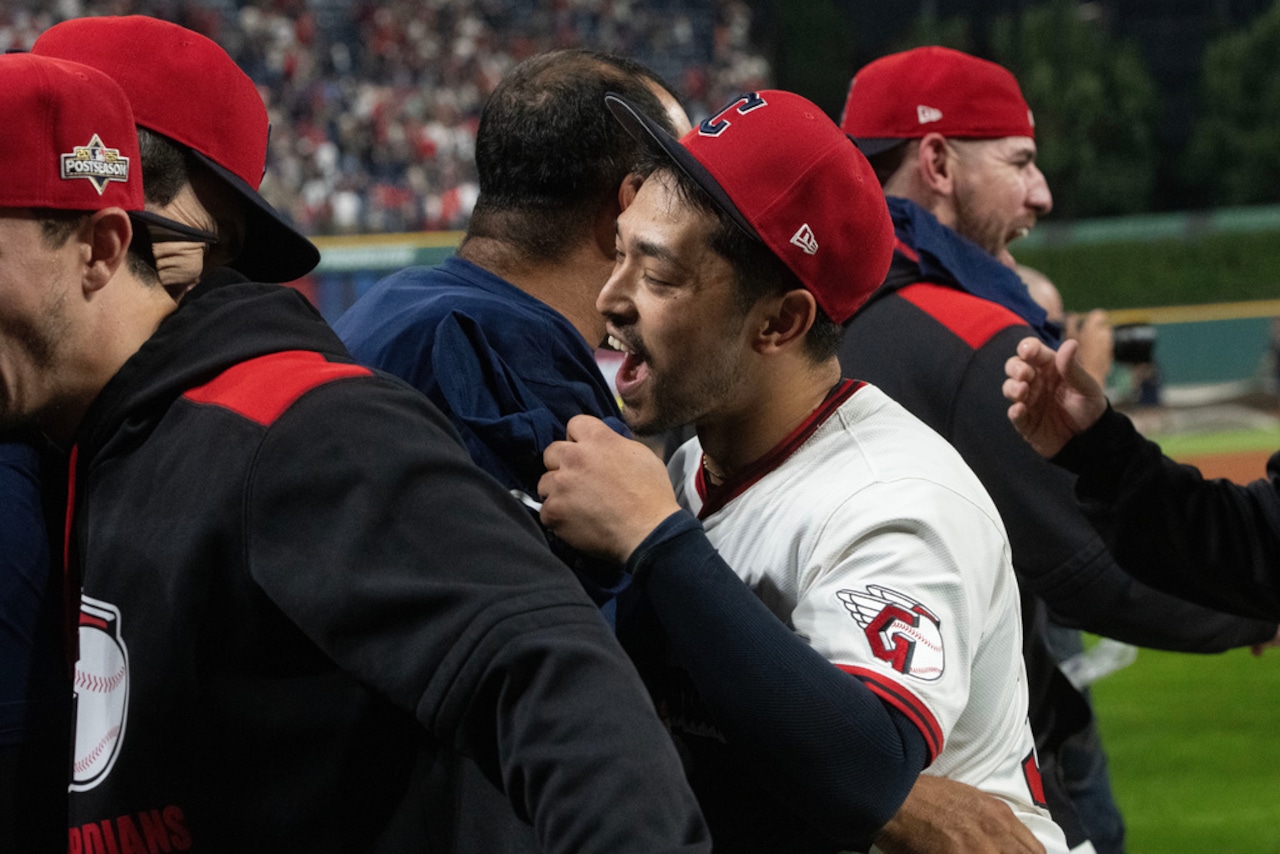
CLEVELAND, Ohio — The latest episode of the Cleveland Baseball Talk Podcast dives deep into what could be another frustrating chapter in the Guardians’ history of losing homegrown stars, as two-time All-Star and four-time Gold Glove winner Steven Kwan heads into salary arbitration with no long-term extension in sight.
Cleveland.com beat reporters Joe Noga and Paul Hoynes paint a concerning picture for fans who’ve grown weary of seeing their favorite players depart. The similarities to past situations with Francisco Lindor and Shane Bieber are impossible to ignore.
“The vibes and the feeling that we sort of sense in this situation right now are more along the lines of Lindor and Bieber when we’re talking about Steven Kwan,” Noga observed during the podcast.
After four stellar seasons in Cleveland, Kwan has established himself as one of the team’s most consistent and valuable players. With a career .281 batting average, 46 runs scored, 36 home runs, 206 RBI, a 3.7 WAR according to Baseball Reference, and a .741 OPS, he’s exactly the type of player franchises typically lock up long-term.
The arbitration process itself is particularly contentious — even though Cleveland isn’t directly negotiating against Kwan in the hearing room. As Hoynes explained, “It’s one players association guy, one MLB arbitrator and one neutral arbitrator.” But the real issue seems to be the inability of both sides to come together on a multi-year extension that would keep Kwan in Cleveland beyond his arbitration years.
What’s particularly frustrating for fans is that Cleveland pioneered the strategy of signing young players to team-friendly extensions, dating back to the John Hart era in the 1990s. As Hoynes recounted, “Greg Swindell and Jerry Brown with the Indians went to arbitration… But Swindell was so upset over the process that John Hart and Danny O’Dowd on the way back from the hearing they decided we’re not going to go through that again… And that’s what started the trend of offering multiyear deals to players, pre-arb players.”
Yet despite this historical precedent, the organization has failed to secure its most recent core of talent outside of José Ramirez, while embattled closer Emanuel Clase and a few others have inked extensions that haven’t panned out as hoped.
The most telling comment from the podcast came from Hoynes, who summed up the situation bluntly: “It’s, it takes two to tango. The old saying. And these two sides have talked and they just haven’t reached a point where both sides agree. And I don’t know if that’s going to happen before Kwan becomes a free agent. We’ve seen this time and time again or he ultimately gets traded.”
With Kwan now just two years away from free agency, the window for a team-friendly extension is rapidly closing. For Guardians fans, the frustration isn’t just about potentially losing another star — it’s about watching a pattern repeat itself despite the organization’s historical innovation in preventing exactly this type of situation.
Want to hear the full discussion about Kwan’s future and what it means for the Guardians? Check out the latest episode of the Cleveland Baseball Talk Podcast for an in-depth breakdown of this critical situation and what it might mean for the team’s competitive future.
Read the automated transcript of today’s podcast below. Because it’s an AI-generated transcript, it may contain errors and misspellings.
Podcast Transcript
Joe Noga: Welcome back to the Cleveland Baseball Talk Podcast. I’m Joe Noga, joined by Paul Hoynes. Hoynsie, the Guardians set to exchange salary arbitration numbers with Steven Kwan. The, the process is to the point now where both sides are going to exchange numbers. The, the, then they go for a hearing. If they get to a agreement before the, the hearing, they can sign at any time. It goes to the arbitrator. It’s either Kwon’s number or the Guardian’s number. And that’s what, uh, that’s what salary the player is going to make in the 2026 season. What, what are you hearing and, and what are your expectations as they, they inch closer to the arbitration hearing with Steven Kwan?
Paul Hoynes: Yeah, interesting development, Joe. Today is the day for exchanging salary figures. You know, the, the team’s version of what’s. Kwan should get paid in 2026 and Kwan is his agent’s version of what he, what he deserves for the upcoming season. The deadline is 1pm today. If they reach an, if they reach a deal, and I think it can go later tonight if they fail to reach a deal and that gives them some more time to negotiate a deal. If not, you know, most teams for the last several years have taken a trial, a file and trial approach. If they don’t get a deal done today, it means they’re going to go to arbitration in early February. And that’s the process you were talking about. Re. Arbitrary arbitrators hear arguments from both sides and they, they pick a, you know, they pick a winner. It’s either the team or the players salary request and no middle ground.
Joe Noga: Now correct me if I’m wrong here, but the people that sit there and negotiate from the team side, those are, those are Major League Baseball representatives. Those aren’t necessarily direct representatives of the Guardians. Correct?
Paul Hoynes: Right. It’s, you know, there’s one, one players association guy, one owner, one player, one MLB arbitrator, I believe, and one neutral arbitrator.
Joe Noga: Right. So, you know, it’s not necessarily Paul Dolan sitting across the table from Steven Kwan and the two of them, you know, going at it. It sort of protects from sort of any sort of animosity in that regard, but it’s still a process that can, that can generate significant friction, I guess, between a player and a club. You know, I think back to a guy like a Trevor Bauer who wanted to go to arbitration as much as possible because he wanted to sit there and prove how right he was all the time. I don’t necessarily get that vibe from Steven Kwan, but Steven Kwan strikes me as the kind of guy who, who knows his worth and you know, wants, you know, sort of that.
Paul Hoynes: Yeah. And you know, Kwan has already been through the process once. You know, he went through it. You after the 2024 season, he came out with a, you know, a $4 million deal. He settled without going to arbitration. Now you know, he’s projected to make, you know, different projections. MLB trade rumors have him at 8.8 million. The baseball perspective has him at 9.175 million and a sport track has him at 8.5 million. So you know that that’s the range that he’s, you know, that he’s likely to make. And I guess they could, you know, also, you know, they could set the stage for a multi year extension. But right now I’m, I’m sure they’re just concentrating on getting, you know, a one year deal done and they’ll go from there. But yeah, it does cause animosity. Way back when in, in the 1990s, Greg Swindell and Jerry Brown with the guard with the Indians went to arbitration. I think Swindell won, Jerry Brown lost. But Swindell was so upset over the process that John Hart and Danny o’ Dowd on the way back from the hearing they decided to, you know, we’re not going to go through that again. We’re not going to put our players through that again. And that’s what started the, you know, offering multi year deals to players, pre arb players and you know that, that really revolutionized the whole game and that was back in the early 1990s and the process is still going on. And you’re right about Bauer, Bauer be beat the guardians twice back to back seasons, you know, going to arbitration.
Joe Noga: Yeah, and that was before he was traded and you know the, the final go around for him in, in arbitration he won as well. So you think about that as, as they, you know, move towards this process. You know I, I just, I wonder from a player’s perspective how eager they are sometimes when they reach the end of this, you know, where Steven Kwan is in this process, the arbitration and the pre arbitration. From the time a player gets called up, it’s a six year process. You get three years of pre arbitration where you make the, the major league minimum salary and that’s pretty much all you can make in that process for those three years unless you agree to like you said, these multi year extensions or deals outside of that process. But for most players on the guardians roster, it’s three years of the major League minimum and then you reach the arbitration process for three seasons and you know, the, the SAL decided for you to a degree. There are other avenues for you to earn more based on your performance that are in place now. But those are for like the elite players, the top players, the guys who dip into that bonus pool of money there. And it’s not necessarily what you’re seeing with some of these multi year extensions where guys are getting paid what, nine figure salaries. The whole process from, from start to finish, it’s designed to reward the guys who are consistent and have the, the, you know, six plus year major league careers. And those are more rare than you would think.
Paul Hoynes: Yeah, Joe, I mean if, you know, you know, in the last negotiation for the basic agreement, you know, the players, the owners wanted to do away with the arbitration system, you know, it jacks up prices, you know, they feel it jacks up prices unfairly, that, you know, the teams, you know, lose both ways because you really, you can’t cut a player more than 20% in the arbitration process. And rarely does a player’s salary ever get cut. It only increases whether they win or lose the arbitration process. So. But obviously the players really want to keep the process. They want to keep the arbitration process. And compromise in the last basic agreement was that $50 million for players that weren’t yet eligible for arbitration. You know, the guys that didn’t have more than three or more years in the big leagues so, you know, out more money to the younger players. And we’ve seen guys like Tanner Bibee really benefit from that. So we’ll see. And we know this is going to be a bone of contention after the 2026 season when the current basic agreement expires.
Joe Noga: Yeah, and you know, teams are already preparing for that, the expiration of the CBA down the line and you know, starting to tighten their belts. And we talked about how free agency has been affected by the upcoming labor negotiations. But this is all part of that. This arbitration process is part of the CBA has been for, like you said, going back to the days of Danny o’ Dowd and John Hart and more. It’s just interesting to me. Cleveland might have been the place that started the whole trend of locking up your core players on multi year extensions and all that. And now it’s something that could save them, it could save the fans sort of the heartache of watching the club have to trade away a guy like Steven Kwan. And yet they haven’t been able to in the last few years. Really the only guy that they’ve been able to lock up like that has been, have been Jose Ramirez, Emmanuel Clase. I think they, they offered and they got Trevor Stefan and Miles Straw to sign deals, but neither of those guys, you know, performed and lived up to those deals. Uh, this is a, it’s a tactic, it’s a, it’s a maneuver that Cleveland, you know, is sort of, you know, really good at. But it’s the guys that you, you would really hope and want to see remain here on those deals, like Steven Kwan, you know, they haven’t been able to get that done. Yeah.
Paul Hoynes: And you know, the players, when the Guardian, when the Indians first started this in the 90s, you know, they, they got every, you know, all their core players to sign multi year deals, you know, before arbitration. Kenny Lofton and Albert Bell and Sandy Alomar. But those guys, you know, they took the security over, you know, their, their earning power. But as these guys progress and became, you know, All Stars, they, they, they out, they, they out talented. Those contracts. Obviously the, the agents and the players caught on and now that’s why it’s so much harder to sign younger players, pre, hard players to multi year deals now because they don’t want to give up the money at the end of the contract that they would be earning if they went one year at a time. We’ve seen Tanner Bybee sign a multi year deal, we’ve seen Andres Jimenez. It still happens, but you know, the, it’s, it’s few and far between and guys like Shane Bieber went year to year, you know, and Kwan is doing the same and it all depends about the player. Is he willing to play without that security? Is he banking on himself? Is he willing to go to arbitration year in and year out? And some guys are, some guys aren’t.
Joe Noga: Yeah, the vibes and the feeling that I, I’m getting that, that we sort of sense in this situation right now more along the lines of a Francisco Lindor and a Shane Bieber when we’re talking about Steven Kwan. You know, guys who, you know, when you talk to them, hey, I’d love to, I’d love to be in Cleveland. I love to spend my career in Cleveland. But you know, nothing ever really materializes of it. The opportunity has been there the whole time even after Kwan signs, you know, or goes through the arbitration process and you know, whether, whether he goes to trial with it or not, even whatever contract he ends up with for the 2026 season, he could tear that contract up and renegotiate and you know, sign an extension Anytime up until basically the, the beginning of the, the regular season and beyond. It’s, it’s just a matter of will he sit down at the table and do that with the club, I’m sure that they would, would welcome the opportunity to, to maybe negotiate, but we’ve just seen no evidence that that’s been the case with Kwan.
Paul Hoynes: Yeah. And you know, now he’s two years away from, from free agency, Joe, and that’s been, you know, that, you know, that’s the goal of all players that you get six years in the big leagues and if he keeps, you know, that consistent, you know, production that he’s had for through the first four years, he’s going to make a lot of money. And if he stays healthy, you know, there’s a lot of ifs. But you know, again, it comes down to believe, you know, the player’s mindset. Does he want security or does he want to maximize his value? And you know, that’s, that’s the game that’s being played right now. And when you get within one or two years of free agency, Joe, it’s rare, very, very rare for a guy to sign a multi year deal to stay with his old club unless he just gets blown away.
Joe Noga: You’ve described it in past stories that you’ve written, Hoynsie. I love it. It’s the sirens call of free agency. They, you know, tie him to the mast. So yeah, you know, the reason that Kwan is so important in this situation, you know, in four years in Cleveland, like you wrote in your post today, 281 average, you know, he’s one of their best hitters over the last four seasons. A 46 run scored, 36 home runs, 206 RBI, a 3.7 WAR according to Baseball Reference and a.741 OPS. He’s a two time All Star, a four time Gold Glove winner. Last season might not have been necessarily his best season, but you know, he still hit.272 scored, 81 runs, goal, 21 bases. It’s, you know, you mentioned injury concerns. This is a guy whose hamstrings are always sort of on the radar for anybody who follows the guardians.
Paul Hoynes: Yeah, you know, the thing I liked about Kwan this past season, Joe, Is he posted 156 games, 125 at bats. So he stayed on the field. And for him to be effective, you know, any player, but especially him, based on, you know, what he does at the top of the lineup, he’s got to be in that lineup, you know, almost every day.
Joe Noga: Yeah, and you know, beyond what he does on the field, he gives you exactly what you want. If you’re a franchise you could, like you said, you could pencil him in every day at the top of the order, plays elite defense, runs the bases, but also is, you know, just a good guy to deal with and talk to and be around and a smart guy, knows the game and you know, improves areas in the offseason. You know, we’ve seen him go into the off season saying I want to improve my arm strength and then he goes out and leads the league in outfield assists. He’s. There are little things about his game that make him the kind of guy that you sign to a multi year extension. And that’s what’s I guess so kind of so frustrating about following this team and being a fan of this team is that, you know, the inability to get that done so far.
Paul Hoynes: It’s, it takes two to tango. The old saying. And these two, these two sides have talked and they just haven’t reached a point where both sides agree. And I don’t know if that’s, if that’s going to happen before Kwon becomes a free agent. Joe, we’ve seen this time and time again or he ultimately gets traded.
Joe Noga: The other big name out there I guess right now when you’re talking about arbitration figures and filings and you know, will he sign, won’t he sign? Will he be traded? Is Tarik Skubal the Guardians nemesis over in Detroit, basically the best starting pitcher in, in the game the last couple of seasons. Two time Cy Young winner. This is a guy who should be making at the top of the pay scale. You know, what he’s, what he’s able to earn. And I think everybody knows that the big rumor this season at the winter meetings throughout the off season is will Detroit trade him? Are the Mets a destination for Detroit or for Skubal because of their ability to pay, you know, whatever. He basically needs and wants the, the arbitration process for position players. I think the record for a player entering his final year of arbitration is 31 and a half million. Deal signed Juan Soto a couple years back. The record for a pitcher is Jacob deGrom 19 million I think Framber Valdez 18 million in his final year of arbitration. So figure for Skubal he’s got to get north of 20 million in, in arbitration just based on who he is and where he is in his career right now. The question is going to be Detroit going to be the one signing that check?
Paul Hoynes: Yeah, you know, well, I think right now you Know, you know, I would imagine, you know, they’re going to one way or the. Yeah, exactly, Joe. I mean, he, he is, you know, he earned 10 million last season. You know, he’s projected to make 17.8 between 17.8 and 22.5 million in arbitration. You know, as we’ve said before, I mean, if you’re Detroit, I mean this is a guy you have to keep. But to me, he’s obviously, you know, a free. What, a free agent, what in two next year, Right. I think free agent. Yeah. So a delicate situation, much like the Guardians with Kwan. But to me, this is a guy you cannot let go. Detroit has money they, you know, they’ve spent on players before. I would think this is a guy you’ve got, the Tigers have to keep.
Joe Noga: Well, I mean, if you’re Detroit and it’s a choice between keeping your homegrown guy in Tarik Skubal or bringing in Alex Bregman who you flirted with last season, the choice has got to be, obviously you’ve got to keep your guy. I mean, it would be devastating to that fan base in Detroit to lose Tarik School. I think even if you’re able to sign a guy like Alex Bregman and reunite him with AJ Hinch, I just can’t imagine he wins 2 side back to back Cy Youngs and you, you trade him away, it’s, it’s a head scratcher certainly. But yeah, I mean it could happen. It still be. Mets are still trying to salvage their off season. By all, by all accounts, it’s a, it’s been a disaster this year for them. But the Guardians would, would not mind seeing Tarik Skubal a little less every season. Maybe if he’s not in the division, you have to face him fewer times. And Detroit sure is good at lining up their rotation every time the two clubs get together and making sure that school has a chance to pitch against them. So it’s something that I, as Guardians fans and people who follow the team, it’s something to keep an eye on. Yeah. You know Tarik Skubal, do you think he should set the record for a pitcher in arbitration?
Paul Hoynes: I think he’s, you know, I don’t know if he should or shouldn’t Joe, but I think he’s in a great position too. You know, if he, I think he, there’s. He could make at least 20 million on a one year deal and that would set the record. Right. I think that would be the biggest one year contract given a picture. So. So he certainly, you Know, he has done nothing over the last two years to get to convince me otherwise. Now, obviously, you go deeper into his past. He’s had some injury problem, as most pitchers have, that he’s had a. He’s had trouble staying on the field. So I don’t know if that comes into play. But right now I think, you know, he’s. He’s number one and he, I mean, he’s a guy right there that. That could easily set the record.
Joe Noga: You touched on this a little earlier about how, you know, Major League Baseball owners and the Players association, obviously we’re heading towards negotiations for the collective bargaining agreement and how, you know, the owners tried in the round of this to. To maybe get rid of the arbitration process. Where do you see. What do you see the future of this process, you know, in baseball, even beyond this upcoming cba?
Paul Hoynes: See, I don’t think the arbitration process is going anywhere, Joe. This is, to me, this is probably one of the, you know, I, I hate to even think of a work stoppage, but, you know, this is probably something that, that the players would draw a line in the sand in or, you know, if. If the, if the owners can come. Come, you know, with a, you know, a different version. But, you know, I think this, you know, this really kind of ratchets it up prices. This, you know, increases the payroll and this increases players salaries. And I just don’t see a way around it.
Joe Noga: Where. Why.
Paul Hoynes: Why would the. The players back away from this, take it out of the next basic agreement? I can’t. I can’t see that. I mean, I know it’s. I think when it first came in, it was two years. You know, two years a player was expanding Robertson, and then they pushed it back. Maybe if that could be some way to work around that. But then, then still your younger players are. Aren’t getting the money that the, that the players, you know, that the union says they should be, because as you said earlier, the game is getting younger and younger.
Joe Noga: You know, if you take away a year of pre arb. Maybe let them get to arbitration quicker, that’s where, you know, the owners can’t go for that because that’s where the. The big money comes in, is when they get to the arbitration process and the figures go up drastically from there. So, yeah, I don’t know if messing with the number of years is something that they can do, but the process itself, I. Is, you know, to me, it’s sort of like, you know, the property tax and school funding issues. People want to change that here. Even in, in the state of Ohio. And until you offer something maybe different, a different way of looking at things and a different way of, you know, coming up with the funding for it, I don’t think the process that’s in place should, should change. And, and I, I guess neither do the players. So, yes, again, this is, you know, where we are sort of in the off season right now is sitting here speculating on contracts and salary figures and things because there’s not a lot of movement otherwise, not a lot of things going on. The only person who’s really on the move again is John Kenzie Noel, who was designated for assignment shortly after being acquired by the Baltimore Orioles earlier this week on waivers. Noel, the former Guardians outfielder, now once again without a team after he was released in favor of another outfielder claimed by the Pittsburgh claim from the Pittsburgh Pirates, Marco Luciano. The Orioles, you know, claim Luciano wave John Kenzie Noel. So Noel out there again, you know, a tough stretch of days here after, you know, 19 days, sort of not knowing where he was going to end up. Noel now again without a team.
Paul Hoynes: Yeah, Joe, hopefully big Christmas can, you know, can drop anchor somewhere somehow and get a job here and, you know, have a team that’ll go to bring them to spring training with and give them a chance to make the ball club. But, you know, when, when players start bouncing around like this, you know, you really, the bright lights and glamour of the big leagues don’t look that glamorous. This is, you know, you’ve got to, I feel for them because it’s an unsettling feeling. You don’t know where you’re going to be. You don’t know if you’re going to play baseball next season. So hopefully another team will take a chance on Noel. I’m sure they will because of his power and he lands on his feet somewhere.
Joe Noga: Yeah. And, you know, not to be overlooked, I think Noel’s defense and, you know, he’s not necessarily the, the fastest guy out there who, he runs well and, you know, he, he plays a good right field, can, can get to balls and has a really strong arm. This is a guy who can do a lot of different things. So, yeah, maybe a team brings him in on a minor league contract and gives him a chance to play any outfield there throughout the season. All right, Hoynes, that’s going to wrap up today’s edition of the Cleveland Baseball Talk Podcast. We’ll be back to wrap up the week on Friday. We’ll talk to you then.
Paul Hoynes: Thanks, Joe.