
Let us take a moment to revisit the Dodgers’ first World Championship as a nice throwback 70+ years later.
The series started with the Dodgers dropping the first two games in the Bronx before storming back to win the next three in Brooklyn. The Yankees forced Game 7, and the Dodgers prevailed in a shutout on Johnny Podres’s second complete game of the Fall Classic.
In what became a franchise form, the Dodgers clinched the Fall Classic on the road.
While the two clubs were comparable at the plate, with Brooklyn hitting like the 2025-Toronto Blue Jays with a .260/.358/.426 slash line for the series and the Yankees having a .248/.321/.392 slash line, the real story in this series was the creativity that Dodgers’ Manager Walter Alston had to rely on to get the Dodgers their first championship.
Modernly, one only has to look back to the 2024 championship club to see a Dodgers manager make do with a hodgepodge pitching staff. Most notably, the 2024 team and the 1955 team had to use a hodgepodge of pitchers in the rotation due to injuries. The 2024 team had to use a hodgepodge of a “rookie” Yoshinobu Yamamoto, the suddenly resurgent Walker Buehler, and the inconsistent Jack Flaherty.
The 1955 team would have killed for such riches.
The 1955-incarnation had Don Newcombe, who was injured and took the loss in Game 1, and only had four pitchers appear in more than one game: Clem Labine (4 games, 1-0, 1 Sv, 9 1/3 IP, 2.89 ERA, 6 H, 2 BB, 2 K), Don Bessent (3 games, 3 1/3 IP, 0.00 ERA, 3 H, BB, K), Johnny Podres (2 games (2 starts), 2-0, 18 IP, 1.00 ERA, 15 H, 4 BB, 10 K), and Karl Spooner (2 games (1 start), 0-1, 3 1/3 IP, 13.50 ERA, 4 H, 3 BB, 6 K). As an odd historical footnote, Newcombe never won a World Series game in his career.
Famously, Sandy Koufax was on the roster but did not play, much like 2025’s Ben Rortvedt. Notably, the 1956 Dodgers failed to repeat as champions, losing to the Yankees in seven games. Don Larsen, who was knocked around in 1955 (five runs in four innings), famously rebounded in Game 5 the following year. Funny enough, in 1956, the Dodgers lost in seven games, after taking the first two in Brooklyn, losing the next three in the Bronx, forcing Game 7, and getting shellacked in the finale.
Like the 2025 Toronto Blue Jays, the 1955 Yankees ran themselves out of a couple of innings. The 1955 Yankees most infamously ruined their final scoring chance on a Yogi Berra fly ball to Sandy Amorós in left field in the bottom of the sixth, which led to Gil McDougal being doubled up off first base. Unlike Addison Barger or Alejandro Kirk, this double play did not end a contest.
Vin Scully talked to Tom Verducci in 2016 before his retirement in San Francisco about the call of Brooklyn winning the World Championship, its aftermath, and the reaction of the team’s relocation to Los Angeles in 1957.
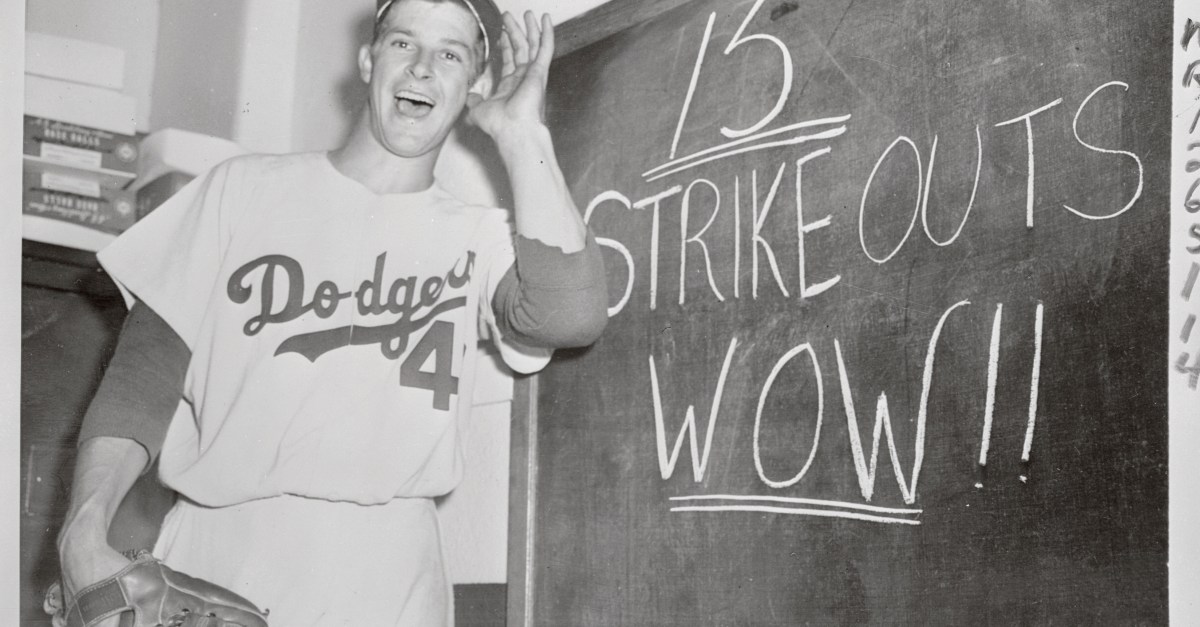
A modern Dodgers fan would be forgiven for not instantly recognizing the name Karl Spooner from the above list of participating pitchers in 1955. Spooner was once the most prized left-hander in the Dodgers’ system, yes, even over the sainted Koufax, and literally defined the term “meteoric” for a career.
In September 1954, Spooner debuted with aplomb, arguably having the greatest debut in Dodgers’ history. He struck out 15 New York Giants in a complete game shutout to both set the franchise record and tie the record for most strikeouts in a debut outing.
This record stands today as Bob Feller of the Cleveland Indians struck out 15 in 1936, and J.P. Richards of the Houston Astros matched this mark in 1971.
The headline of “We needed Spooner much sooner” echoed the sentiment of the fanbase as Spooner took the league by storm in this final start of the year by throwing another complete game shutout, striking out only 12 Pittsburgh Pirates in a 1-0 victory. Spooner struck out 27 batters over two games, trailing only Feller’s 28 in MLB records at the time.
Still, the Dodgers missed the playoffs. Per the Society for American Baseball Research’s Richard S. Cohen, life was good for Spooner during the 1954 offseason:
Spooner had the world on a string. His home town gave a parade in his honor, and he served as King of the 1955 Winter Carnival in Old Forge, New York, where he allegedly asked if he could keep the beaver skin coat lent to him by a major sponsor to keep him warm in the open air convertible in which he rode for the event’s big parade. Many in his home town suspected the injury that was to lead to the end of his career may have started by his throwing a few too many snowballs too hard at this event.
In 1955, disaster struck, and the bloom of Dodgers pitching fell. There is no definitive answer to when Spooner got hurt, but what is not in dispute is that Spooner did get hurt. Once again, Mr. Cohen:
Indeed, calamity struck early during 1955 spring training, probably on March 9. As Spooner later told author Peter Golenbock, “Johnny Podres was supposed to go the first three innings, and I was supposed to go the second three, but Podres got in trouble and only pitched two innings. I tried to warm up real fast. I don’t think I was really good and loose, and I guess I just tried to throw too hard, too soon…I threw a real good curveball to Jim Rivera, struck him out, and I felt a kind of a pull in my shoulder, but it didn’t hurt that much, and so I finished the inning and the next inning. After I took a shower and was dressing, jiminy crickets, it started hurting real bad, and I could hardly even put my damn shirt on. And that’s when I told the trainer.”
[Emphasis added.]
Vin Scully attributed the injury to throwing a ball for a publicity photograph, while Walter Alston said, years later, that:
One of the best prospects Brooklyn ever had, Karl Spooner, wrecked his arm merely throwing on the sidelines before a game. You never know about these things.
The Dodgers held Spooner back until mid-May and tried to have him play through the pain, which was a catastrophic mistake. He just wasn’t the same pitcher.
Per Mark Langhill of Medium.com:
The Dodgers started the regular season without Spooner, but he wasn’t missed as Brooklyn won its first 10 games and roared to a 22–2 start, the best in franchise history. Spooner didn’t make his first start in 1955 until May 15 at Cincinnati. He lasted 13 batters in an 11–4 loss to the Reds, allowing four runs on five hits with two walks and one strikeout.
Spooner’s next appearance was a start 20 days later in the second game of a doubleheader against the Cardinals at Ebbets Field. Spooner fared better, getting a no-decision after four runs (one earned) on six hits in four innings with two walks and six strikeouts.
The rest of Spooner’s season was a mixed bag: June (2–0 record, 1.88 ERA), July (0–3, 6.51), August (4–1, 2.35) and September (2–1, 2.08). He struck out 78 batters and walked 41 in 98 2/3 innings.
Spooner’s final major league win was earned coming out of the bullpen against the Milwaukee Braves on September 8, the date that the Dodgers clinched the NL crown. For the year, Spooner went 8-6 with two saves and a 3.65 ERA in 98 2/3 innings.
Spooner appeared twice in the Fall Classic, first in Game 2, where he pitched three scoreless innings of relief, striking out five in the loss. Game 6 was the final game of Spooner’s MLB career. For the final time, Mr. Cohen:
Had he performed as well as he had in relief in Game Two, and had his second baseman Junior Gilliam performed to his capabilities, Karl Spooner, not Johnny Podres, may have been carried off the field by the World Series champion Dodgers. But in the first inning at Yankee Stadium, Spooner walked Phil Rizzuto. Billy Martin struck out while Rizzuto easily stole second – Gilliam was late covering the base. Then, after Gil McDougald walked, Gilliam let a possible double-play ball from Yogi Berra get by him for a single which scored Rizzuto. Hank Bauer then singled in McDougald, and Bill Skowron homered, knocking Spooner out of the box.
Spooner lasted just a 1/3 of an inning, gave upfive runs, and essentially guaranteed Game 7. Manager Walter Alston went to pull Spooner before Skowron had even touched home plate. Spooner bounced around the minors for a couple of seasons before being selected in the Minor League portion of the Rule V draft by the St. Louis Cardinals after the 1957 season. Spooner was out of baseball after 1959. He died of liver cancer at 52 on April 10, 1984.
Meteors are known for burning brightly before blinking out of existence. Spooner could arguably be seen as a cautionary tale about how can’t-miss prospects often do or the negligence of medical services in baseball. While he raised a family and died all too young, he tasted glory if only for a far too-brief moment.
In what I can only call a bit of serendipity, the YouTube channel Baseball Replay Journal, run by Daniel Evensen, had the same idea of a recap and beat me to it by both essay and video compilation. On New Year’s Day, he published a 36-minute compilation retrospective on When ‘Next Year’ Finally Came as the Brooklyn Dodgers finally vanquished the Yankees, as well as how that victory rippled throughout baseball for years to come.
I figure it is my duty to appreciate and share his work in both video and essay. Some salient, final points about the 1955 Championship that Evensen highlighted, which we would be remiss to forget, are presented below:
The Dodgers really were snakebitten. There was a feeling of desperation that pervaded Brooklyn’s 1955 season. Though nobody said it, you got the feeling for the entire season that the Dodgers would need to do it this year if they were going to do it at all.
It was clear that the Dodgers wouldn’t be around forever. Brooklyn attendance was down after hitting high points in the late 1940s. There have been rumors over the years that Walter O’Malley might have taken steps to sabatoge the team in hopes of getting approval for a new stadium. What is absolutely clear, though, is that there was talk of the Dodgers playing in New Jersey throughout the 1955 season.
The Dodgers were the most popular team in North America. Newspapers all over the United States and Canada featured articles on the inner workings of the Brooklyn Dodgers. The idea that this was the team that simply could not beat whatever curse they might have had created a swelling of support for the team. And, while it’s clear the other National League fans wanted their teams to win the pennant, it’s also clear that almost the entire country was pulling for Brooklyn in the World Series.
The Dodgers had to get creative to win it. We tend to forget how Alston went against the book to finally win the title. Walter Alston tried everything, including starting youngsters Roger Craig and Karl Spooner instead of sticking Billy Loes back out there. Starting changeup specialist Johnny Podres in Game 7 was risky, but turned out to be brilliant – and I should note that we’ll probably never see a change of speed artist start a World Series Game 7 again. And the bunting attack to score the second run in Game 7 was a thing of beauty.
From lovable losers to a seemingly unstoppable juggernaut, 70 years later. History can often reduce the nuance of these stories to stark contrasts over time. Those who remember the 1955 Fall Classic slip away with the proverbial sands of time, as those who just lived through the past two championships are fated to do. Success in 2025 was not predestined, and who knows what will be remembered ten, twenty, or seventy years from now.
The Los Angeles Dodgers have done a service by creating a baseball culture to be proud of in Los Angeles. It would take little effort to try to cultivate the legends and stories that arose in Brooklyn all those years ago.