
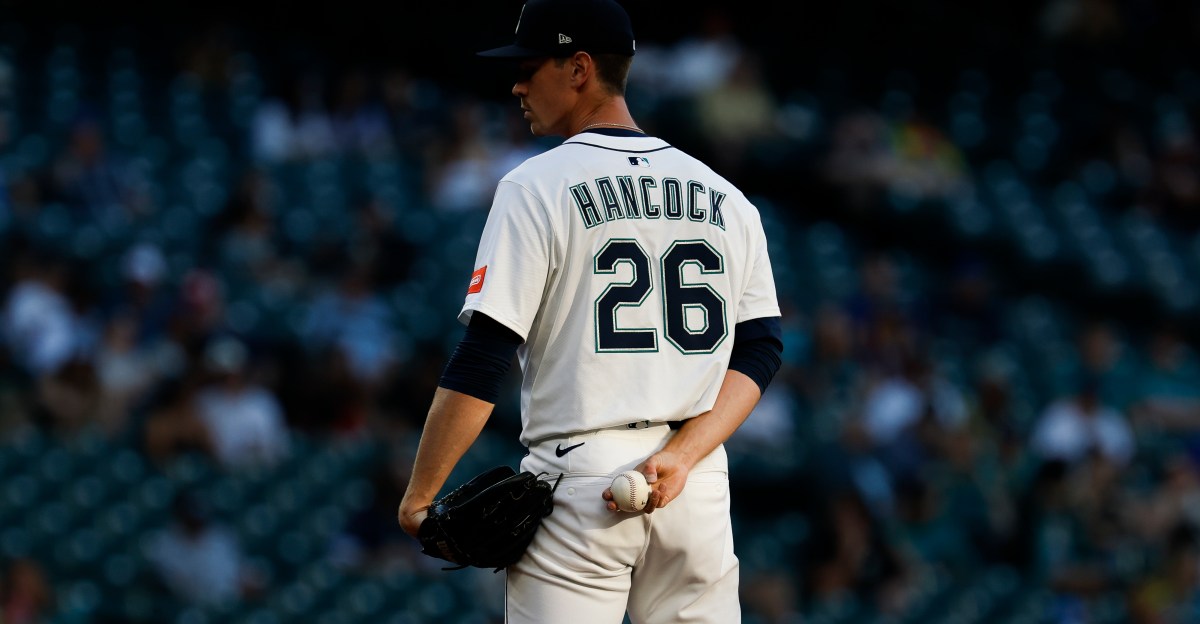
Brussels sprouts, my sister’s boyfriend, yoga, the television show Letterkenny, most weird chip flavors, The Ballad of Dood & Juanita, and Emerson Hancock.
It was not my intention to cultivate any affinity for this Georgia fella, but by the time we closed out the 2025 season it seemed that prolonged exposure had worked its magic once again. For six years, the deck had been stacked against him. Hancock, like many in that 2020 draft class, suffers a bit from our collective mid-pandemic fugue state. With the cancellation of the college and minor league seasons that year, the draft felt a bit like being gifted a printout of your present and being told it would arrive in 6-10 weeks. It’s hard to get excited for something you can’t see, even if that something is a 6’4, sixth overall pick with a tantalizing fastball.
Unfortunately for Hancock, it isn’t just exposure that has endeared him to me; it’s his precipitous descent into a mire of mediocrity. In nearly 163 innings in the major leagues, Hancock has been worth 0.1 fWAR. Baseball Reference, gauging more off outcomes than process, has him at -0.7. Last year, he was given more opportunities than anyone may have hoped, as the Mariners’ rotation fell victim to injury after injury. In his 90 innings of work, he put up a 5.08 FIP, a 4.90 ERA, a 4.61 xFIP, gave up 1.5 home runs every nine innings and 93 total hits. Regardless of your preferred metrics, he wasn’t very good. Perhaps most telling was how the M’s chose to use him, which was with impunity. They used him like he was Christian Bergman or Chase De Jong or Tommy Milone, or any of the other ignominious swingmen of years past who lurk eternally in the recesses of my brain. They certainly did not treat him like a number one pick.
The Bulldog has become an underdog. (No one would ever accuse me of having good taste.)
Over the course of the 2025 season, I developed a strange soft spot for the guy who kept stepping in as the need arose. He started, he relieved, he put his body out there whenever he was called upon, and in a period when eating innings was at a premium, he ground it out to the best of his abilities. The hard part was that it wasn’t always (often? mostly? usually?) enough. I watched his starts and remembered filling the gaping pushpin holes in my postgrad apartment in Fremont, when I hadn’t bought a putty knife and was left to smear spackle on the walls like finger-paint. It mostly got the job done, but it didn’t look very good and in some instances the dried rubble left behind was worse than the original holes. There were periods of promise in Hancock’s 2025 performance: He maintained a higher velocity over extended periods of time, he debuted a pair of new pitches – a sweeper and cutter, and he stayed healthy. But none of it made a demonstrable difference.
Hancock is a perfect case study for all that is exciting and aggravating in our ever-growing understanding of pitching. When he was drafted in 2020, his four-seamer drew comparisons to Justin Verlander, with a tantalizingly high spin rate. Now, it’s more akin to George Kirby’s, but without that career-altering command. We’ve learned that there’s more to spin rate than a pitch’s RPMs; Hancock’s arm angle and release point, coupled with that high spin rate, actually produce an impressively flat fastball, that spirals right over the heart of the plate. You watch Hancock pitch with his lanky body and smooth movement, and it’s maddening! Why is the person who was supposed to pitch well faring so poorly? Why can’t he fix things – his release point, the shape of his sweeper, anything – and become better? It feels like success should be right there on the horizon, but it keeps disappearing as you approach. There’s nothing lurking in the tapes, no hidden gems on Baseball Savant or secret tips buried within FanGraphs – I even asked former pitcher and fellow writer John Trupin, who shrugged and said, “All his pitches are just kind of fine.” That’s the type of analysis y’all pay the big bucks for. But truly, that does seem to be it and, unfortunately, fine just doesn’t cut it in the bigs.
2026 is Hancock’s Golden Baseball Season: His age 26 season as #26, made all the more powerful by the propitious alignment of the calendar year. Left with no other options, perhaps this fateful numerology will be the key to Hancock finding big league success (whether that’s with the Mariners or a change of scenery). It certainly can’t hurt.