
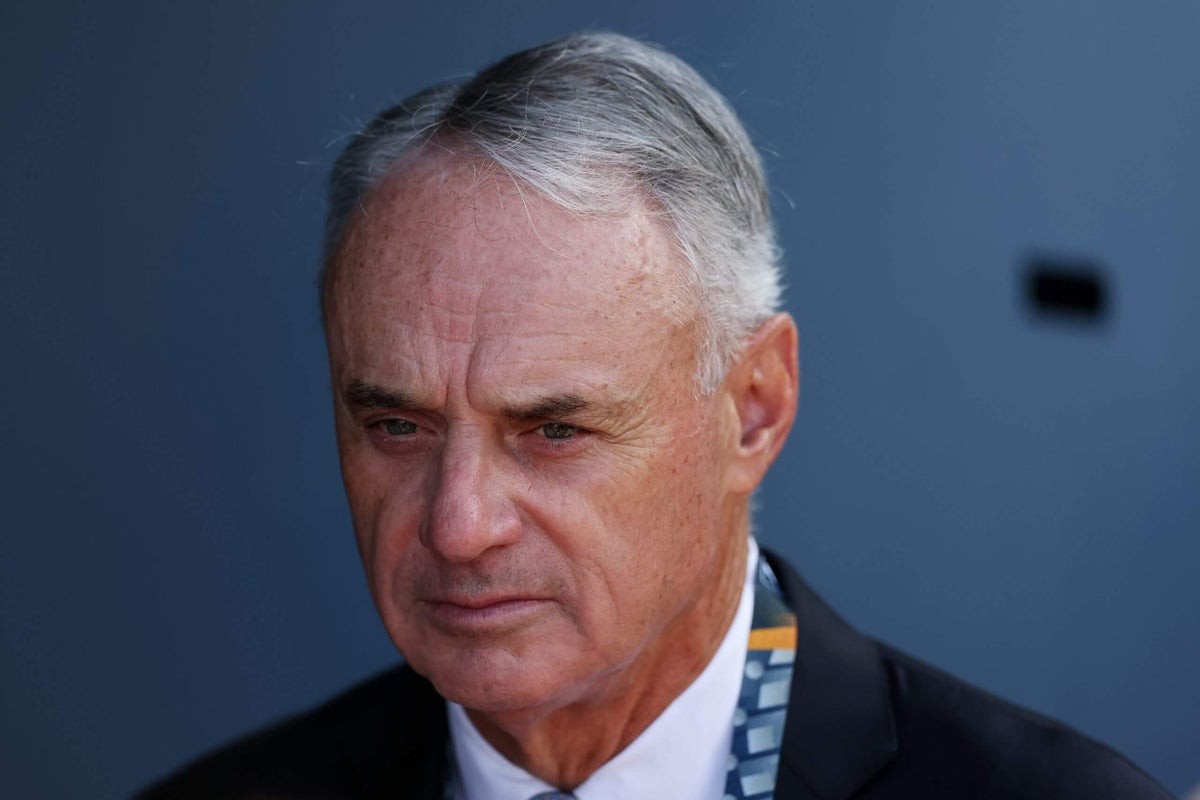
Major League Baseball commissioner Rob Manfred stumped for a free-agent signing deadline in a radio interview Thursday, one day after slugger Brent Rooker of the Athletics said on social media that a deadline was “pretty close to the most anti-player idea you could possibly have.”
Tony Clark, the head of the players’ union, then warned Manfred could be veering into a “self-defeating calculation of massive proportions” after Manfred said he didn’t buy the players’ argument against the deadline: that it would lead to subpar contracts for players.
Manfred indicated he’s indeed likely to again propose a signing deadline during this year’s upcoming labor negotiations.
“I think there’s going to be some more conversation about it, because I do believe that there’s a marketing opportunity,” Manfred told WFAN hosts Craig Carton and Chris McMonigle. “Let’s face it, we operate in a really competitive environment. Just put entertainment, generally, to one side — just sports, right? It’s really competitive. And I think that you make a mistake, particularly during the offseason, when you don’t take every advantage to push your sport out in front of your fans during that down period.”
Baseball free agents can sign during spring training or even once the season has begun. Fans, media and industry officials often raise the deadline discussion when free agency goes slowly, as it has this winter.
“I can only tell you what they said. I don’t know what was in their heads,” Manfred said when asked how players thought about the matter. “But what they said back was, they thought that kind of deadline would work to the disadvantage of the players. And you know, I just — I don’t put much credence in this.”
Clark responded forcefully.
“Free agency thrives when competition thrives — on and off the field,” Clark said in a statement to The Athletic. “If the owners are genuinely interested in improving free agency, there are many ways to get there, and we look forward to having that discussion in the coming months.
“But if their true interest is to blow up the very system on which our streak of uninterrupted seasons has been built — with the game reaching record heights and poised to go even higher, no less — that would be a self-defeating miscalculation of massive proportions.”
Manfred told WFAN his goal is to keep a full schedule of 162 games intact for 2027, the first season of the next collective bargaining agreement.
The current deal expires in December.
Agent Scott Boras represents three of the biggest names still on the market: Cody Bellinger, Alex Bregman and Ranger Suárez. Boras said Thursday he opposes a deadline, a position he’s long held.
“The sole purpose of deadlines (is to) simply restrict competition and deny players the true market,” Boras said by phone. “Our current rules allow for ultimate roster construction and the best possible team for a season. (A deadline is) not for competition reasons. Every owner wants the opportunity for time to allow him to respond to changes by his competitors. That’s why there’s been many significant signings more in late January, February and March, because owners have responded.”
Kyle Tucker, Bo Bichette and Framber Valdez are among the other standout players available this winter. Boras said he thinks the market has been slow, but only for certain types of players.
“Yes, certainly for the premium position players and the premium starters, it has,” Boras said. “For relief pitchers and closers, no.”
Others see some potential for a deadline system, but they have unanswered questions.
Joel Wolfe, head of the Wasserman agency’s baseball division, has seen positive results with deadlines when clients have joined MLB from abroad. The posting process for Japanese pro players includes a signing window.
“If there was a way to re-create the exceptional efficiency of the posting system for all the free agents, I would certainly be interested in that,” said Wolfe, who represents Los Angeles Dodgers pitchers Roki Sasaki and Yoshinobu Yamamoto. “But I have yet to see a good answer as to what happens to the FA’s if they go unsigned that doesn’t unfairly prejudice them. MLB teams always seem to find a way to game the system and crush a large part of the class. I think it’s worth exploring.
“I just haven’t seen any great idea yet that benefits all the players.”
Rooker took the general idea to task on X, where he also asked why fans thought a deadline would make a difference.
“This is a genuine question that I am asking based on a lot of the replies,” Rooker wrote. “What difference does it make if a guy signs on Dec. 1 instead of Feb. 1? How does that extra 2 months negatively affect the experience as a fan?”
The commissioner thinks MLB could grab attention away from other sports.
“From the first of December to the 20th, if we had a period in there when all that free agency activity went on, it’s a great marketing opportunity for the game, at a point in the calendar when you’re not quite in the NFL playoffs, the NBA’s still kind of early,” Manfred said on WFAN. “It’s a great chance to kind of own some offseason weeks, which is crucial to selling tickets, selling season tickets. So that’s why I was interested.”
The league proposed a deadline in the negotiations that produced the current CBA and the 2017-21 CBA. MLB also proposed a deadline during talks held in 2019.
“After due consideration, we rejected their proposal as not being in the best interests of players,” Bruce Meyer, the MLBPA senior director of collective bargaining and legal, said in a 2019 statement. “We asked if MLB was interested in discussing other, more direct and tangible ways of incentivizing early signings and they weren’t at this time.”
Manfred doesn’t think a deadline would affect the money players make.
“Let’s face it, on both sides of these negotiations, there’s really sophisticated people who negotiate for a living all the time,” Manfred said. “You tell them whatever the hell the rules are, it’s all going to turn out the same no matter what — the money’s the money is the money.”