
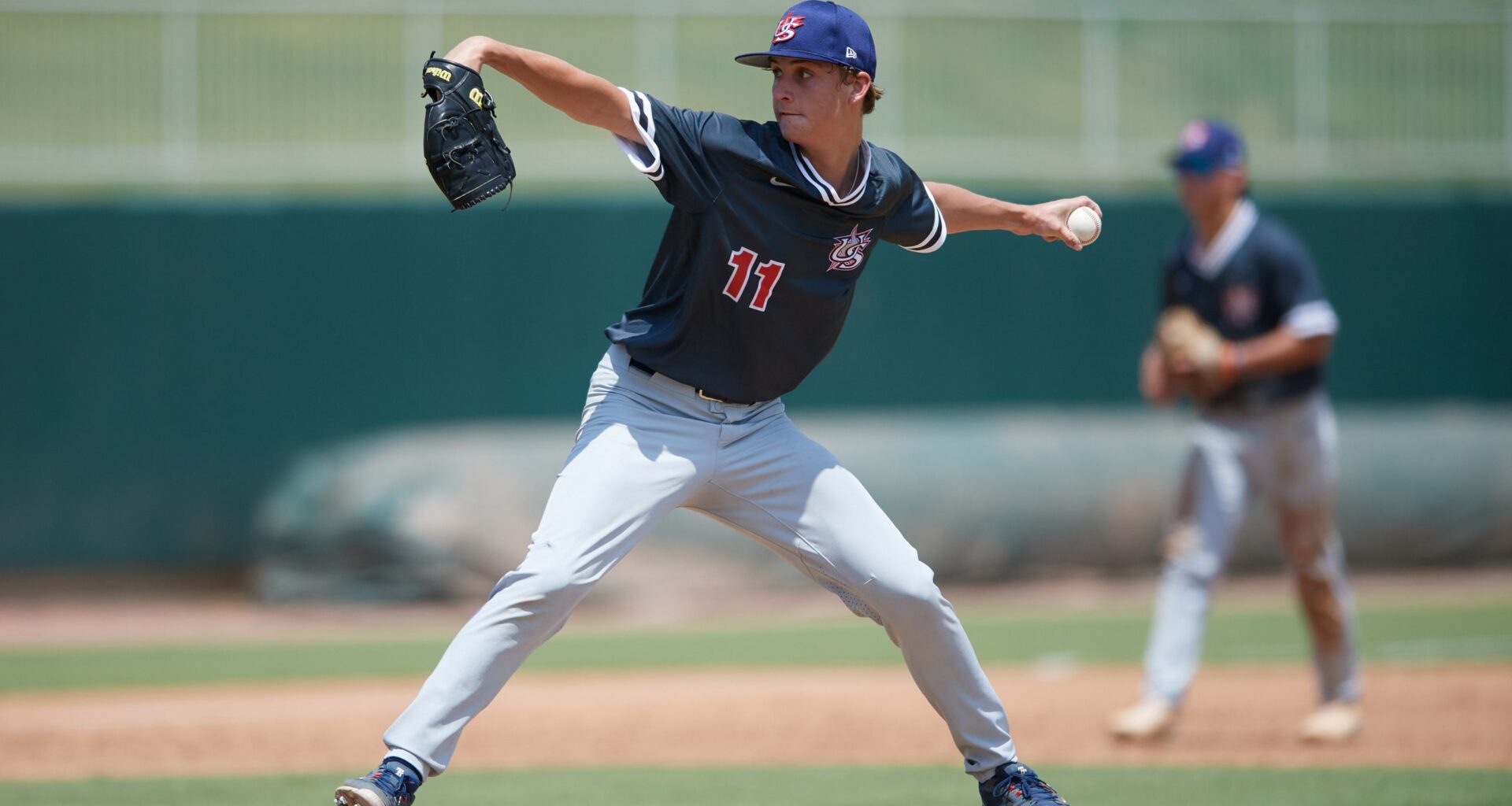
With college baseball’s Opening Day a little over a month away, Baseball America presents the top 25 freshmen who are in line to make an immediate impact for their respective programs in 2026.
Last year’s MLB Draft ranking was taken into account to compile the list, but so was each player’s fall performance and their projected long-term role. Players are listed in alphabetical order.
Stay tuned in the coming weeks as we continue to ramp up our 2026 college baseball preview coverage, including our preseason Top 25 next week followed by preseason award picks, conference previews, our initial Field of 64 projection and lots more.
Cameron Appenzeller, LHP, Tennessee
No team in the country has had a more hectic fall than Tennessee given former coach Tony Vitello’s move to the majors, but the Volunteers are in great hands with Josh Elander now at the helm. Appenzeller was the crown jewel of Vitello’s final recruiting class, and he is in line to log meaningful innings in 2026 after drawing legitimate top two-round draft interest and opting to honor his commitment to the Vols.
At 6-foot-5 and 180 pounds, Appenzeller is a solid athlete with a repeatable delivery and plenty of projection remaining. His fastball has been up to 94 mph with life through the zone to go along with two distinct secondary offerings. Appenzeller’s high-70s-to-low-80s slider features two-plane bite and has plus upside, while his mid-80s changeup flashes plenty of fade and is a real weapon against righthanded hitters. Throughout his time in Knoxville, expect Appenzeller’s velocity to continue to tick up and his pure stuff to get more dynamic.
Jack Bauer, LHP, Mississippi State
The highest-ranked player on the final BA 500 to make it to campus, Bauer was the headliner of the Bulldogs’ 2025 recruiting class.
Last spring, he cemented himself as the hardest-throwing prep lefthander of all-time after touching 102, though he’s not a one-trick pony. On top of his explosive fastball—which eclipsed triple digits in both of Mississippi State’s scrimmages this fall—Bauer routinely spins his sharp breaking ball in the 3,000 rpm range, and his low-to-mid-80s changeup has also flashed. His secondary offerings and pitchability need refinement, but there is an unbelievably appealing foundation in place with Bauer.
At 6-foot-4 and 190 pounds, Bauer has room to continue to fill out. He has plenty of arm speed and gets to his top-of-the-scale velocity with relative ease. If Bauer can compete in and around the zone on a consistent basis while flashing his premium stuff, he very well could be a first-round pick when he’s next eligible for the draft in 2028.
Alec Blair, OF, Oklahoma
From a pure athlete standpoint, Blair was one of the best in the 2025 draft class. On top of his ability on the diamond, he was also a four-star basketball recruit and was slated to play both at Oklahoma until early November.
While his swing can get out of sync and isn’t the most fluid looking, Blair’s power upside is monstrous. If he fills out physically, there’s a chance he grows into true plus power before too long.
For someone of his size, Blair moves quite well and has turned in plus run times. His length, athleticism and speed allow him to cover plenty of ground in center field, though if he were to move off the position, it will likely be to left field given his fringy arm.
Carson Brumbaugh, INF/RHP, Arkansas
The headliner of Arkansas’ fifth-ranked 2025 recruiting class, Brumbaugh hit the ground running this fall. At 6-foot-2 and 195 pounds, he has a strong, athletic frame to go along with a smattering of impact tools. He has big-time bat speed that yields plus raw power, and if he can limit his swing-and-miss, there’s a chance his game power also grades out as plus. He’s done well at mitigating whiffs this fall while consistently generating quality contact.
On the dirt, Brumbaugh’s plus arm, solid hands and speed all profile well at shortstop. His arm strength is perhaps Brumbaugh’s loudest tool, and even if he ends up moving off shortstop in the future, it will more than play at third base.
While Brumbaugh certainly fits into the position player bucket long term, he also projects to make an impact on the mound during his time in Fayetteville. His fastball has been up to 96 mph to go along with a solid low-80s slider and a more firm upper-80s changeup.
Arkansas’ crop of position players is a talented one, but don’t be surprised if you see Brumbaugh’s name penciled into the starting lineup come Opening Day.
Dominic Cadiz, 3B, UCLA
Cadiz was one of the best performers in the West Coast League regardless of class. A 15th-round pick by the Brewers last summer, Cadiz lit up the WCL to the tune of a .345/.454/.628 slash line with 14 doubles, nine home runs, 36 RBIs and a walk-to-strikeout ratio of 25-to-21.
The 6-foot-2, 205-pound infielder has a compact stroke with plenty of bat speed, and he has shown the ability to hammer the baseball to all fields. It’s no secret that UCLA returns almost all of its key producers from last year’s College World Series team, but expect Cadiz’s bat to force its way into coach John Savage’s starting nine at various points throughout the season.
Angel Cervantes, RHP, UCLA
Cervantes was selected No. 50 overall by the Pirates in this year’s draft but was unable to reach a deal. Instead, the true freshman will compete for a spot in UCLA’s weekend rotation.
A 6-foot-3 righthander, Cervantes just turned 18 in August and has an appealing blend of starter traits and advanced pitchability. He has a simple, repeatable delivery in which he attacks from a three-quarters slot with plenty of arm speed. Cervantes’ fastball sits in the low 90s and has been up to 95 mph, but it’s his ability to command that stands out. Cervantes can locate it to both sides of the plate and the quality of his strikes stands out.
Cervantes’ low-80s changeup was one of the best in this year’s class, and it’s a no-doubt plus pitch. He does a nice job of maintaining his arm speed and gets great separation off his heater. He has a high-level feel for the pitch and can both locate it in the bottom half of the zone for strikes and consistently generate whiffs with it.
Cervantes rounds out his arsenal with a pair of high-spin breaking balls in a low-80s slider and a high-70s curveball. They’ll blend together in shape at times, but they both have above-average potential. Cervantes ties his four-pitch mix together with plus control, which helps his entire arsenal play up.
Brett Crossland, RHP, Texas
Standing 6-foot-5 and 240 pounds, Crossland is plenty physical and features a big league frame. He has a somewhat deep arm stroke and attacks from a three-quarters slot. Crossland last spring sat mostly in the low 90s with his fastball, but he has been up to 97 mph.
In addition to his heater, he features a pair of breaking balls in a tight mid-80s slider and an upper-70s curveball that is distinct in shape and flashes impressive depth. Both of his offspeed offerings have shown above-average potential, with the curveball flashing plus at times. Crossland rounds out his arsenal with a low-80s changeup that flashes healthy armside fade.
While his command can waver at times, Crossland has the look of a workhorse starter.
Uli Fernsler, LHP, TCU
Fernsler had top two-round interest in last year’s draft, and getting him to campus was a major recruiting win for coach Kirk Saarloos and his staff.
Listed at 6-foot-4 and 215 pounds, Fernsler is an advanced strike-thrower whose deception helps his entire arsenal play up. His fastball only sits in the high 80s/low 90s, but his delivery and flat vertical approach angle allow it to play up. Fernsler’s low-80s changeup and low-80s slider are both viable secondary weapons with above-average upside, and he completes his arsenal with a mid-70s curveball.
Fernsler was only 17 on draft day, and between his strikes, pure stuff, underlying traits and upside, he has a chance to soar at TCU.
Linkin Garcia, SS, Texas Tech
Garcia didn’t have the same draft buzz last spring as some of the other names in this piece, but he’s enjoyed one of the louder falls of any true freshman hitter and could be the Red Raiders’ Opening Day shortstop.
Garcia put up eye-popping numbers this fall, hitting .550 with four home runs across a sample size that eclipsed 50 at-bats. He posted a handful of exit velocities of 110 mph or better and should only grow into more impact as he continues to fill out physically.
Listed at 6-foot-3 and 190 pounds, Garcia has a lean and high-waisted frame. He stands tall in the box with a relaxed setup, generates easy bat speed and has shown a particular knack for creating leverage to the pull side. Garcia this fall flashed an advanced feel for the barrel and an intriguing hit-power combination.
On the dirt, he moves well at shortstop with range to either side and more than enough arm strength to handle the position. If Garcia ends up outgrowing shortstop, his defensive skill set would also translate well at third base.
Ethan Grim, RHP, Virginia Tech
Headlining this year’s group of newcomers in Blacksburg is Grim, who had tons of draft buzz last spring, but opted to honor his commitment to Virginia Tech. His performance on the summer circuit was particularly impressive, and between East Coast Pro and the Area Code Games, he struck out 11 of 19 batters faced.
Grim’s fastball has been up to 96 mph with life through the zone, and it consistently gets over the barrel of opposing hitters. He has a feel for both his upper-70s-to-low-80s slider and mid-70s curveball, and he rounds out his arsenal with a low-80s changeup for another pitch showing advanced feel.
Grim is perpetually in “attack mode” and he consistently competes in and around the strike zone. With an appealing blend of strikes and stuff, he is a safe bet to start long term.
Trent Grindlinger, C, Tennessee
Grindlinger ranked inside the top 100 on the final version of last year’s BA 500 and was one of the top prep players from the draft class to make it to campus. He flipped his commitment from Mississippi State to Tennessee in May 2025.
While he is tall for a catcher, Grindlinger’s plus arm and advanced catch-and-throw skills give him a strong chance to stick at the position long term. He performed well on the travel circuit, consistently generating quality contact while flashing a feel for the strike zone.
Grindlinger has above-average raw power and has demonstrated a knack for using the entire field.
Brayden Jaksa, C, Oregon
Jaksa was the crown jewel of Oregon’s 2025 recruiting class. He ranked No. 76 on the final BA 500 and will compete for meaningful playing time from the get-go.
At 6-foot-6, Jaksa is ultra-tall for the catcher position. He has above-average arm strength, but he’ll need to continue working hard at refining his overall defensive skill set to stick at the position. Even if he’s unable to stick behind the dish, Jaksa could be a nice fit in right field.
At the dish, Jaksa has above-average power, though it could eventually grade out as plus as he continues to add strength to his frame. He has minimal moving parts in his swing, and he’s a patient hitter with a feel for the strike zone.
Brock Ketelsen, OF/LHP, Stanford
It’s hard to not be incredibly excited when talking about Ketelsen after he flashed his tantalizing toolset this summer with the Corvallis Knights of the West Coast League, hitting .328/.467/.458 with 10 extra-base hits, 27 RBIs, 35 stolen bases and 29 walks to just 19 strikeouts. As a cherry on top, Ketelsen surrendered just one run and collected 19 strikeouts across 8.2 innings on the mound.
Ketelsen is a good athlete on the mound who’s armed with a low-90s fastball and a downer curveball. However, his future—especially in pro ball—is as a hitter.
In the box, Ketelsen has present bat speed, and his highest quality of contact comes to the pull side. At 6-foot-4 and 205 pounds, he has room to fill out physically and figures to grow into at least above-average power. Even though he’s long-levered, Ketelsen has flashed above-average bat-to-ball skills—especially against fastballs—and a sound approach. A plus runner with an above-average arm, Ketelsen has a chance to stick in center field.
Ketelsen is on his way to earning a spot in Stanford’s Opening Day lineup and has Freshman of the Year upside.
Jack Lafflam, RHP, Arizona
A 6-foot-6 righthander, Lafflam is tall and projectable with ample room to fill out his frame. He has a unique operation on the mound and deploys a high-spin fastball that’s been up to 97 mph with gloveside life.
Lafflam pairs his heater with a high-spin, mid-80s sweepy slider that regularly flashes above-average. He also throws a curveball in the mid-70s, though it lacks the bite that his slider has. To round out his arsenal, Lafflam possesses a high-80s changeup that will flash both tumble and fade.
There’s some reliever risk that stems from Lafflam’s delivery and whether or not he’ll throw enough strikes. However, if it all clicks, he has Big 12 Freshman of the Year upside in 2026.
Nico Partida, INF/RHP, Texas A&M
How Partida has performed this fall has made it awfully hard for Texas A&M coach Michael Earley to keep him out of the Opening Day starting nine.
A 6-foot, 190-pound infielder and righthanded pitcher, Partida has announced his presence in College Station with authority. While he doesn’t necessarily have a carrying tool offensively, it’s clear Partida knows what he’s doing in the box. He has good hands to go along with above-average contact skills and some thump, and this fall he homered in the Aggies’ first scrimmage.
On the mound, Partida’s fastball has been clocked as high as 98 mph, and he does a good enough job of filling up the zone with it. Partida’s mid-70s curveball is an average secondary that varies in shape. He completes his three-pitch mix with a low-80s changeup that flashes fade to the arm side, though he has the tendency to slow his arm down when delivering it.
Regardless of which side of the baseball it’s on, expect Partida to be a key player for the Aggies this spring.
William Patrick, OF, LSU
Patrick ranked as the No. 95 overall prospect on the 2025 BA 500 and currently sits inside the top 50 on our 2027 college draft prospect board. Not surprisingly, he is in line to make an immediate impact for the Tigers in 2026.
The 6-foot-2 outfielder possesses an exciting blend of athleticism, physicality and tools. Patrick has loads of strength in his frame and a simple operation in the box featuring quick hands and plenty of torque. While he has plus power upside, he will need to continue to shore up his hit tool. He showed swing-and-miss tendencies against some of the top arms on the travel circuit as a prepster.
Patrick is a double-plus runner whose plus arm and range translate well to center field.
Mason Pike, INF/RHP, Oregon State
Pike ranked No. 68 on the final iteration of the BA 500 and he heads into 2026 as one of the most prized freshmen in the country.
Pike has a chance to make an immediate impact on both sides of the baseball, but his ability on the mound is slightly more appealing. His fastball, which has been up to 97 mph, is a high-spin pitch for which he deploys two different shapes. In addition to his four-seamer, Pike’s sinker this fall has proven to be effective, with upwards of 18 inches of run.
Pike’s go-to secondary offering is a low-to-mid-80s sweeper that routinely flashes above-average. His mid-80s changeup is a clear third pitch. His strike-throwing can be inconsistent, but his pitchability took a step in the right direction last spring.
In the box, Pike is a switch-hitter with quick hands who has shown he can drive the baseball into either gap.
Brock Sell, OF, Stanford
Sell ranked as the No. 55 overall prospect on the BA 500 and had serious draft buzz last July. However, much like the overwhelming majority of Stanford commits in the last decade, he opted to take his talents to Sunken Diamond.
Sell has a short, contact-oriented stroke from the left side and advanced bat-to-ball skills to go along with a polished approach. He consistently puts together quality at-bats and is a nuisance—both in the batter’s box and on the base paths—for opposing pitchers to deal with.
Sell is a comfortably plus runner and high-level athlete, which, along with his solid arm, makes him a rather safe bet to stick in center field.
Omar Serna, C, LSU
Cade Arrambide will be the defending national champions’ primary catcher next year, but coach Jay Johnson will look to get Serna in the lineup whenever he can.
Serna withdrew his name from the 2025 draft in the weeks leading up to it, but he had no shortage of top five-round interest. He’s been a high-level performer this fall for the Tigers and has consistently generated quality contact. In last weekend’s scrimmage against Samford, he homered, and three of his batted balls had exit velocities of at least 107 mph.
At 6-foot-2 and 225 pounds, Serna is plenty physical, and both his arm strength and raw power grade out as plus. In fact, his arm is closer to double-plus than it is plus. Serna has tons of bat speed and is more than capable of driving the baseball with authority to all fields. His hit tool could use a coat of polish, and he’ll need to continue to work on his actions behind the plate, but Serna will have top two-round upside coming out of LSU.
Aiden Stillman, LHP, Vanderbilt
Vanderbilt has a couple other exciting freshman arms—namely Tyler Baird and Wyatt Nadeau, who was up to 100 mph last month—but Stillman appears to be in the best position to contribute right away.
A 6-foot-3 lefthander, Stillman has an appealing blend of strikes and stuff. He has a clean operation that includes a bit of deception and features a three-pitch mix. His fastball has been up to 95 with life, though between his present arm speed and projection remaining, its velocity projects to continue to tick up.
Stillman relies heavily on his heater, but he also has a solid feel to spin his high-70s-to-low-80s slurvy breaking ball. Its shape varies, and sometimes it will take on more of a slider look with more lateral break than depth and vice versa.
Vanderbilt has had a freshman arm take on a prominent role in each of the last few seasons, and that trend figures to continue in 2026 with a handful of quality arms set to make noise in the Music City.
John Stuetzer, INF, Florida State
Stuetzer also starred on the gridiron in high school, and he’s a double-plus runner who has experience both at shortstop and in the outfield. While he’s handled both, his defensive skill set profiles best on the grass.
Offensively, Stuetzer has demonstrated the ability to generate quality contact, but he’ll need to shore up his hit tool in order to be able to do so on a consistent basis.
Stuetzer was one of the Seminoles’ top newcomers this fall and very well could be penciled into the starting lineup come Opening Day. Even if he isn’t, Stuetzer is a name to watch both this spring and beyond down in Tallahassee.
Ty Thompson, SS, Auburn
Thompson presents an athletic look on both sides of the ball. He is an aggressive hitter with above-average contact skills and fares particularly well against fastballs.
Defensively, Thompson is a plus runner with enough arm strength to potentially stick at shortstop long term. With Ryne Farber and Chris Rembert projected to make up the middle of Auburn’s infield in 2026, it will be interesting to see where Thompson factors in. He could be in line for a more prominent role as soon as 2027.
Diego Velazquez, SS, Southern California
The big fish of this year’s group of incoming freshmen for USC is undoubtedly Velazquez.
Though he was just 17 on draft day, Velazquez already boasts an impressive blend of bat speed and physicality. He has a loose, easy swing from the left side and regularly works the middle of the field. He has a chance to possess an enticing hit-power combination when all is said and done, and he performed well this fall.
Defensively, Velazquez’s actions and smooth hands give him a chance to stick at shortstop, but his above-average arm also profiles nicely at third base if he needs to move off the position.
Charlie Willcox, RHP, Georgia Tech
Willcox ranked just outside the top 100 on the final 2025 BA 500, and landing him on campus was a major recruiting win for first-year coach James Ramsey.
The 6-foot-3 righthander has a strong, athletic frame and an easy operation that showcases his athleticism. Willcox has run his fastball into the mid 90s, though his best pitch is a high-spin curveball that flashes both depth and bite.
Willcox also features two distinct changeups, including a mid-80s offering that flashes fade at times and a true split changeup on which he does an excellent job killing spin. The spin rates on his split changeup regularly dip below 1,000 rpm, and it looks the part of a highly effective pitch to round out his arsenal.
Michael Winter, RHP, Texas
Winter was a key recruiting win for coach Jim Schlossnagle and company, as he was a late flip from Dartmouth to Texas. The 6-foot-5 righthander was a buzzy name last spring and had his fair share of momentum heading into the draft, but when all was said and done, he decided to honor his commitment to Texas.
Winter has a pro body and certainly looks the part. He has a clean delivery with a loose arm stroke, and his fastball sits in the low 90s and has been up to 95 mph. He supplements his heater with a high-spin slider that regularly flashes sharp two-plane tilt and lateral life, as well as a mid-to-high-80s cutter and a mid-80s changeup.
Winter boasts an exciting blend of “now” stuff and upside, and—while it may not be in 2026—he figures to pitch his way into the Longhorns’ weekend rotation before long. He’s shown well in-game this fall for the Longhorns and checks a number of boxes.