
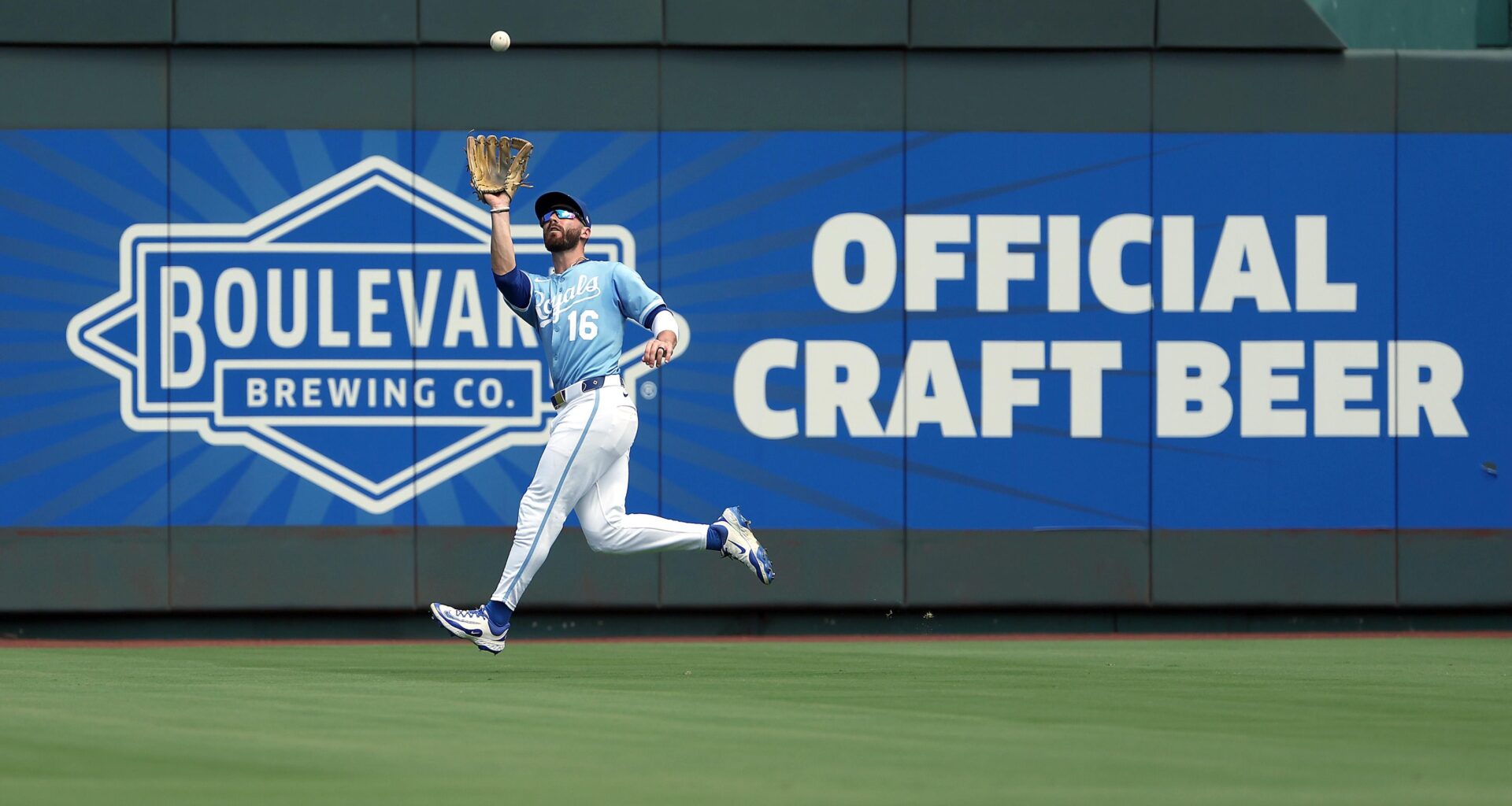
The Kansas City Royals are moving the majority of their outfield fences in by 10 feet, according to ESPN’s Jeff Passan.
“We want a neutral ballpark where if you hit a ball well, it should be a home run,” Royals general manager J.J. Picollo told Passan regarding the team’s reasoning for the move. “The second they start feeling like they can’t get the ball out of the ballpark, they start changing their swing. I watched it for years and years and years, and I just felt like this is the time to try to push it and see if everything we felt for however many years is accurate.”
According to Passan, center field will remain 410 feet from home plate. However, the power alleys are moving in from 389 feet to 379 feet.
“The fences will continue on that path, nine to 10 feet shorter, nearly all the way to the corners, where the 330-foot foul poles will remain. The height of the fence will also be shortened from 10 feet to eight-and-a-half,” Passan added.
The Royals are expected to announce the decision on Tuesday, per Passan. The front office reportedly had internal discussions for years about changing the field dimensions. Then the organization connected with its analytics department months ago for a “palatable middle ground between the fly ball dead zone of Kauffman Stadium and other stadiums where home runs soar at extreme rates.”
It seems as though they came to a suitable conclusion.
According to Baseball Savant, Kauffman Stadium had a home run factor of 83 (with 100 being average) last season. That ranked 27th in MLB.
Baseball Savant offered an explanation of what the numbers mean in more detail:
“Statcast park effects show the observed effect of each displayed stat based on the events in the selected park. Each number is set so that “100” is average for that metric, and the park-specific number is generated by looking at each batter and pitcher, controlled by handedness, and comparing the frequency of that metric in the selected park compared to the performance of those players in other parks.
For example, the 135 HR mark for 2018-2020 at Great American Ball Park does not mean the Reds hit 35% more home runs at their home park. It means for batters and pitchers who played both at GABP and elsewhere, 35% more home runs were observed at GABP.”
In short, though, it’s harder to hit a homer in Kauffman Stadium than it is for the vast majority of the league.
So it’s easy to see why the Royals, who were 26th in MLB (and last in the American League) with 159 home runs last year, wanted to make the move. Only four of their players had 10 or more homers, and three players (Vinnie Pasquantino, Salvador Perez and Bobby Witt Jr.) accounted for more than half of them (85).
Pasquantino offered a thoughtful response to the decision on Tuesday.
The Royals showed promise and improvement in 2024 following a 56-106 season in 2023, making the playoffs as an 86-win Wild Card team and reaching the American League Division Series, where they fell to the New York Yankees in four games.
Last year’s team regressed a bit at 82-80, but the Royals certainly have the talent in place to make another run for the division title. Moving the fences in (and decreasing their height) can certainly help boost the offense as Kansas City fights for the AL Central.