
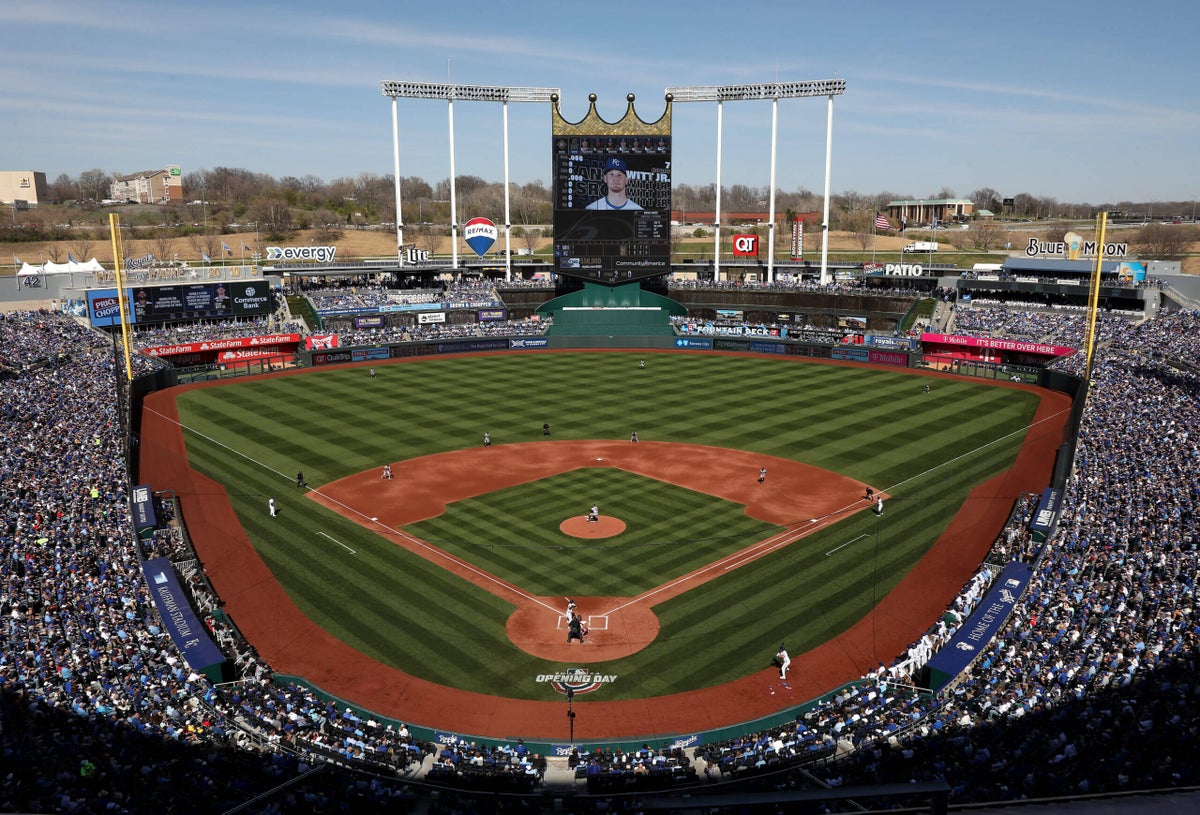
Even as the Kansas City Royals returned to postseason relevance the past two seasons, they continued to hit fewer home runs than almost any other playoff contender. On Tuesday, the team announced a move intended to change that.
It wasn’t a free agent signing or trade for slugger. Instead, the Royals announced a change to their outfield dimensions, moving the wall at Kauffman Stadium in eight to 10 feet and also lowering it by roughly a foot and a half.
In a press release announcing the changes, the Royals acknowledged the decision was made by their baseball operations department “for competitive reasons” to help Kauffman Stadium play more like other Major League ballparks.
“Making this a fairer ballpark will help with roster construction, but more importantly will allow our players to keep the same approach regardless of where we play,” vice president of research and development Dr. Daniel Mack said in a released statement. “Our approach was carefully considered to account for as many factors as possible. We believe this will ultimately reduce the constraints within Kauffman Stadium.”
By average fence distance, Kauffman Stadium will remain one of the biggest parks in Major League Baseball — especially to straightaway center field — but in a press conference on Tuesday, general manager J.J. Picollo said internal analysis showed that a modest change of eight to 10 feet was the sweet spot in which the Royals could generate an offensive boost without an extreme overcorrection or diminishing return.
The Royals’ lease at Kauffman Stadium expires after the 2030 season.
“From a competitive nature,” Picollo said, “we felt like this was a good time and a unique time for us to look into how we could secure wins, put our team in a good position to win ballgames, knowing our roster, knowing how long we’ll be in this ballpark, and in the end, we weren’t surprised overall with what the research told us.”
Picollo emphasized that the Royals wanted to create a “fair” ballpark, not one that plays to either extreme.
“It’s simply, when a ball’s hit well, you will be rewarded,” Picollo said.
Picollo and Mack noted that their research suggests the Royals’ best player, perennial MVP candidate Bobby Witt Jr., has been among the players most negatively affected by Kauffman’s massive dimensions, and they expected the adjustment to help his fly ball run production, especially his opposite field power. It’s worth noting that Witt is 25 years old, in his prime, and signed through at least the 2030 season. Witt has helped push the Royals back into contention the past two years.
After losing 106 games in 2023, the Royals made the playoffs in 2024. They missed the playoffs last season but again had a winning record. In those two resurgent seasons, though, the Royals hit just 329 home runs, ahead of only the rebuilding Pirates, Nationals, White Sox, Marlins and Cardinals. The average wall distance at Kauffman was 384 feet, second deepest in baseball behind only Coors Field in Colorado (where the fences are pushed back to account for higher elevation that makes the ball fly). At Kauffman, the deep outfield resulted in a higher-than-average number of doubles and triples — it was the third-most triple-friendly park in the league last year — while significantly suppressing home runs. The Statcast park factors in 2025 ranked Kauffman as the fourth-worst home run park in the majors ahead of only Progressive Field in Cleveland, Oracle Park in San Francisco, and PNC Park in Pittsburgh. In franchise history, only five Royals have ever hit more than 34 home runs, and only two — catcher Salvador Perez and first baseman Vinnie Pasquantino — hit more than 23 homers last year.
“Hitters like hitting at the K because the visuals are nice but everyone also agrees it’s been a pitchers park forever,” Pasquantino wrote on X. “What this means is that you can’t hit cheap homers. That’s literally all a hitter saying a park is a hitters park or not means. But the data firmly supports it being a hitters paradise because you can get more singles doubles and triples. Will the park factor actually go down if it’s more of a neutral park because there will be less triples even if there is an uptick in home runs?”
Please don’t read this is you don’t care. This is too long and after I wrote it I felt dumb but I’ll still put it out there. At the end of the day our job is go win games that’s it.
I’m just going to respond like an adult.
I’m very curious how this is going to play out in… https://t.co/DFqbY7WVjt
— Vinnie Pasquantino (@VPasquantino) January 13, 2026
The Royals hope that this helps hitters who are putting quality swings on the ball no matter what their power potential.
“The guys who have had the most success in his ballpark,” Picollo, “are the ones that didn’t get out of their swings, that just took their doubles.”
At their best, the Royals have built their teams on strong pitching and a contact heavy offensive approach. That was true the past two seasons, and when they last won the World Series in 2015. When the Royals made the playoffs in 2014, first baseman Eric Hosmer hit a Kauffman Field triple off the outfield wall that might have otherwise been a home run, and then-GM Dayton Moore later grumbled: “We should have made that wall lower.”
Picollo mentioned the Hosmer triple again on Tuesday.
“That’s a homer now,” he said.
Renovations are expected to be complete at least 10 days before the Royals home opener, and Picollo said the changes are expected to cost less than $5 million. The outfield wall will come in eight to 10 feet starting in the outfield corners and tapering toward center field, where the wall will remain 410 feet from home plate (keeping Kauffman one of the deepest parks to straightaway center). The gaps will go from 387 feet to 379. The height of the wall will drop from 10 feet to 8 1/2 feet in most places, and the additional space behind the wall will allow more than 200 seats to be added.
According to the team, internal analysis suggests the changes “will take the run value of fly balls at The K from the bottom third of MLB ballparks to the middle, primarily through more extra-base hits.”
That should be good news for Witt and middle-of-the-order sluggers Perez and Pasquantino, but also for young right fielder Jac Caglianone, whose tremendous raw power resulted in only a .295 slugging percentage in his big league debut last season, and offensive super-utility man Jonathan India, who hit just four home runs at home last year after hitting 11 in his home park with the Cincinnati Reds the year before. It’s less of a boon for the pitching staff, but Picollo said the team’s research suggests their specific staff is relatively well-suited to this type of park.
“Clearly when we look at the projections, our offense comes out far ahead of maybe the negative impact it could have on our pitchers,” Picollo said.