
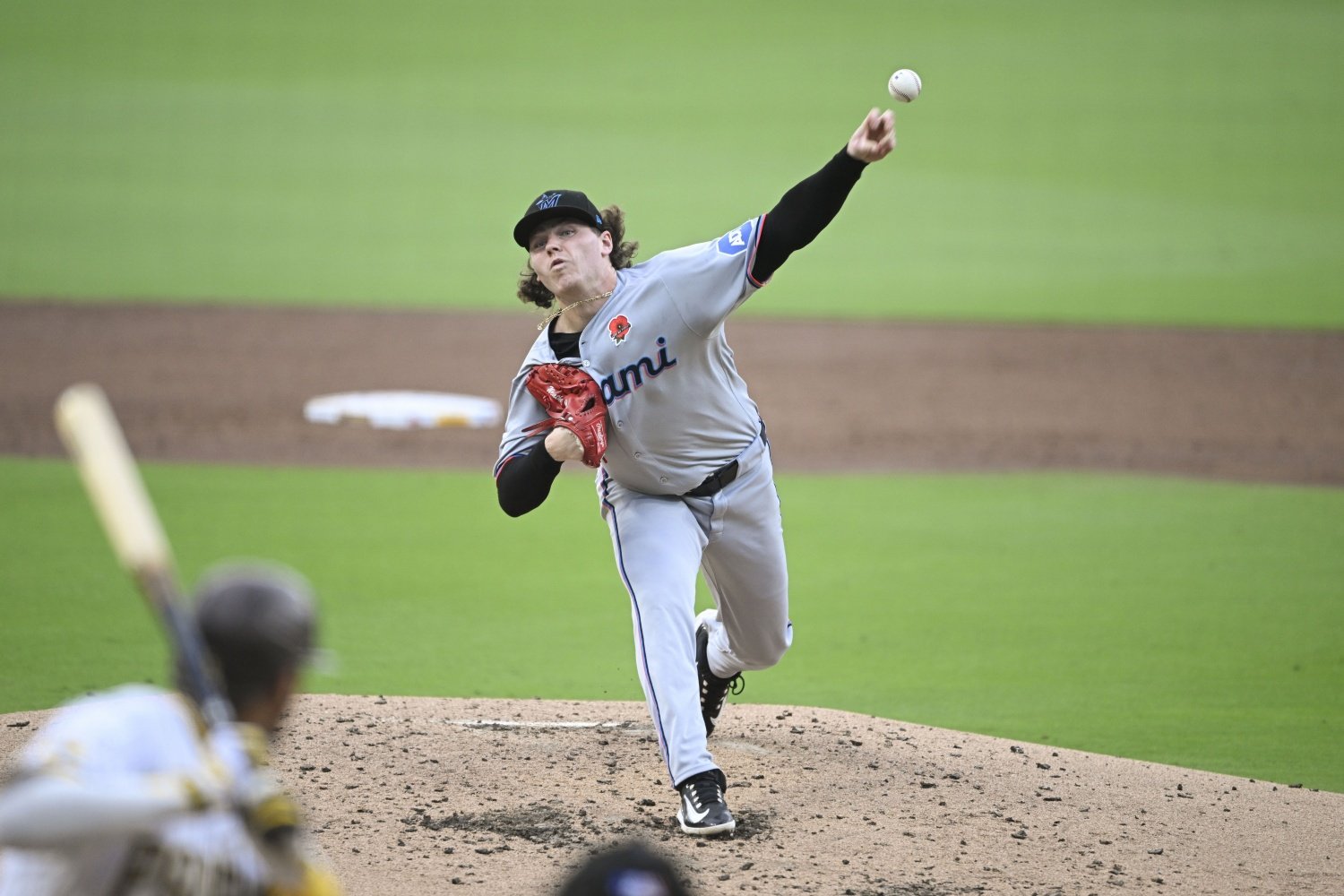
The New York Yankees wanted to use outfield prospect Dillon Lewis as the centerpiece of a trade to bolster their starting rotation, but the Brewers were never going to accede to a deal focused on Lewis in exchange for Freddy Peralta. Thus, New York circled back to the Miami Marlins Tuesday, after missing out on Edward Cabrera with a bid that had also included Lewis. This time, they got a deal done, packaging Lewis and three other prospects to acquire left-handed hurler Ryan Weathers from the Fish.
Lewis held some appeal for the Brewers, but the Yankees’ efforts to pump his value this winter worked better on some other teams than they did on the Milwaukee front office. The Crew also liked Brendan Jones, a speedy outfielder who served as a secondary piece in the deal and will join Miami’s farm system, instead. Thus, for the Yankees to land Peralta now, the two sides would have to start almost from scratch.
We can’t dismiss the possibility that the Yankees will still make a play for Peralta, but it’s now more remote. In theory, New York has more depth in their rotation now, but most of their penciled-in starters either will begin the season on the injured list or seem like safe bets to land there eventually. Weathers is under team control for three more seasons, which matches the term for which they control Luis Gil—the hurler the Brewers wanted as the big-league anchor in a deal for Peralta. Brian Cashman could try to build a new, higher-echelon prospect package to entice the Brewers, swapping Gil for Peralta at the cost of more farm system punch but backfilling Gil’s spot with the equally talented and equally fragile Weathers. On balance, though, that’s unlikely.
The Yankees are at least the third team to take an active interest in Peralta this winter, only to end up solving their rotation problems with different deals. The Orioles could still be in the market for a free-agent starter, but they spent the capital they might have included in a Peralta deal in acquiring Shane Baz from the Rays, instead. The Astros not only signed Tatsuya Imai to replace the departing Framber Valdez, but traded for Mike Burrows of the Pirates.
Weathers, Baz and Burrows all have multiple years of club control remaining, which made the teams acquiring them more comfortable sending significant prospect capital the other way in trades. The Cubs were certainly never going to trade for Peralta, given the competitive tension between those two teams right now, but they, too, demonstrated their preference for a longer-term solution by trading for Cabrera. Even the Red Sox, who surrendered a modest return for Sonny Gray from the Cardinals, also traded the tantalizing Jhostynxon García to the Pirates for more team control over Johan Oviedo.
Suitors remain. The Diamondbacks, Giants and Padres all need rotation help if they want to contend for playoff berths in the increasingly competitive National League, and each has at least checked in with Milwaukee this offseason about Peralta. It’s not clear what the team from the northwest suburbs of Atlanta could offer for Peralta—their farm system is weak—but they have some measure of interest. The Mets and Dodgers boast two of the game’s deepest farm systems. The Queensmen desperately need a starter to anchor a shaky rotation, while Los Angeles is shopping for capstones for a roster hunting a threepeat.
None of those six teams make as neat a fit for Peralta as others have seemed to, at various points this offseason. As has been true all along, the Brewers themselves feel little pressure to move him. The pending disruption of their local broadcast distribution (and, thus, revenue therefrom) could ratchet that pressure up slightly, but it’s more likely the Brewers will simply eschew hoped-for secondary spending, if needed, than that they’ll take a reduced return just to shed an $8-million obligation for 2026. With each of the trades mentioned above, the chances that the team gets the kind of offer they’ll demand have dwindled. Eventually, a team will have to increase its bid, or the team will hold onto its All-Star righty.
Perhaps the more intriguing notion is of the Brewers themselves putting a controllable starter in play. If the robust offers that might inspire them to trade Peralta are being reserved for pitchers who will be around through at least 2028, could Milwaukee get the juicy prospect recharge they’re looking for by trading Aaron Ashby or Robert Gasser?
The markets for those pitchers might not be as fevered, but they would include more teams. Every club tries to accumulate both talent and club control. Peralta only offers one of those two things. While he’s more talented and more accomplished than Baz, Burrows, Cabrera, Oviedo and Weathers, he’s also a rental. So far, the Brewers have insisted that if a team is to nab him, they need to pay controllable pitcher prices, to reflect both Peralta’s raw on-field value and the utility of his below-market $8-million salary.
Late in the winter, small-market teams get their chance to shine. The Brewers won’t tiptoe silently all the way to spring training. They’re unlikely to make a major financial outlay, but they will continue refining the roster. Trading Peralta could still be part of that, but the lineup of likely partners in a trade has changed as the offseason has unfolded. Each team (effectively) eliminated from consideration clarifies the market, but the Brewers hold the trump card: They can choose whether or not to transact even on the highest offer they get, so they control the market, even with fewer teams whom they can use to apply leverage to the others.