
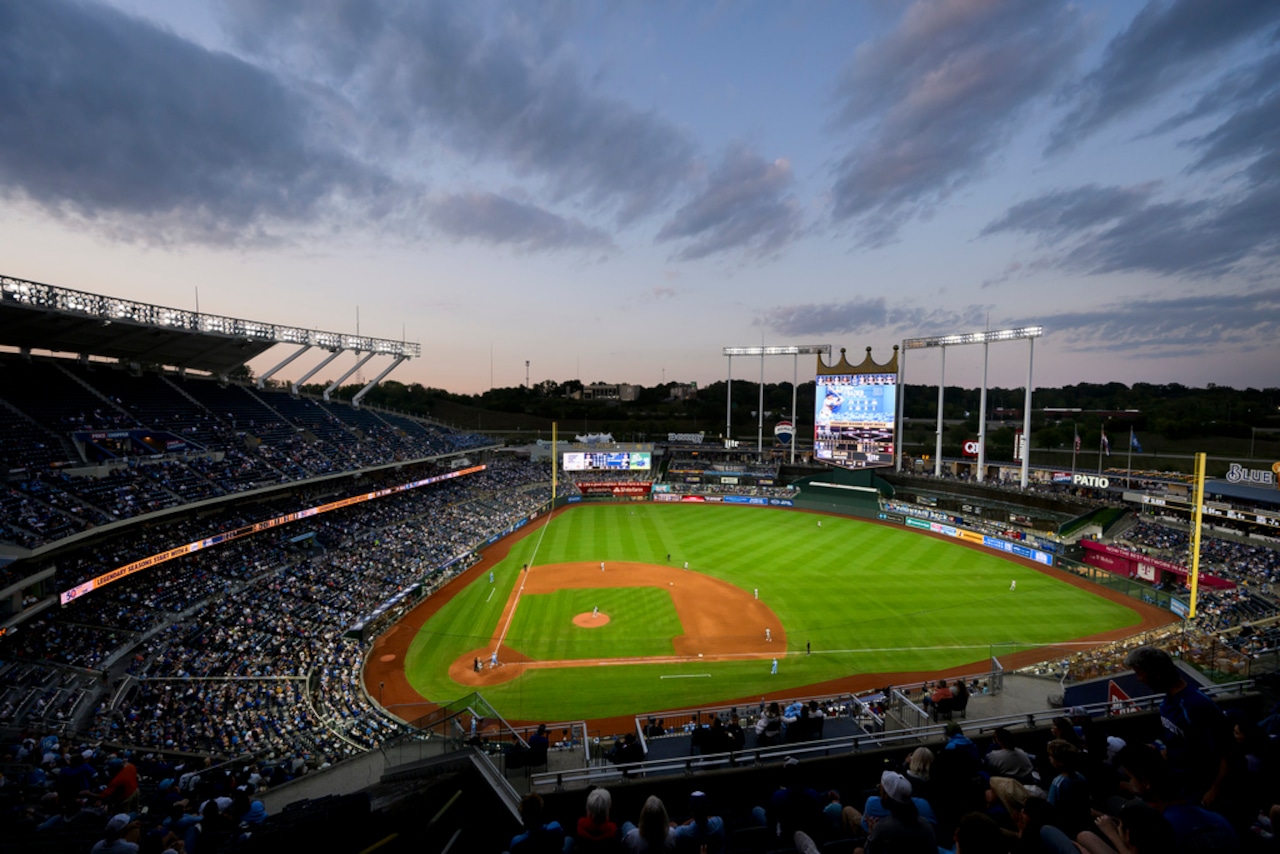
CLEVELAND, Ohio — The Kansas City Royals have officially joined the growing list of MLB teams altering their ballpark dimensions in recent years, announcing plans to move in the fences at Kauffman Stadium for the 2026 season. This decision reignites a debate about ballpark identity and whether teams should adjust their dimensions to suit their rosters.
Cleveland.com’s Joe Noga didn’t mince words about the trend during a recent episode of the Cleveland Baseball Talk Podcast: “This goes back to the debate that we had last, last season with Baltimore moving their fences for the second time. Like I said, ballparks aren’t made to be transformers. They aren’t made to shift shapes every other year or look different.”
Kauffman Stadium has long been known as one of baseball’s most difficult home run environments while simultaneously being a paradise for doubles and triples. The Royals’ decision to move the fences in nine feet at the corners and ten feet in the alleys while lowering the walls from over ten feet to approximately eight and a half feet represents a significant shift in the park’s character.
Paul Hoynes of cleveland.com contextualized the move: “They finished last in the American League in runs scored last year with 301 runs at home. They still hit for a decent batting average .249, but they only hit 70 home runs at ranked 27th in the big leagues.”
The Royals’ calculation appears straightforward — sacrifice some of their pitching advantage for increased offensive output. “The front office has made a decision. This will help the offense more than it will hurt their pitching staff. Offense, I guess, wins in this situation,” Hoynes noted.
But the decision raises larger questions about roster construction and free agent recruitment. As Noga astutely asked: “Does this make the Royals a more attractive destination for an offensive player as a free agent? Does this make the Royals a less attractive destination, sort of like the Rockies, where pitchers don’t want to go there because their numbers are going to be skewed?”
This dynamic has precedent. Hoynes and Noga recalled Juan Gonzalez’s reluctance to remain in Detroit after playing in spacious Comerica Park, which eventually had its own fence adjustments.
The changes will undoubtedly benefit Kansas City’s core of young sluggers like Bobby Witt Jr., Vinnie Pasquantino, and veteran catcher Salvador Perez. But the question remains whether altering a ballpark’s fundamental character is worth the potential long-term consequences for team identity and player recruitment.
With these changes, Kauffman Stadium joins a growing list of ballparks that have undergone dimensional adjustments in recent years. This trend toward homogenization raises legitimate concerns about whether MLB is sacrificing the unique characteristics that have historically made each ballpark special.
Read the automated transcript of today’s podcast below. Because it’s an AI-generated transcript, it may contain errors and misspellings.
Podcast Transcript
Joe Noga: Welcome back to the Cleveland Baseball Talk Podcast. I’m Joe Noga joined by Paul Hoynes. Hoynsie, just to recap something we talked about at the end of Tuesday’s podcast, we, we, we want to mention the Guardians inviting former Washington Nationals first round pick Carter Keiboom to spring training. They signed Kee Boom to a minor league deal. Just what, what can we expect from Keiboom this season and, and where he slots into the spring training sort of competition and mix there. What were the Guardians hoping in signing Kee Boom and bringing him in, you.
Paul Hoynes: Know, another right handed hitter. Joe, he’s on a minor league deal. You know, he’s, he’s former number one pick as you said of the Nationals and he’s coming off a strong season at AAA with the, with the Angels. He only played, I think he got called up briefly at the end of the season for three games. But this isn’t a guy that you know, can move around the infield. He can play first base can and just you know, kind of another kind of shot in the dark. You know, obviously he has, you know, good pedigree. He’s had some good numbers in the minors, played parts about four or five seasons with the Nationals and didn’t really get on track so far in the big leagues.
Joe Noga: Yeah, he was a first round pick out of high school. Took a little a while to develop and in coming up with the Nationals I actually remember seeing him in the Futures Game when the Futures Game was played in a progressive field back in 2019, watching him as part of the group there and it just seems like he never really hit that consistency level with the, the Nationals. But a guy who spent last season basically at AAA hitting.319 in the Pacific Coast League, you know, that tells me that he can at least put the bat on the ball. Whether or not he’s been able to unlock the, you know, the power potential that there remains to be seen but versatility and basically he swings the bat from the right side of the plate and that’s the, the Guardians are, are, are, are needing and have been needing for a while. If, if an opportunity presents itself we, we might see him at some point get a shot with the big league club.
Paul Hoynes: Yeah, no doubt about it. I’m not sure how many options he has left or if he does have any options. He probably, you know, he probably doesn’t. I, I would have mentioned.
Joe Noga: No, I, I think he’s, I think he’s out for sure.
Paul Hoynes: He’s, you know, he’s 28 years old. So it’s kind of one of those deals where you know, if he doesn’t make the club out of spring tr, go to AAA and wait for an opportunity or perhaps he becomes a free agent at the end of spring training if he doesn’t make the club. But you know, certainly, you know, somebody with some experience, he’s not going to get in the way of anybody. You know, he’s kind of a non threatening sign. He’s not going to steal at bats from any of their prospects but he could, you know, help them especially the way vote, you know, mixes and matches his lineup of according to who they’re, who they’re facing on the mound.
Joe Noga: Yeah, I like the way you put that. He’s not going to be sitting there in the clubhouse getting in the way of the development of a guy like a Kyle Manzardo. He’s not going to get in the head of a guy like Kyle Manzardo who’s not going to have to look over his shoulder at a more veteran player like Kibum and think oh, is this guy going to take away at bats or take, take opportunities away from me? They sort of not only want to clear the, the Runway physically, they, they kind of want to clear the Runway mentally for Kyle Manzardo as well. So keep him in a good headspace in terms of you’re the guy, you’re, you’re who they want at first base and DH and in that role and like you said, non threatening signing. I like that. Now Hoynsie, it’s, it, you know, sort of really describes the way that this, this could work out for the Guardians but a really good insurance policy just in case something goes terribly wrong.
Paul Hoynes: Yeah, and you know, Stuart Fairchild is the other right handed hitter they’ve signed and invited to camp on a minor league deal. He’s an outfielder, Boom’s an infielder. You know, it kind of makes sense that both these guys are in the same boat and I’m sure could help them if they, you know, either make the club out of camp or, or agree to go down and, and wait it wait for a chance at Triple.
Joe Noga: A. I can’t wait for Hammy’s first home run call from Keiboom just to, to hear what he comes up with. But could be an interesting summer. Who knows. All right, you know, big, big news out of Kansas City this week as the Royals have announced that they are going to move their outfield fences in at Kaufman Stadium for this season. It’s been quite a while since they’ve adjusted the, the fences there at the ballpark, which plays as one of the notoriously most difficult home run ballparks in all of baseball. The numbers offensively are really good there because it’s a big outfield and the, the, the gaps and the, the power rallies are places where a lot of triples and, and doubles happen. But it’s, it’s hard for players to, to hit home runs. There has been. And when you’ve got a lineup that features guys like Bobby Witt Jr. And Vinnie Pasquantino, Jack Caglione, you’re gonna want to give these guys every opportunity. This goes back to the debate that we had last, last season with Baltimore moving their fences for the third time in four years or however many times it was. And I remember I used the line in discussing this and I said, you know, ballparks aren’t made to be transformers. They aren’t made to shift shapes every other year or look different. You know, you build a park, you set up the dimensions and that’s how you should play. This just seems like you’re overcompensating for something. Hoynsie, what did you think when you heard Kansas City was moving in the fences at Kaufman Stadium?
Paul Hoynes: Well, Joe, I wasn’t really surprised because they finished last in the American League and run scored last year with, I should say at home. 301 runs at home. As you know, as you said, they still hit for a decent batting average.249, you know, but they, they only hit 70 home runs at ranking 27th in, in, in the big leagues. And you know, overall, overall, you know, for the season they, you know, they had trouble scoring runs just as the Guardians had trouble scoring runs. You know, as far as left handed hit power hitting goes, Coffin Stadium is really a tough ballpark for left handed power hitters. And Vinnie Pasquantino hit 32 there last year. But their number one pick, Jack Caglioni struggled pretty much when he got his, you know, a couple shots at the big leagues last season. So I’m sure they’re moving, you know, they’re doing that with, with that in mind and they’ve, it sounds like they’ve made a decision that, you know, they have a pretty good pitching staff and that they, that, that they, you know, the front office has made a decision. This will help the offense more than it will hurt their pitching staff. You know, offense I guess wins in this, in this in situation. But we’ll have to see how it unfolds. It doesn’t sound like Joe, they’re making really big Moves, they’re moving the fence at the corners, they’re moving the fence in nine feet. And in the center field alleys they’re moving it in 10ft. You know, in the alleys. That’s probably significant. It sounds like they’re lowering the walls as well a little bit.
Joe Noga: Yeah, the walls there were I think over 10ft high and I think they’re lowering them to like eight and a half feet or something in that range. You’re going to see more home runs at, at Kaufman Stadium. It should be a significant number more home runs. I just, you know, you know, when Vinnie Pasquintino hits a home run, they’re generally no doubters. I mean these are, these are home runs that will be home runs in 30 out of 30 ballparks. And you can, you can check that on, on Baseball Savant, on statcast. It tells you pretty instantly when, when a ball is hit out of a park how many, you know, ballparks that would have gone out in. And you know, Caglion and Pascutino and Bobby Witt for the most part are guys that hit no doubt home runs that would have gone out anywhere. I think this is going to help guys like Mikel Garcia. You know, don’t forget Sal Perez. He’s Perez. We’ve seen him hit, you know, four home runs against the Guardians how many times? But it’s going to help the rest of the roster. I think the guys at the top are always going to get theirs. You know, how many times do you sit there and think ball hits off the top of a 10 foot wall in the, the alley at Kaufman Stadium and you’re thinking, wow, that would have been a home run anywhere. But it’s interesting, you bring up their, their pitching staff and how this is going to affect them.
Paul Hoynes: It.
Joe Noga: Does this make the Royals a more attractive destination for an offensive player as a free agent? Does this make the Royals a less attractive destination? Does this make them sort of like the Rockies where pitchers don’t want to go there because their numbers are going to be skewed?
Paul Hoynes: Yeah, interesting point. You know, Kaufman Stadium has always been to me a pitcher friendly stadium. A hard place to drive the ball out of. But you know, but you know, it, it kind of the compensation is that it’s a big outfield and as you said before, it’s, it’s a place with. That always seems to lead the league in triples. You know, this, you hit, hit it down the line, get it into the corners. You know, it seems like that in a Comerica park seem to manufacture triples. So it’s interesting, Joe, and I think, you know, and, and another factor is, you know, how long are they going to be at Kaufman Stadium exactly? Sounds like they want to build a new town. You know, they’re, they’re. I know. You know, the ownership is pushing for a new downtown ballpark. So who knows if, if this will have any lasting effect on who and what kind of free agents they can attract to Kansas City.
Joe Noga: It could be years though before they, they actually get and move out of coffin stadiums that you get, you got to play for now. I guess all of that, that sort of line of thinking made me think of Juan Gonzalez and Detroit and Comerica and how, you know, he didn’t want to stay there as a free agent because, you know, he couldn’t, you know, he didn’t think he could hit home hit home runs there. And you know, they eventually wound up moving in the fence at Comerica as well.
Paul Hoynes: Joe, I’m just thinking, why don’t they, Are they ever moving fences, Especially the left field wall at Progressive Field? That’s a little harder than moving a fence, don’t you?
Joe Noga: Yeah, I think just structurally that, that would require a lot more than the, the ballpark renovations that they did. You forget, changes at Progressive Field aren’t going to come from moving the fences in. They’ll just open up more of the, the upper deck for the, the wind tunnel to push home runs out that way. Because isn’t that the, the prevailing thought all the home runs from 2024 that they hit in the first four months of the season were aided by wind. Right. I gotta believe that again. That’s obviously a joke. I don’t want Chris Antonetti, you know, sending a text saying hey, I thought we covered this.
Paul Hoynes: Oh.
Joe Noga: You know, with a wind study.
Paul Hoynes: That’s why Cleveland has so many left handed hitters because they don’t have the kind of, they don’t have the right handed power to hit the ball over the wal left field. You know, I’m convinced of that.
Joe Noga: I saw John Kenzie Noel hit a couple of home runs over that wall and they had, you know, but you know, you’re right, you’ve got a bunch of lefties.
Paul Hoynes: So you know, it’s, it’s interesting. It’s. But I, you can’t, you can’t move that wall.
Joe Noga: I don’t know, it’s, that would make things a little more difficult for sure. Hey, Hoinsey, I don’t know if you saw but the Sunday Night baseball schedule Sunday night baseball moving to NBC for the upcoming 2026 season. And of days ago they released the schedule for the season. The Guardians making a couple of appearances on Sunday Night baseball this year. Definitely going to screw some of our travel plans up because getaway games on Sunday afternoons are always nice, but when you got to stick around at the ballpark, it’s kind of a stinker. But for the Guardians themselves, this is great. They’re going to play the, the first actual Sunday night game on NBC. NBC is going to have a double header on opening day, which is the 26th and then of March and then the 29th is the first Sunday night game. They’ll be playing at the Mariners that Sunday night.
Paul Hoynes: Yeah, it’s that, that’s kind of exciting. They haven’t been on Sunday night baseball for a while. I don’t believe. I guess, you know.
Joe Noga: Well, they’re certainly not on it as much as the Yankees and the, the Red Sox.
Paul Hoynes: Let’s put it down and you know, I think it’ll be good. You’re coming out of spring training when you play most of the games during the day night game on Sunday. This will get you used, get the Guardians used to the season where the, you know, the majority of games are played at night and it’s always a different vibe. It’s not like Monday Night Football, but it is, it is a little, you know, you do have like kind of a, maybe kind of a playoff feel.
Joe Noga: To it and most of the other teams, they’ve played their Sunday afternoon game, everybody’s home, sort of watching, getting reset for the, the upcoming week. It is sort of a different vibe. You know, a national showcase, a national stage and they’re the, the two time defending division champions. They should be on Sunday Night baseball a little more, more than maybe once a season. They’ll also play, they’re also scheduled to play April 12th at Atlanta on Sunday night. So those two games you can circle early on the, the calendar. Early in the season we get to see Jose Ramirez and, and I’ll be interested to see what the broadcast crew and what the packages is like that they can put together for NBC. That, you know, obviously when, when NBC took over the NFL Sunday night games years ago and sort of made that into a big production and put their, their best crews on it and got the best games for those featured night or for that feature at night, it really worked out for NBC. So, you know, maybe that’s going to be the case here with Sunday night baseball. We’ll, we’ll Certainly see that. Any chance you get to put Jose Ramirez and Stephen Kwan out there early in the year and let the, the, the, the national media get their eyeballs on them and understand how important they are, I think it’s a good thing. And, you know, depending on who’s pitching in those games, you, you might get a chance to see Tanner Bybee or Gavin Williams step up and really have a showcase moment.
Paul Hoynes: Yeah, definitely. You know, and ESPN isn’t doing it right anymore, right this Sunday night.
Joe Noga: No, that was, that was ESPN’s sort of. They, they had Sunday night baseball for years and now with the, the new deal that has gone over to NBC, That’ you’re right.
Paul Hoynes: It’ll be interesting to see how they showcase it, how NBC handles it. So, yeah, just a good moment and it’s even a better moment if the Guardians play well.
Joe Noga: Want to mention a couple of, you know, player notes that we saw Tyler Beatty, who was with the guardians in 2024, early in the season, made a few appearances before getting released. Uh, he signs a minor league deal with the, uh, the Cubs. Tyler Beatty for his brief time with the guardians in 2024 had a major lasting impact. I think as a veteran guy on that, on that roster, on that team, in that clubhouse. One of the traditions that he started was he bought the championship belt, the wrestling style belt with the Guardians logo. And it’s still, you know, a tradition that’s been carried on by the club, by Austin Hedges. We see him handing out the belt when, when we’re in the clubhouse celebrating a Guardians division champ right before the champagne sprays. He awards the belt to Stephen Vogt or Brayan Rocchio for their performances or for a special meaning. So Beatty is not around, but the belt lives on. What do you think of Tyler Beatty trying to stay on with the.
Paul Hoynes: Well, I wish him the best, Joe. He’s a great guy. Now, you know, he brought that when he was in training camp with the guardians in, in 2022. He brought, he bought the bill, kind of put it in the clubhouse, checked around with kind of the veterans if it was. And he said he had, he had got the idea, he had gotten the idea from the, when he played with the Giants that the Giants did it and he thought it would be cool to bring the tradition over to Cleveland. And it’s something that stuck, Joe. So it’s cool and I wish him.
Joe Noga: The best of luck.
Paul Hoynes: Hope he, you know, hooks on with the Cubs.
Joe Noga: Nolan arenado, traded from St. Louis to the Arizona Diamondbacks. The big thing there, it might not necessarily be a big surprise that Aaron got traded. It’s really how much of the, the, the contract that Arenado is owed that the Cardinals are going to be eating?
Paul Hoynes: Yeah, just a huge, A huge, you know, kind of, I guess if the Cardinals were going to trade this guy, they knew they were going to have to assume, you know, a huge part of this deal. From what I read, he’s got what they are assuming, almost 30, over 30 million of the remaining. Of Arenado’s remaining contract that runs for two years and forever in deferred payments. So, you know, just a, you know, you know, Arenado’s kind of, you know, on the back end of his career, but that’s a heck of a deal for Arizona. If you need a third baseman, you know, they’re not going to trade a Catal Marte. You know, that’s, that looks like, you know, they’re going to be a serious contender in the AL in the NL west again. That’s a pretty good move if, if Arenado, you know, has something left in the tank.
Joe Noga: Yeah. And that’s the thing is, you know, what version of Nolan Arenado are you going to get? Are you going to get the guy who was a perennial MVP candidate for several years and always a Gold Glover at third base and in the last few years in St. Louis, he really hasn’t been the same player. So if you’re getting that Nolan Arenado, then yeah, Arizona can contend. They’ve got a good young core there. But, you know, it remains to be seen if that’s the case with Arenado. The thing that gets me is the deferred payments. And, and you and I were, were talking here before we started recording and 2 to 3 million dollars over the next almost 20 years for Arenado in deferred payments. That’s reaching up into Bobby Bonilla territory. I think with these deferrals. And it got me to thinking, you know, when are they, when are you going to see the Guardians step into the deferred payments arena and maybe offer some of these guys money that, you know, goes beyond their playing years?
Paul Hoynes: Does the word never sound familiar, Joe? Think. I don’t think with this, with the Dolan family, I don’t think they are going to go in for deferred payments. I can’t. I’m trying to remember who the, who the last Guardians player had had deferred payments. And it escapes me right now. Yeah.
Joe Noga: And you know, you were talking about how there was talk when, when they were trying to retain Manny Ramirez back in the early 2000s that there was an offer for actually more money than what Boston was offering, and some of that was in deferred payments. But. But, man, he didn’t want to dance.
Paul Hoynes: Yeah, he wanted the money up front.
Joe Noga: So.
Paul Hoynes: But. So that was one case where they were willing to do it. But, you know, I. They have. I don’t think there’s been any deferred contracts that. Any contracts sets then that have. That have included deferred money.
Joe Noga: Well, here you go. If they want to extend Jose Ramirez for a couple more years coming up, you know, make it with a big signing bonus and then some deferred payments so that you can keep him on the payroll for the next 20 years or so, because he certainly earned it here in Cleveland. He would be the only guy that I would think you would want to extend like that and have had that sort of loyalty towards. All right. We’ve been talking a little bit earlier in this week. We saw MLB.com released its list of 40 players that we could see in 2026 who are future hall of Famers. And basically it goes by their, their WAR statistic, the Major League Baseball WAR statistic, which is sort of a combination of. Of baseball reference and fan graphs kind of WAR and a different formula there. But it’s takes the guys who are. We could potentially see on the field this year. Some of these veteran guys are a little older, so, you know, we might not see them for a full season, but it all. It ranks them in their likelihood of making the hall of Fame at some point beyond their playing days. The first two guys on the list, Justin Verlander and Max Scherzer, basically, they’re, you know, pushing 40. And their pitchers, whether or not they, you know, pitch a full season or a little bit of this season or whatever, we could see them pitch this this year. But both of those guys are pretty much locks to make the hall of fame. Verlander an 84.3 WAR, Scherzer a 73.5 WAR talking six Cy Young awards, 17 All Star selections, an MVP, and four World Series rings between the two of them. You gotta think both those guys are locked for the hall of Fame, probably first ballot.
Paul Hoynes: Yeah, I would think so, Joe. No doubt about it. At this point of their career, they’re. They’re specialists. They pitch like you kind of give them 15 starts during the season, and then maybe if you get to the postseason, they can fill in, you know, make two more starts, but you’re not going to get 32 starts out of.
Joe Noga: Them, but there’s still the next sort of tier of players that they talk about. Number three and number four on the list, Shohei Ohtani and Juan Soto. And these are guys who are pretty much in the primes of their careers and they’re, they’re unique and nobody is like them in baseball. And if they continue on their trajectory that they’re on, these guys are pretty much locks for the hall of Fame. I would say if, if Juan Soto and Shohei Ohtani never played another game of baseball in their, their lives from this moment on, both of those guys would still be in the hall of Fame right now.
Paul Hoynes: Boy, Ohtani, you’re talking about maybe the best player ever in baseball history right now. He’s still a young man. He’s still got, you know, some prime years ahead of him. And Soto, he’s, you know, just watching him at the plate is, is a joy. He hit, he can hit for average, he can hit, he can hit for power, he can steal bases. Just a dangerous guy. Both. Yeah, definitely future hall of Famers.
Joe Noga: Yeah. Juan Soto, a joy to watch at the plate. Unless you’re Gavin Williams working on a no hitter, one out in the ninth inning. I think all of us would agree with that assessment.
Paul Hoynes: Hunter Dan is trying to get him out in what, game five.
Joe Noga: You just rip open the wound over and over again. Then the next tier is the one that I’m most interested in and I think the Guardians fans are most interested in. These are players 5 through 14 on the list we just talked about Nolan Arenado. He’s there at 14. They start with Mike Trout and Freddie Freeman. Mike Trout, I think, you know, before he was beset by so many injuries and inconsistent playing time over the last, you know, several years, this guy was on a rocket ship to the hall of Fame and now he’s, they’ve got him listed fifth. There was a time when he would have been the, the number one obvious shoe in Freeman with his World Series success and, you know, an mvp. You’ve got Mookie Betts, you’ve got Aaron Judge, obviously, Francisco Lindor ranked number nine on that list. I think his last couple of seasons with the Mets sort of have put him up there in that conversation as well. Then you’ve got number 10, Jose Altuve. He’s got the rings, he’s got an MVP. You know, hard to argue there, but number 11, Jose Ramirez, 57.7 WAR, according to their calculations, ranked number 11, ahead of Manny Machado, ahead of Bryce Harper, ahead of Nolan Aeronaut to round out that tier. Just, you know, what can we take away from MLB.com’s assessment of. Of Jose Ramirez being the 11th most likely player in baseball this year, ranked in terms of their most likely probability of getting into the hall of Fame at some point?
Paul Hoynes: Yeah, I think they hit it right on the nose, Joe. I don’t know about Jose being the 11th player. You know, his ranking, but, you know, he’s definitely on a Hall of Fame path right now. He’s done everything. He’s. He’s been the model of consistency to me on a team that has not really overwhelmed him with support of hitters in front of him and behind him, but he still manages to produce big numbers year in and year out. You know, the. The best and most consistent player I’ve. I’ve covered in covering the Indians and Guardians.
Joe Noga: All right, so my question here is, given the. The 10 players ahead of him on that list, is there anyone and anyone you would move him in front of that I. That I talked about? Obviously not Scherzer or Ver Lander at the top. Obviously not Otani or Soto. On that second tier, we’re talking Trout Freeman, Mookie Betts, Aaron Judge. Then we get to Francisco Lindor, and they’ve got him ninth. And I. I get that. And then the metrics and the numbers are all very good. And. And Jose Altuve is ahead of him. He’s won an mvp. He’s won a couple of World Series. I think there’s credibility there with having him ahead of Ramirez in that regard. But Lindor’s the one that I question if I were doing this ranking and if it weren’t being done solely by the WAR statistic, if it were more of an opinion piece, I would put Lindor one behind Ramirez at this point, simply because what is Francisco Lindor done in terms of winning an award, winning a Gold Glove? He’s. He’s won a Gold Glove. That’s. That’s the only award that he has that, you know, was voted on. Right. And he’s not won a World Series. To me, Ramirez, right now, I would put one. One step ahead of Lindor just based on the number of MVP finishes, the number of Silver Slugger awards, and basically every other voting or opinion piece award that Ramirez has gotten.
Paul Hoynes: Yeah, it’s an interesting argument, Joe, definitely. Especially since there were teammates for, what, five or six years in Cleveland. It seemed like Francisco always got a little more of the spotlight than Joseph, and that may be continuing in these rankings. But, yeah, I think when Lindor went to the Mets his first couple years there he struggled, there’s no doubt about it. Ramirez meanwhile was just kept cranking out one great one all star season after another. I don’t think you’d get much of an argument on your, on your point of view in Cleveland and might not get much of an argument in New York from Mets fans. Francisco does play shortstop, premier position. He’s still playing shortstop. So you know that, that might have, have gone into MLB’s ranking.
Joe Noga: I mean to me the difference is Lindor was a first round draft choice, a highly touted prospect, you know, rookie and who came up and was highly anticipated and, and made a big splash and had you know, a lot of success early and really drove that, that, that sort of success in the, the 2016 season and, and for the next several years for, for Cleveland. But Ramirez is the unheralded prospect the, the guy they signed out of the Dominican and he, he’s a self made sort of player there. He did all, he put in all the work to, to get to where he is. To me the only difference between the two of them is Lindor, you know, chased the big contract and got what he wanted and Ramirez took a team friendly deal to stay comfortable and stay in Cleveland. That’s, that’s the difference between the two for me.
Paul Hoynes: They’re both great players, both switch hitters, both have power. I mean it’s, you know, you could separate them with what you know, you can. It’s hard to separate the two of them. I think they’re joined at the hip but, and maybe they’ll go into the hall of Fame in the same year. But you know, MLB story says, you know, names all these guys that from 5 to 14 that they’re clearly in getting into hall of Fame. So you know that I think either one of these guys, it won’t matter when they get in as long as they get in.
Joe Noga: Now you separate. They were separated by 15ft for all of six seasons together playing side by side in Cleveland. And I think that was some of the best baseball that you know, we’ve, we’ve seen from the left side of a Cleveland infield field for a long time. So just a, an interesting sort of thought exercise there. I, I can run through and name the, the rest of the 40 guys that they’ve, they’ve listed here according to war, John Carlos Stanton at 15. But then they’ve got guys like Ronald Acuna, Bobby Witt, Fernando Tatis, Jordan Alvarez, Julio Rodriguez, Vladimir Guerrero, Gunner Henderson and Corbin Carroll. That gets us to 23 the rest of these guys younger or, you know, some veteran guys who play positions like Sal Perez, who doesn’t have a huge WAR number. But all of these guys worthy of hall of Fame consideration, you know, certainly to, to be in the top 10 or 11 of, of that makes you one of the best players in all of baseball. We will continue to track hall of Fame progress and much more hall of Fame conversation coming up in, in the next week or so with ballots being revealed. Actually, they’re less than a week away from finding out who gets into Cooperstown. Who’s going to be riding in the parade with Hoynsie come the end of July. Brush up on your Carlos Beltran knowledge. I think Hoynsie, there’s a good possibility there maybe Andrew Jones will be riding in the parade behind you. Everybody’s second to Hoynsie on July 25th. Can’t wait for that. We will look forward to that. Hoy, what do you, what do you think if I just a straw poll real quick, who do you think’s getting in this show year?
Paul Hoynes: Yeah, I think Beltran and, and Jones get in. Joe Beltran was close last year and Jones has really got an uptick over the last couple years. So I think both those guys have a great chance of getting 75% of the vote.
Joe Noga: All right, well, we’ll keep talking about that progress. Hey, tomorrow we get, we get to talk to Stephen Vogt, we get to talk to Austin Hedges and Hunter Gaddis. So looking forward to a little off season availability here for some of our favorite guardians.
Paul Hoynes: It’ll be fun. You know, it’s been a quiet, quiet off season for guardians on, you know, in the, in the player acquisition part of the, part of the game. So it’ll be good to get some perspective from those guys.
Joe Noga: I’m afraid that all we’ll have to talk about is like offseason engagements and you know, all that kind of stuff with Hunter Gaddis and Kyle Manzardo. And I think Nolan Jones just got married the other day. So a lot of, a lot of relationship stuff to talk about with these guys tomorrow when we get the chance. Hoynsie, that’s going to wrap up today’s edition of the Cleveland Baseball Talk podcast. We’ll check in with you again on Thursday.
Paul Hoynes: Good deal.