
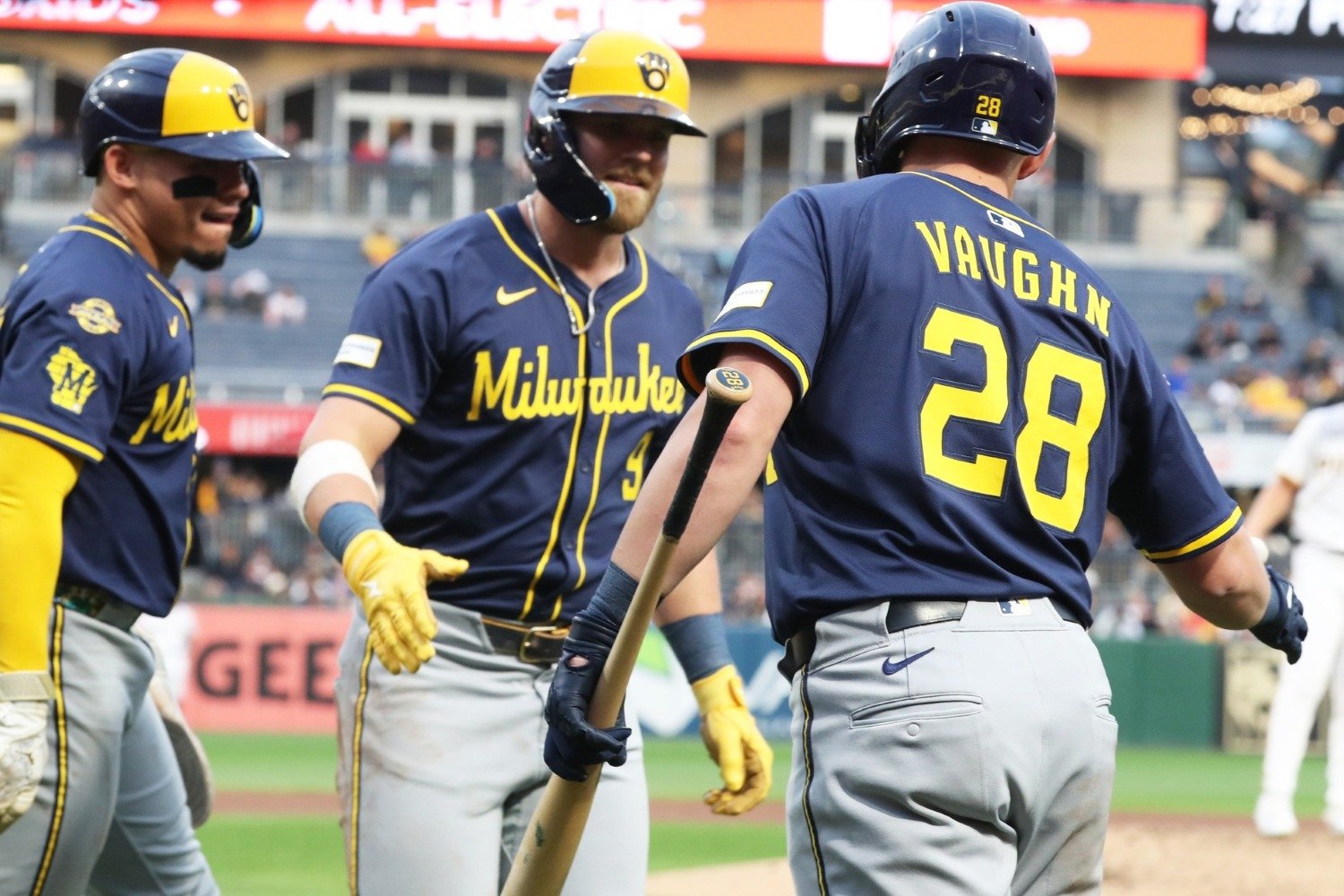
One way or another, Andrew Vaughn and Jake Bauers will divide time at first base for the 2026 Milwaukee Brewers. In 2025, each was a productive hitter. Vaughn batted .308/.375/.493 in 254 plate appearances after joining the team in early July. Bauers played a much smaller role and didn’t enjoy the same kind of luck, but he still hit .235/.353/.399 in 2018 trips to the plate. By now, Vaughn’s emergence is extremely familiar to Brewers fans. Our Jake McKibbin also laid out the ways that Bauers blossomed last year, back in November.
With Christian Yelich likely to spend nearly all his time at designated hitter and William Contreras needing a few appearances there to spare him from overuse at catcher, Vaughn and Bauers will vie for the same pool of playing time in 2026. Neither is an especially capable defender anywhere but first base, and Bauers’s only fallbacks (the corner outfield spots) are places where he’s fourth or fifth on the team’s depth chart. Since Bauers bats left-handed and Vaughn bats right-handed, there will be at least some version of a platoon in effect.
With any platoon, though, there comes a set of questions. Which of the two players involved is the better hitter, considering their performance against both left- and right-handed pitchers? If it’s the right-handed one, a pure platoon—whereby the lefty sees every right-handed pitcher you can get them in against and the righty faces all the southpaws—doesn’t necessarily make sense. Is one of them a better defender than the other, by a distance sufficient to make it more than a tiebreaking consideration? And finally, what idiosyncrasies of each player’s swing and approach are worth considering when playing matchups, beyond simple platoon dynamics?
The first question instigatea a more serious consideration of the other two, in this case, because coming off 2025, Vaughn sure looks like the better of the two hitters in a vacuum. He made both approach and swing changes after joining the Brewers that unlocked the latent talent that made him a top draft pick by the White Sox in 2019. Bauers, by contrast, was exceptionally patient and showed some lethal swing characteristics when he was healthy, but he spent much of the campaign either shelved or hampered by injuries. Here’s how Vaughn hit after coming to Milwaukee, broken down purely by handedness:
vs. RHP: .262/.315/.456 in 168 plate appearances
vs. LHP: .403/.494/.569 in 86 plate appearances
Here’s the same breakdown for Bauers:
vs. RHP: .238/.358/.411 in 201 plate appearances
vs. LHP: .200/.294/.267 in 17 plate appearances
No one has any illusions about what will happen when a southpaw takes the mound in 2026: the Brewers will start Vaughn at first base. Based on the numbers above, though, you’d also give Vaughn the nod against righties. He didn’t get on base as well as Bauers did against them, but he was both more powerful and more likely to come up with a hit, as opposed to requiring a walk to reach. We’re clearly in one of those situations where a direct platoon (which, given the distribution of lefty and righty pitchers throughout the majors, would give Bauers about two-thirds of the playing time) is too blunt an instrument.
We can briefly consider the defensive aspect, but at first base, that matters much less than it often does when a team is platooning (for instance) a pair of outfielders. By the eye test, Bauers is a better defender. He’s taller and faster, and occasionally makes the kinds of plays ranging toward the hole that are almost impossible for right-handed fielders. Vaughn, who’s shorter than a typical first baseman and doesn’t move well to his right, has gotten better at both footwork and using soft hands on scoops and hard grounders. Both grade out as subpar fielders, though, and by about the same magnitude. In each of the last two years, Vaughn has been tagged with -4 Defensive Runs Saved, to Bauers’s -1, but that’s largely because Vaughn has played much more than Bauers. Broadly speaking, they’re of similar defensive value, with Bauers holding a small but not significant edge.
That leaves us to figure out what differentiates the two, beyond handedness, at the plate. Since the goal should be to find some right-handed pitchers against whom it makes more sense to use Vaughn than to use Bauers, the important question is: which ones?
First, let’s harken back to a table I produced for a piece about Jackson Chourio‘s brilliant performance against offspeed pitches, earlier this offseason. I found that Chourio’s unusually flat swing was part of the reason why he crushed changeups—and, indeed, that while steep swings tend to be better overall, there is one area where it works better to swing flat: on changeups and splitters.
Pitch Types
RHH v RHP
RHH v LHP
Four-Seamers
Whiff Rate
RV/100
Whiff Rate
RV/100
Steep
20.2
-1.813
17.2
-1.045
Flat
24.2
-2.415
23.3
-2.505
Sinkers/Cutters
Steep
15.1
-2.173
16.2
-1.81
Flat
15.4
-2.448
16.6
-2.23
Breaking
Steep
32.7
-1.788
30.6
-1.893
Flat
27.8
-1.878
22.7
-1.907
Offspeed
Steep
35.9
-2.948
35.5
-3.165
Flat
26.9
-1.422
28.4
-3.132
Pitch Types
LHH v RHP
LHH v LHP
Four-Seamers
Whiff Rate
RV/100
Whiff Rate
RV/100
Steep
17.6
-1.396
20.8
-1.071
Flat
22.5
-2.874
22.6
-1.548
Sinkers/Cutters
Steep
15.6
-1.202
17.7
-2.82
Flat
16.5
-1.845
15.8
-3.246
Breaking
Steep
30.1
-1.553
33.8
-3.246
Flat
21
-0.957
30.2
-3.186
Offspeed
Steep
32.1
-2.983
36.1
-2.693
Flat
25.4
-3.603
28.2
-4.851
That’s important information, though it’s also incomplete. There’s a bias in studying whiff rates and run values per swing based on pitch type, because (for instance) the best changeups to hit are the ones pitchers leave up, which will invite any hitter to swing flatter than if the pitch was diving below the zone as the hurler intended. Part of the fact that it’s better to swing flat against changeups is that it’s best to have had the plate discipline not to swing at all on the changeups that would have required steep swings.
So, we have to consider swing characteristics to find the right matchups for both Bauers and Vaughn, but we also have to understand their approaches. Bauers gets a lot of credit, for instance, for the better patience he displayed last year, which pushed that OBP against righties almost to .360. It’s extremely hard to get on base 36 percent of the time in the modern game and not be a valuable hitter. Bauers showed great plate discipline, which led to more walks and fewer strikeouts. Vaughn made similar adjustments, but he’s at a material disadvantage when it comes to swing decisions against righties. Most of the platoon advantage derives from an opposite-handed batter’s superior ability to identify pitches and anticipate their locations, relative to a same-handed batter seeing the same offerings.
Keeping that in mind, let’s turn to a quick analysis of the two players’ swings:
Jake Bauers
Split
Swing Speed
Swing Tilt
Attack Angle
Attack Direction
v. RHP
76.6 MPH
34°
12°
3° Pull
29.2
v. LHP
74.9 MPH
34°
13°
7° Pull
32.5
Andrew Vaughn
Split
Swing Speed
Swing Tilt
Attack Angle
Attack Direction
v. RHP
70.9 MPH
30°
7°
1° Pull
28.5
v. LHP
71.6 MPH
32°
8°
4° Pull
30.7
Bauers swings faster; that’s not news. Since we already feel very confident that Vaughn will play any time it’s possible against lefties, the big question comes against righties. Bauers’s swing speed advantage is huge, but there’s also a marked difference in what kinds of swings they each take against righties. Compare these slow-motion breakdowns of their moves.
First, note the different paths their hands take right at the start of their swings. Vaughn is very direct, which is where the tendency toward flatness comes from. He keeps his hands high and works around his back side, sinking into his back leg even as he pushes off of it. Bauers, by contrast, works down to get himself in better position to start working up. He does what hitters call working underneath the front side, creating more tilt and a longer stroke.
Compare a still from videos of each player early in their swing, and you can see (even with less than perfect matching of camera angle) how Vaughn stays upright, opens his hips and shoulders sooner, and lets his hands get farther from his body sooner. Bauers has more bend, and tucks the back elbow in to his ribcage more, creating lift and torque but channeling it to work vertically, as well as horizontally.
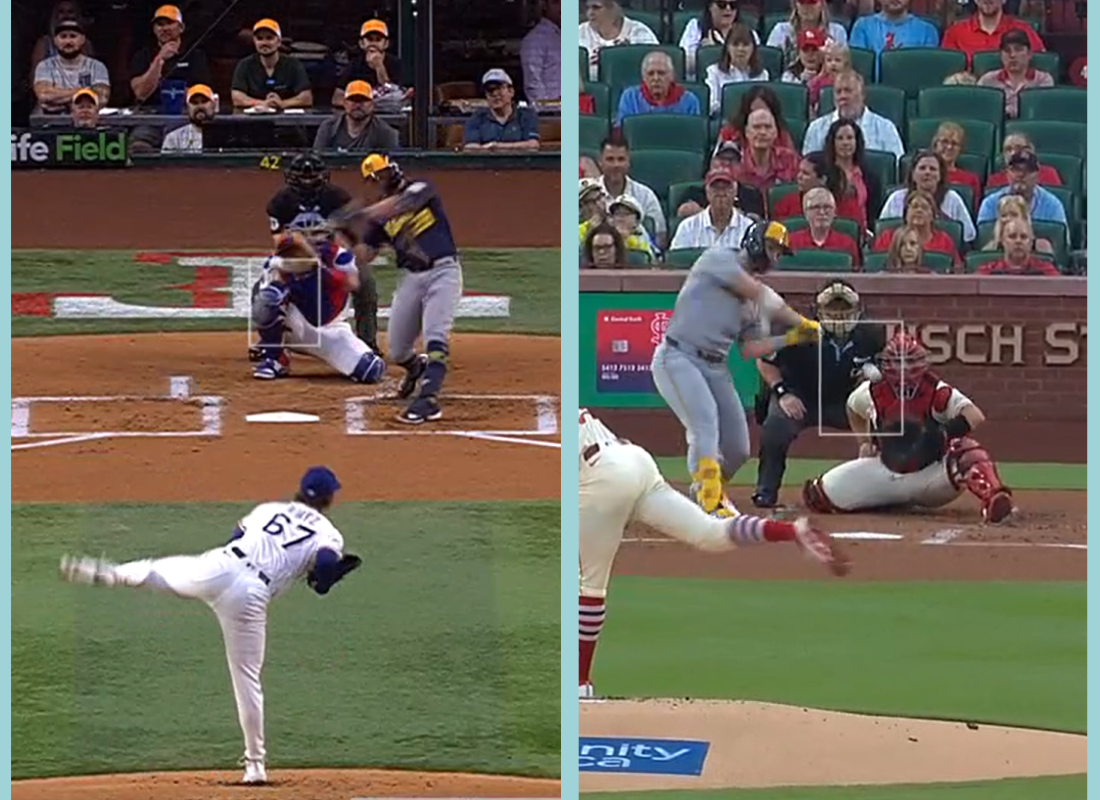
Watch the animations above again, and you can see how the two swings are geared to take each hitter to a different place, via a different route. Vaughn’s swing is about getting his hands around his body and into the space just beyond the left side of his torso as smoothly as possible, with his trunk rotation supplying all the power. Bauers is much more expansive. His hand path is about getting underneath his own front side, which stays slightly more closed. That gives him something firm around which to rotate, but the rotation can’t all come from his trunk, because the front side is firmer. Thus, Bauers’s hands and arms create much of the bat speed, generating a longer but faster swing.
As you might guess, it’s much harder to exploit Vaughn’s swing than it is to do so with Bauers’s, even for a right-handed pitcher. Vaughn is better against offspeed and breaking stuff, even against righties, because his bat path allows for a lot of mishit singles. The bat moves in an arc that leaves more of it in the hitting zone longer, generating vicious line drives when he’s right on time but plenty of flares and sharp grounders when he isn’t. Bauers is capable of hitting mistakes farther, but much more likely to swing and miss on a well-executed pitch that messes with his timing or moves sharply.
Given the steepness of his swing, you might expect Bauers to struggle more with rising fastballs, too, but it’s not so. He was so good at laying off the ones he couldn’t handle last year that he forced pitchers to either walk him or come into his wheelhouse. Assuming he can do that again, Bauers is the right guy to use against fastball-dominant righties, especially if they have a firm breaking ball. Vaughn, however, should start whenever the Brewers are scheduled to see a righty who’s likely to throw the kitchen sink at them, loading up on breaking balls and offspeed stuff.
Of course, a pitcher will typically approach right-handed batters and left-handed ones differently, so from day to day, the Crew will also have to study the tendencies of their opponents within each handedness matchup. If a pitcher is heavy on soft stuff to lefties but goes right after righties with high-rise heaters, the team might not have a great matchup for tham at first base that day. Most of the time, though, there will be a clear right answer. The best guess is that Vaughn will start about half of the games at first base, if both players are healthy all year, with Bauers starting another 50 or 60 and the rest going to one of the team’s slugging prospects as they reach the majors late in the season. With the righty in the would-be platoon being slightly better than the lefty, a perfect platoon wouldn’t be wise, but a modified one could be yet another way for the Crew to find an extra handful of runs over the course of the year.