
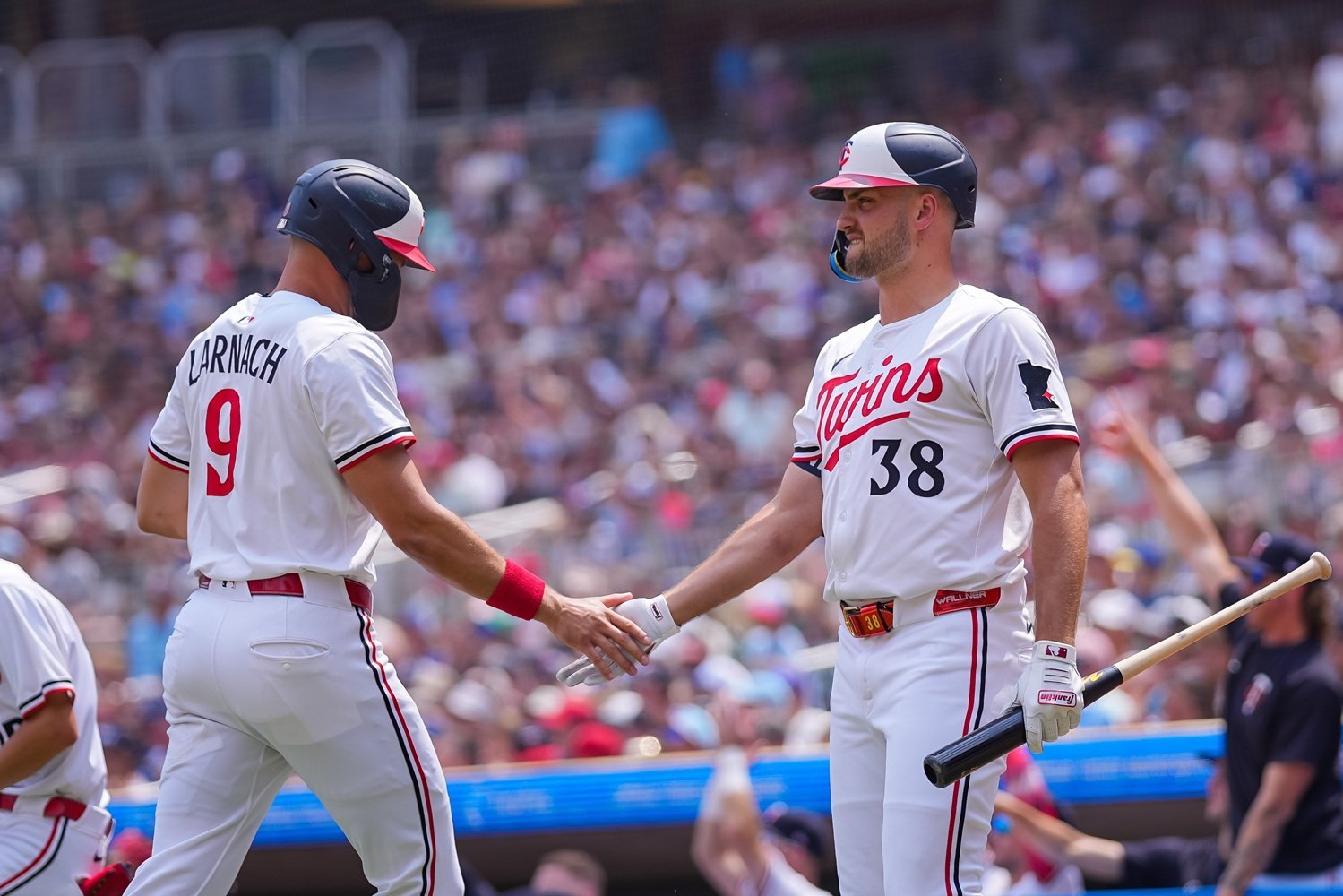
The Twins’ projected lineup is a testament to the team’s commitment to building from within, and to the success of their scouting and development pipeline. Seven of the nine projected starters were drafted and developed by the organization, and every one of those seven was selected in either the first or second round. In a vacuum, that kind of alignment feels like a win. Draft well, develop well, and let those players carry the roster.
But context matters. The team hasn’t made the playoffs in either of the last two years, and this season doesn’t look likely to break that pattern. Is this lineup a sign that the Twins are maximizing value from premium draft picks, or is it a reflection of financial realities pushing inexpensive, controllable players into everyday roles?
The answer, as is often the case, likely lies somewhere in between the extremes.
The Case for Optimism
There is no denying the upside in what the Twins have built. First- and second-round picks are supposed to become core players. Many do not. Minnesota has managed to turn a long list of those selections into legitimate big-league contributors and, in some cases, foundational pieces.
Byron Buxton, Royce Lewis, Brooks Lee, Matt Wallner, Trevor Larnach, Ryan Jeffers, and Luke Keaschall all project as everyday starters. That group spans more than a decade of drafts, from Buxton in 2012 to Keaschall in 2023. The timeline alone suggests this is not a one-year fluke, but rather the product of sustained investment at the top of the draft.
According to FanGraphs, the Twins’ projected lineup against right-handed pitchers is:
CF Byron Buxton (1st Round- 2012)
2B Luke Keashall (2nd Round- 2023)
1B Josh Bell (Free Agent)
RF Matt Wallner (1st Round- 2019)
C Ryan Jeffers (2nd Round- 2018)
DH Trevor Larnach (1st Round- 2018)
3B Royce Lewis (1st Round- 2017)
SS Brooks Lee (1st Round- 2022)
LF Austin Martin (Trade)
Twins president of baseball operations Derek Falvey sees that through the lens of process.
“What I think it says is that we’ve had a run of guys that we’ve identified in the draft, near the top,” Falvey said. “No one is going to bat 1.000 in the draft—we all know that—but we have a number of picks who have found a way to contribute at the big-league level. It speaks a lot to our development process, too.”
There is also value in cost certainty. These players are producing while still under team control, allowing the Twins to allocate resources elsewhere if ownership allows the front office to spend. When draft picks turn into everyday players, the return on investment is significant.
The Counterargument
The other side of the conversation is less comfortable. While the lineup is filled with former high draft picks, it is notably light on proven, impact bats acquired from outside the organization. Only Josh Bell and Austin Martin project to start after coming over from another team at any point, and Martin arrived in trade while still a prospect.
That absence is not just philosophical. It is financial. Minnesota is projected to operate with a payroll in the league’s bottom third, and the lineup reflects it. Cheap players are not just nice to have. They are (unfortunately) necessary.
It’s hard not to draw parallels to the Metrodome era, when the Twins routinely fielded rosters built around young, inexpensive talent because they had little choice. Those teams developed well, but they also often lacked the external reinforcements needed to push from mere respectability to contention.
Falvey has acknowledged that roster building cannot rely on a single path.
“I don’t think there is one-size-fits-all for any team,” he said. “You need to have some homegrown players. There have been stretches of time where we’ve had a bunch of acquisitions on our team. Two of the pitchers at the top of our rotation were traded for, Pablo and Joe, at different stages of their careers. Jhoan Duran was a trade, but he was in [Class A] and we grew him up through the minor leagues.”
The concern is whether the current balance is intentional or forced—and whether the team’s development infrastructure is good enough to make the most of this homegrown approach. With the exceptions of Buxton and Jeffers, the homegrown hitters holding onto lineup spots have interspersed flashes of brilliance into long periods of either struggle or injury-related absence.
Development Versus Ambition
Falvey has consistently stressed the importance of blending acquisition methods, rather than shutting any doors.
“You don’t want to shut off any valves to potentially get talent into your system,” he said. “Probably the best teams overall, over time, find a way to blend all of that. They get their top draft picks, they pick out a few guys later in the draft. In our case, that’s a Bailey Ober or a Griffin Jax converting himself from an up-and-down starter to a good reliever. We need more of that.”
The Twins have done much of that work already. The question is what comes next. If this lineup represents a foundation that will be supplemented aggressively when the time is right, it’s easy to view it as a positive sign. If it represents the ceiling imposed by payroll limitations, the optimism dims.
A Familiar Crossroads
League-wide, no team projects more first- and second-round homegrown position players in its starting lineup than the Twins. That is an accomplishment worth noting. At the same time, projections do not see Minnesota as a clear contender.
Thus, the lineup becomes a Rorschach test. It can be read as evidence of strong drafting and development finally paying off. It can also be read as a reminder of past Twins teams that survived on efficiency, rather than ambition. Perhaps the truth is that it’s both. The Twins are getting real value from their earliest draft picks. Whether that value is being leveraged into something more meaningful will determine how this era is ultimately remembered.
Are the Twins seeing the payoff of strong drafting and development, or are these players in the lineup more because they are affordable than because the roster is complete? Leave a comment and start the discussion.