
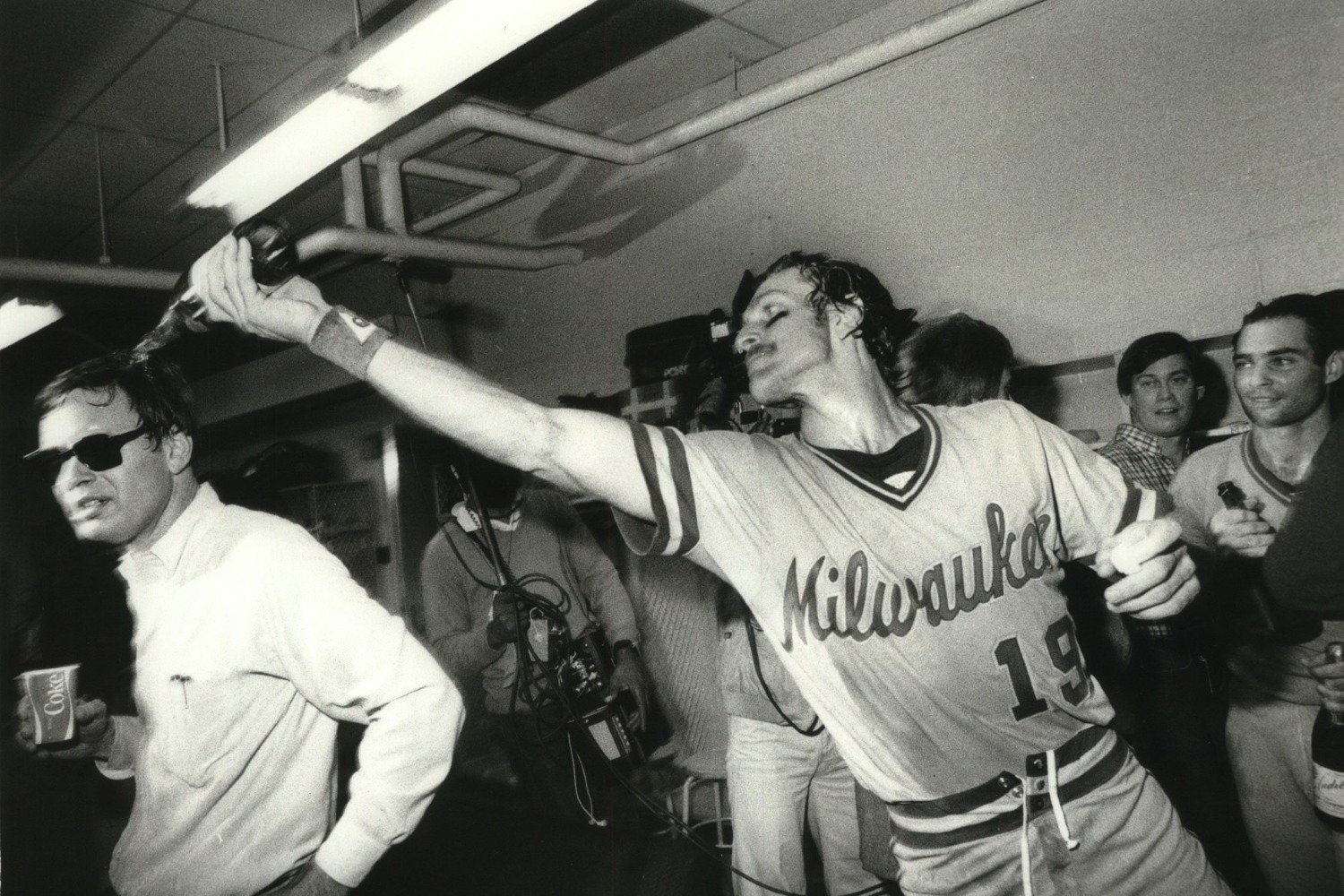
This multi-part series talks about how the Brewers got to the World Series and offers a timeline of the 1982 campaign, including player information, game recaps, and other events that affected the season.
Part 1
Part 2
Part 3
Dog Days? Not For the Brewers
The Brewers had their best month in June, winning 20 games while losing seven. Buck Rodgers was the skipper for the first win, but Harvey Kuenn got credit for the next 19 victories. But what is even more impressive is how well the Brewers played over the final three months of the campaign.
The Farmer’s Almanac defines the ‘Dog Days’ as a period from July 3 to August 11. (Originally, the term referred to the stretch during which Sirius was brightest in the night sky.) Baseball players feel it runs later than that, from late July through late August, when the players start to run out of gas toward the end of a long season and before September brings cooler air or the whiff of offseason freedom. No matter which period you choose, the Brewers were consistently good for the months of July, August, and September.
Here is their record (by month) for the final half of the season.
Month
W-L
Pct.
July
16-11
.593
August
19-11
.633
September
17-11
.607
Milwaukee started slowly the first week in July, going 3-4 before running off an eight-game winning streak over the weekend before the All-Star break and the weekend after. It wasn’t just the stars that were doing their part.
Second baseman Jim Gantner hurt his left shoulder diving for a ball against Detroit in mid-June. He missed about three weeks, but his spot was taken by utilityman Ed Romero, who performed admirably, batting .309/.341/.407 across 81 at-bats while filling in.
During the winning streak, the Brewers outscored their opponents by a total of 55-27 while hitting only nine home runs, showing that they could play some small ball in addition to smashing round-trippers. Rollie Fingers notched five saves during the streak and was starting to look more like the pitcher who won the 1981 AL Cy Young Award.
The last two weeks of the month didn’t go as well, with the Brewers winning only five of their last 12 games. Despite the stumble, Milwaukee still led the AL East with a record of 58-42 at the end of July, one-half game better than Boston.
County Stadium: Home Run Hitter’s Park or Just Another Park?
In their first 100 games, the Brewers slammed 141 home runs and were making a run at the then-record 240 home runs hit by the 1961 New York Yankees.
Visiting players had no doubt about the question listed above.
“This place is a bandbox.” (Toby Harrah, Cleveland)
“The ball seems to carry well here.” (Mike Hargrove, Cleveland)
“This place is more of a launching pad than Atlanta.” (Manager Sparky Anderson, after the Brewers hit five home runs to beat Detroit in mid-June)
But sometimes facts get in the way of opinion. In fact, of those 141 home runs, only 52 (or 37%) were hit at County Stadium. Baseball Reference lists single- and multi-year park factors for the home park of each team from each year of big-league history, and County Stadium played about 5% more friendly to pitchers than an average park during the early 1980s. Harvey’s Wallbangers didn’t benefit from cozy dimensions or scorching, dry air. They just banged.
“The fact is, we just have the people who can hit the tar out of the ball,” Don Money said.
Putting the Pedal to the Metal
After Mike Caldwell and Fingers combined to beat the Cleveland Indians 4-2 on July 31, the Brewers would never relinquish their grip on first place in the AL East, even though they were tied with Baltimore after the penultimate game of the year.
The Brewers scored at least one run in each of their last 82 games after being shut out 3-0 by the Minnesota Twins on July 8. The row of goose eggs put up by Twins pitchers Jack O’Connor and Ron Davis that day was the only time the Brewers were shut out in the regular season.
Fingers saved four games in the first fortnight of August while Milwaukee went 9-4, increasing their lead to 5 ½ games over Boston. Fingers missed about a week with a sore elbow, for which he received a cortisone shot. When asked about the elbow, Fingers downplayed it.
“If the pain isn’t gone, I’ll just pitch with the arm sore,” he said.
He came back on August 21 in Seattle to earn his 28th save, although he made a 3-0 game a lot more interesting when he gave up a two-run blast in the bottom of the ninth to Dave Revering. Fingers notched one more save in the month as the Brewers finished with a mark of 77-53, pacing the AL East by 4 ½ games over Boston.
The Brewers made three player moves in August. They purchased pitcher Doc Medich from the Texas Rangers; sold pitcher Randy Lerch to the Montreal Expos; and (biggest of them all) traded outfield prospect Kevin Bass and pitchers Frank DiPino and Mike Madden to the Houston Astros for a starting pitcher named Don Sutton.
The Stretch Run
Brewers fans felt their collective hearts stop beating when they learned that Fingers left the game on September 2 with muscle spasms in his right forearm. Initially, the diagnosis was a slight muscle tear, and he was expected to be out for a week.
The week turned into two, but Fingers shut it down after throwing 25 “half-speed” pitches in mid-September before a game with the Yankees. On the day that Fingers made his attempt, the Brewers held a two-game lead over surging Baltimore, who had bypassed Boston in the standings. Milwaukee went to a closer-by-committee arrangement, led by Jim Slaton, Dwight Bernard, and Pete Ladd.
The Brewers played .500 ball in early September (7-7) before running off six straight wins. The last week of the month, Milwaukee won four and lost four and held a three-game lead in the AL East over Baltimore. The season would be decided with a four-game series in Baltimore starting on October 1.
In the meantime, while it appeared that Fingers would not return to the team, backup catcher Ned Yost—who would manage the Brewers from 2003-08—hit a three-run homer in the top of the ninth off Mark Clear at Fenway to give the Brewers a 6-3 win over the Red Sox with five games to play. It was Yost’s only homer of the year, but it was clutch.
The new pitching arrivals were doing their parts, as well. Sutton made six starts in September, winning three while losing one. Medich also made six starts and went 3-3. As September ended, the Brewers traveled from Beantown to Baltimore for the huge four-game series to decide the winner of the AL East crown.
The Final Weekend
Rollie Fingers was out. Manager Harvey Kuenn was asked if his closer might be available during the weekend series.
“Right now, I doubt it,” Kuenn admitted. But as it turned out, the closest game was a five-run contest. Closers didn’t factor into things.
Milwaukee came into the series with a record of 94-64, with Baltimore three games behind at 91-67.
The first game of Friday’s twin bill saw Milwaukee’s Pete Vuckovich get hammered, giving up nine hits, five runs, and two walks in 4 1/3 innings. The Orioles had six extra-base hits, including a Ken Singleton home run, in an 8-3 loss for Milwaukee.
Game Two was no better, as the O’s had Mike Caldwell’s number, banging out 13 hits while scoring seven runs in seven innings in a 7-1 drubbing. The Brewers’ lead dropped to one game.
Saturday’s game was much of the same, as Medich, Moose Haas, and Bernard got roughed up for a combined 18 hits and 11 runs; the Brewers took an 11-3 whipping. Going into the final game of the season, both teams were tied at 94-67. It would be win-or-go-home on Sunday.
“I don’t think there is that much frustration or demoralization here,” Paul Molitor said. “It’s just a matter that we were sitting in an ideal situation when we came in here. Now, all of a sudde,n we are faced with elimination. That’s the reality of the situation.”
Fortunately for the Brewers, Sutton would be on the mound. Unfortunately, Orioles ace Jim Palmer would oppose him.
The day dawned bright and warm, with temperatures in the mid-70s at Baltimore’s Memorial Stadium. A boisterous sell-out crowd of 51,642—fourth-largest in Orioles regular-season history—was quickly quieted when the Brewers came out hot and scored single runs in each of the first three frames, powered by a pair of solo shots off the bat of MVP candidate Yount. Glenn Gulliver homered off Sutton in the bottom of the third to make it 3-1 and give life to the Orioles faithful.
Cecil Cooper led off the top of the sixth with a homer to right-center, making it 4-1. Palmer would leave one batter later, after a walk to Simmons. The Brewers increased the lead to 5-1 in the 8th on Ben Oglivie’s RBI single. Terry Crowley singled off Sutton in the bottom half to cut the lead to 5-2.
The Brewers doubled their run total in the ninth on an RBI single by Molitor, a two-run double by Cooper, and the coup de grâce: a solo shot by Simmons to extend the lead to 10-2.
Bob McClure pitched the ninth and gave up a pair of singles but no runs, as the Brewers took a 10-2 victory, earning the AL East title.
Regular Season Honors
Yount won the AL MVP, a Gold Glove, and a Silver Slugger award. Vuckovich carried off the AL Cy Young award. Cooper also won a Silver Slugger award.
Coming soon: The Postseason.
Are you interested in Brewers history? Then check out the Milwaukee Brewers Players Project, a community-driven project to discover and collect great information on every player to wear a Brewers uniform!