
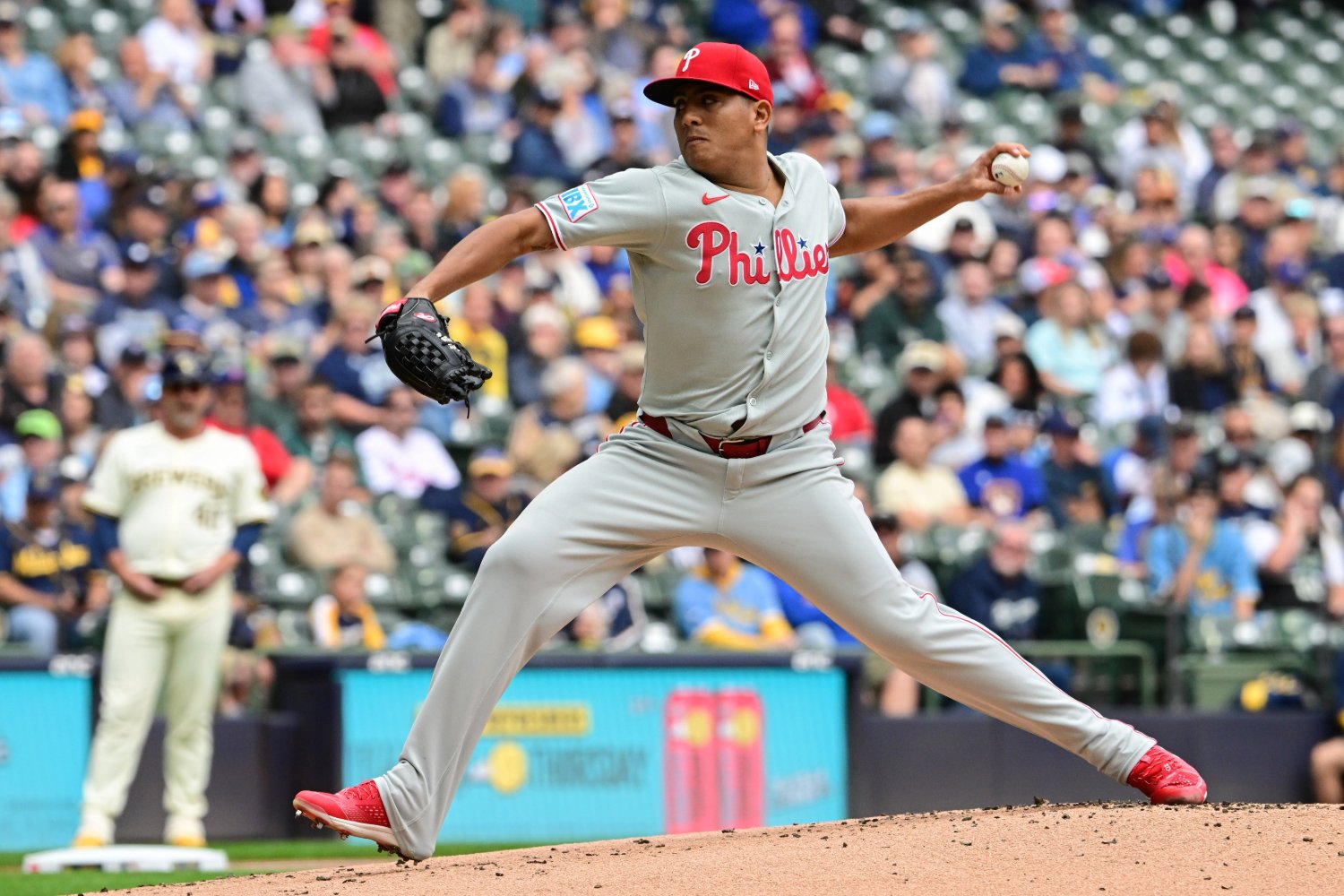
The ice has been broken. After a frustrating series of events regarding Alex Bregman, the Boston Red Sox bounced back, signing LHP Ranger Suarez to a five-year, $130 million deal with no opt-outs and no no-trade clause. In other words, right up Craig Breslow‘s alley in terms of the contract. Suárez, DiamondCentric’s second-highest-ranked starting pitcher remaining on the market, is a great get for the Sox. A team with an already solid rotation gets even stronger, making an argument for the strongest rotation in baseball.
Suárez has been a model of consistency over the past five seasons with a 3.25 ERA, ranking 13th amongst all starting pitchers with a minimum of 500 innings pitched in that time frame. It’s all backed up by luck stats as well, touting a 3.44 FIP.
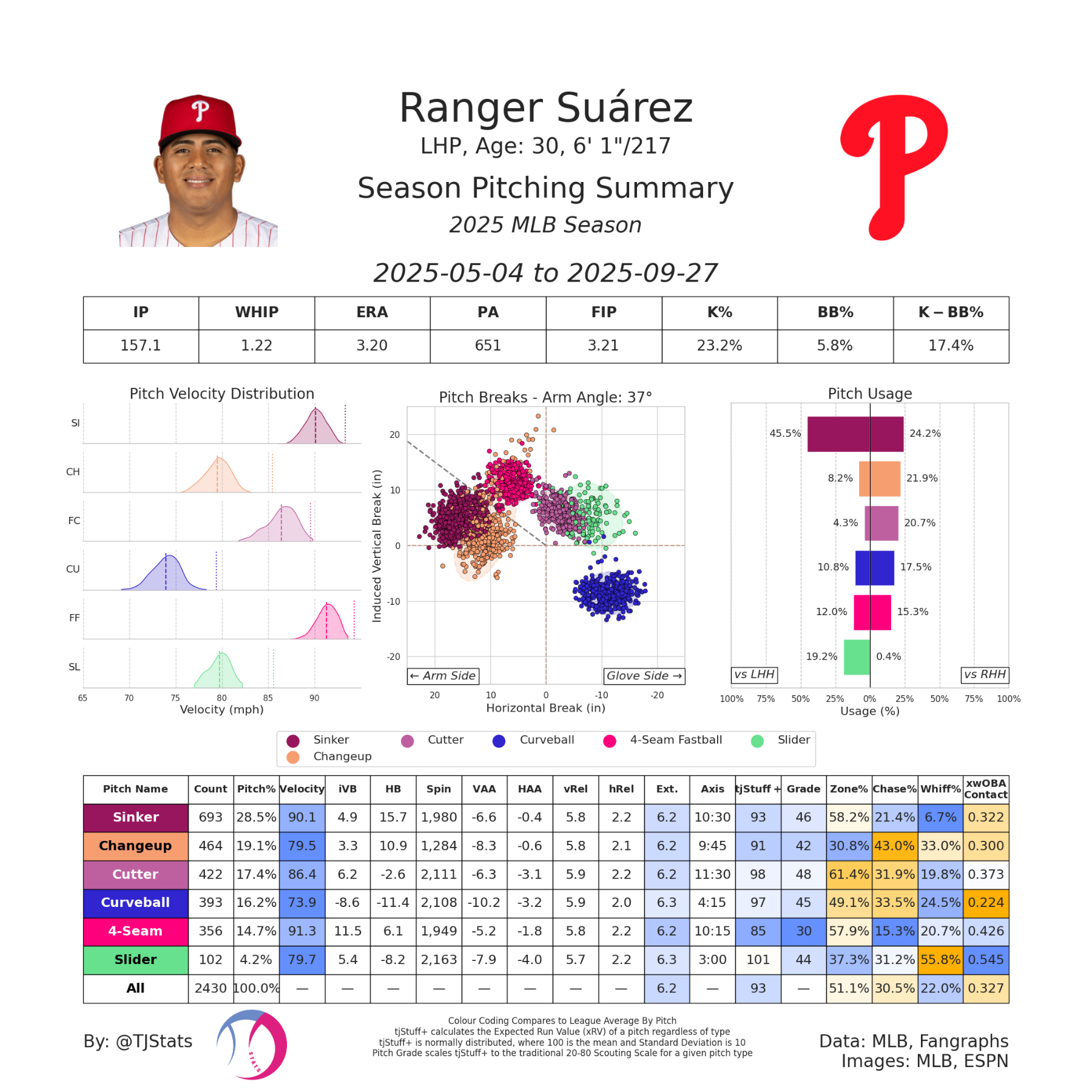
The newly acquired lefty does not fit the mold of other Craig Breslow moves this offseason. In guys like Johan Oviedo or Jake Bennett, there was a clear trend in extension and height. Suárez does not check off either of those boxes, standing at 6’1 with just 6.2 feet of extension, which ranks in the 29th percentile in MLB. He is also in the 7th percentile in average fastball velocity, sitting at 91.2 mph.
He doesn’t have the typical mold of a modern starting pitcher, and yet he finds success. In today’s game, pitchers without elite velocity or strikeout rates often struggle to hold rotation spots unless they excel elsewhere. Suárez does exactly that, combining elite control with a well-above-average ability to keep the ball on the ground.
Suárez ranked 21st in BB% (5.8%), 16th in ground-ball rate (46.8%), and led the league in Location+ (113). Location+ operates the same way as Stuff+, providing a baseline of 100 based on how well a pitcher can locate in each count relative to the league. Put simply, how well can a pitcher locate along the edge of the zone compared to the rest of the league? Suárez is the best at this, and it’s a skill that ages much more gracefully than velocity.
His elite location ability allows him to garner elite results in average exit velocity (95th percentile, 86.5) and hard-hit rate (98th percentile, 31.1%).

From a pitch-mix standpoint, Suárez leans heavily on his sinker, throwing it 28.5% of the time. The pitch generates an excellent 62.9% ground-ball rate, though it was hit at a moderate clip, allowing a .768 OPS. His best offering, however, is clearly his changeup. Using the pitch, he posted a microscopic 2.8% walk rate and a strong 25.2% strikeout rate. Opponents produced a 48 wRC+ and a .499 OPS, both ranking 16th-lowest in the league. The pitch is rarely thrown in the zone, evidenced by a 30.8% Zone%, yet it generates a massive 43% Chase%. It tunnels effectively off the sinker with a similar horizontal approach angle while dropping an additional two inches, driving swing-and-miss.
M3k0eDRfWGw0TUFRPT1fVTFNQVZBQUhWd2NBQUZNRUF3QUhDUUJXQUFBQlYxY0FVd2NCQmdJQ0NBRURDQUVI.mp4
Despite lacking the traditional traits often associated with top-end starters, Suárez fits the bill. With pinpoint command, a lethal two-pitch mix, and a consistent ability to limit hard contact, his skill set projects to age well. None of these strengths rely on upper-echelon velocity, which inevitably declines over time. As a result, the Red Sox’s $26 million annual investment should not become burdensome, even in the later years of the deal.
One clear area of need remains. With yet another ground-ball-heavy pitcher added to the rotation, the importance of a reliable infield defense is magnified. Still, after a weekend of significant frustration, it is encouraging to see the front office respond quickly and decisively. This has the makings of one of the best rotations in the sport, where, from Garrett Crochet through Johan Oviedo and beyond, the team should feel competitive every time out.
The organizational pitching depth is a clear strength, and it will be fascinating to see where the roster construction goes from here. For now, though, enjoy the moment. The first free agent has landed, and the rotation just got even better.