
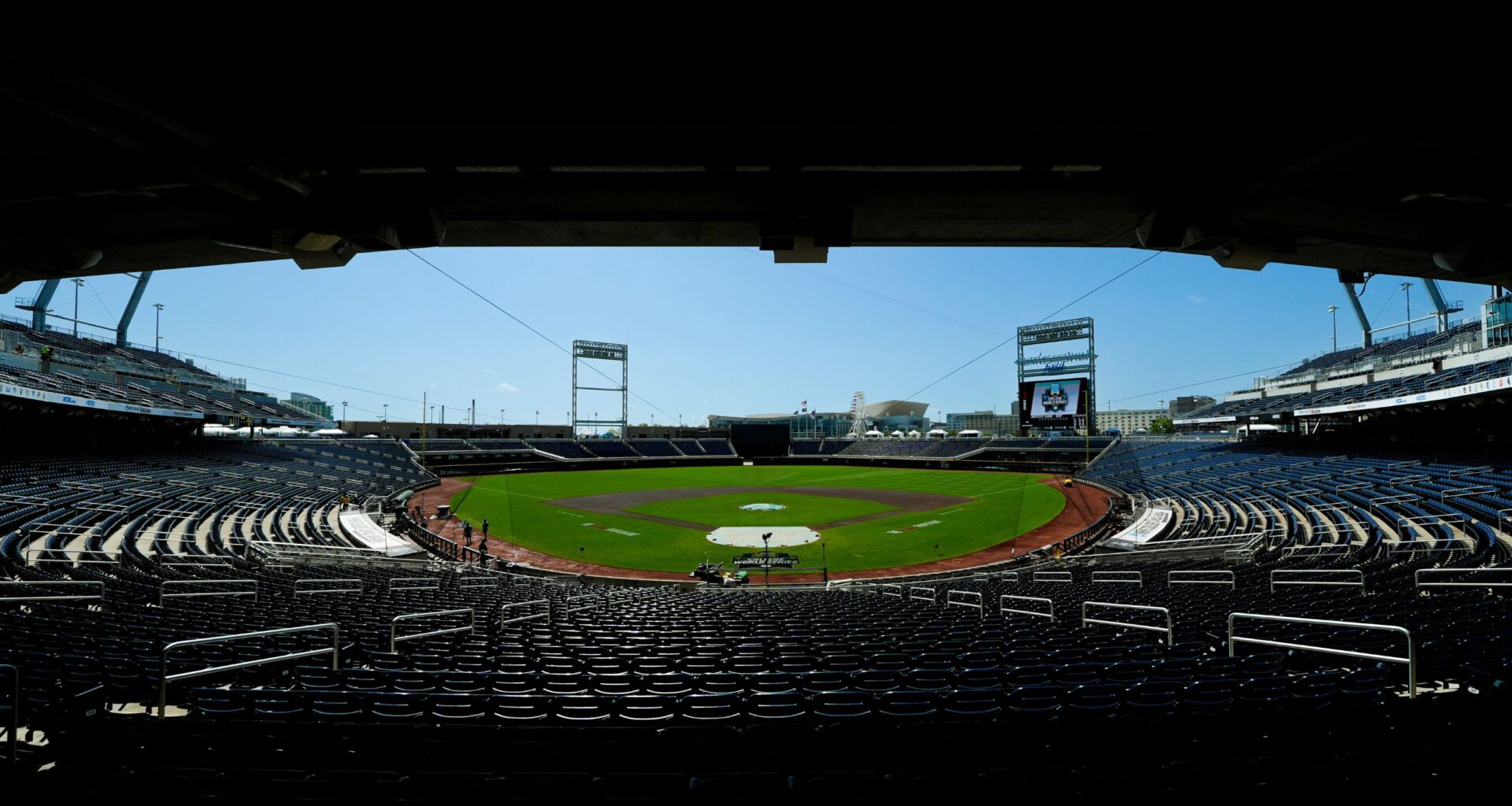
College baseball has never been an equal-opportunity sport. Geography, weather, facilities, scholarships and institutional commitment have always shaped the landscape. But coaches across the country believe the divide has widened into something more structural—and more permanent. It’s no longer a conversation about marginal advantages. It is about whether large segments of the sport are still competing in the same ecosystem.
“You ask the question, ‘Who should win the national championship?’,” one mid-major coach told Baseball America. “An SEC team should win the national championship every single year. You’re talking about resources, salaries, scholarships, player salaries, revenue share. It’s not the same game as the one I’m trying to play. It’s pro baseball over there and survival out here.”
The imagery coaches use reflects how stark that divide feels from the dugout.
“You’ve got the majors and you’ve got rookie ball, with a bunch of people trying to hang on in Double-A,” the coach said. “They’re not flying to games. They’re taking the bus.”
Most acknowledge the imbalance has always existed. What feels new is how few guardrails remain. NIL, the transfer portal and revenue sharing have converged without meaningful regulation, and coaches say the system is now driven almost entirely by money and mobility.
“It’s never been a level playing field,” one coach said. “But right now, how do you fix that with what’s going on? You don’t.”
The financial reality is no longer theoretical. It plays out roster by roster, decision by decision, often in ways that leave smaller programs with no viable counter.
“I paid my top pitcher $100,000 last year just to keep him here,” a mid-major coach said. “He could have made $400,000 to go to a power conference school, which was communicating with him through another player. How am I supposed to compete with that?”
The frustration, coaches insist, is not rooted in envy. It’s simply a matter of practicality.
“Someone might read this and go, ‘Oh, he’s just complaining,’” the coach said. “But be realistic with me for a second. How, for real, am I supposed to be expected to take this team to Omaha when I’m fighting with my school to put bathrooms in the stadium?”
For some, the conclusion feels unavoidable. Competitive balance, they argue, may require formal separation.
“Eventually, you almost have to separate mid and high majors,” one mid-major coach said. “You have to have a scholarship or coaching minimum to be in League A.”
If resources are the underlying fault line, the calendar is where many coaches see the most immediate leverage. Across levels, the same solution keeps resurfacing: Move the season back.
“If our sport is ever to be taken seriously on individual campuses around the country,” one high-major coach said, “this would have to happen.”
In colder regions around the country, the case to amend the schedule extends beyond weather concerns. Coaches frame it as a matter of visibility and relevance in an increasingly crowded sports calendar.
“Revenue generation gives our sport a voice,” another coach said. “It would amplify the voice of college baseball if more schools had a fighting chance to generate dollars. I haven’t even mentioned the competitive inequities created by keeping the season as is.”
Others arrive at the same conclusion through competitive analysis.
“I would move the season back,” one coach said. “I would start March 1 and go into summer. Weather and ramp-up time would be primary factors.”
For some, it is no longer a hypothetical.
“I really am beyond convinced on moving the season back,” another said. “You need to balance the country from a competitive playing standpoint.”
That shift, several believe, would require a postseason rethink, as well. One coach proposed a longer NCAA Tournament scenario featuring 32 host schools to “effectively have two rounds of super-regional-style play.” Others envision a full calendar reset that aligns college baseball more closely with professional rhythms.
“My idea is the season runs April through July,” one coach said. “The portal window is 14 days from the national championship to Aug. 15. Instructional-only practice in September and October. No practice from November through December. Practice resumes January through March. Like spring training.”
If the baseball calendar is one stress point, the transfer portal is another. Coaches across the sport describe unlimited transfers as the most destabilizing change of all.
“If I could change one thing,” one coach said, “it is the unlimited transfer opportunities.”
Few argue against player movement entirely. Many argue for boundaries.
“I’m all for a newer version of college baseball which allows players to transfer,” another coach said. “But I am adamantly against the multiple transfer.”
The most common proposal mirrors old rules with modern flexibility, with one coach proposing a system in which players would get one “free transfer” but would have to sit out a season should they decide to change schools again after that.
Some believe enforcement must eventually mirror the professional side.
“When players break contracts or transfer multiple times, there’s no penalty,” one coach said. “If a head coach leaves a multi-year contract, there’s usually a hefty buyout. Possibly down the road, they have to implement something that fits that narrative.”
Tampering, particularly after seasons end, is another shared concern. Coaches say rosters are effectively left unprotected.
“Once the season is complete, programs should have the ability to sign their players for another season,” one coach said. “That locks them in and prevents entry into the portal.”
Others prescribe narrow negotiation windows to stabilize rosters before summer. One coach suggested implementing a 3-5 day period between the end of the season and the opening of the transfer portal that would allow coaches to negotiate with their players and sign deals for them to return.
Underlying nearly every proposal is discomfort with how money in the college game currently moves.
“There needs to be public disclosure of NIL and revenue-sharing deals and contracts,” one coach said. “There’s way too much unregulated, unchecked money flying around right now. Millions and millions of dollars a year are being dished out to players who become free agents annually. It’s total chaos.”
Some go further, with another coach saying: “I would eliminate NIL entirely and move to a revenue-share-only model.”
Eligibility and roster rules round out the list of frustrations, particularly when compared to other sports. In college football, for example, FBS coaches recently voted unanimously to adjust the sport’s redshirt rule to allow players to participate in as many as nine games while still preserving full-year eligibility. In college baseball, just one official at-bat or pitching appearance burns a player’s redshirt.
“Freshmen should be able to play a certain percentage of the season and still preserve a redshirt,” one coach said. “Our rules make no sense when football players can play a quarter of the season and keep a year of eligibility.”
There is also near-universal agreement on one logistical fix.
“We need the draft back up in June,” one coach said. “It makes sense for all parties across all levels of the sport. It’s not hard. Everyone wants this.”
Taken together, the voices reflect a sport pressing against its own framework. College coaches are not calling for cosmetic change. They are asking for structure, limits and clarity in a system that currently rewards scale and speed above all else.
Whether the answer is reform, separation or recalibration, the message from the dugout is consistent: College baseball cannot keep operating as if nothing has changed.