
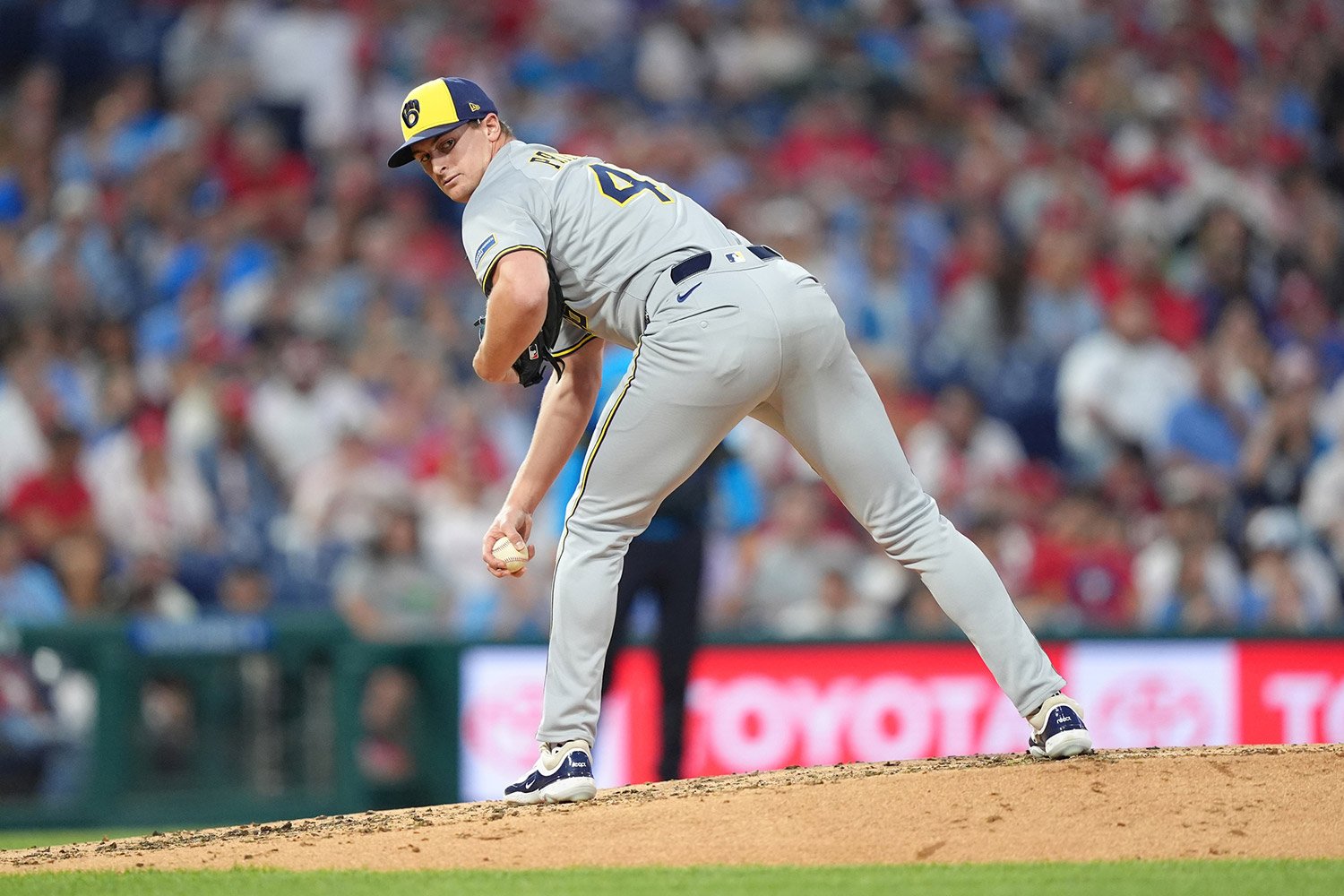
The Brewers’ offseason has been – in a word – quiet – as we wait in anticipation for the Freddy Peralta trade that feels inevitable. The Brewers are masters of improving on the margins and making seemingly small (or even tiny) moves that result in acquiring players with an outsized impact on the team’s success, but this winter feels exceptionally slow. To be fair, the Brewers won more games than any other team in 2025 and do not have any glaring holes. While we wait for more action, here is a ranking of the top five player moves from last season.
Honorable Mention: Jake Bauers and Anthony Seigler sign minor league contracts
After initially non-tendering Jake Bauers in November, the Brewers brought him back on a minor league deal in January of 2025. Bauers had an up-and-down season and dealt with injuries, but he really came on in September and was a standout for the Brewers in the playoffs. He has excellent bat speed, and the Brewers will look to utilize him in advantageous matchups in 2026.
Anthony Seigler was the Yankees’ first-round pick in 2018. Like Blake Perkins in November 2022, Seigler left the Yankees organization and signed a minor league contract in November 2024. He is an interesting and versatile player, logging a good number of innings at third base, second base, and catcher in 2025. The Brewers like Seigler’s swing decisions at the plate, and with prospect Jeferson Quero currently looking like the backup catcher at the MLB level, it’s possible the Brewers will give Seigler more time behind the plate during spring training this year.
The Brewers traded 2024 7th round draft pick Mason Molina less than six months after drafting him to the Rangers in exchange for a relief pitcher with a career 62 1/3 innings pitched and a 6.35 ERA. Of course, the Brewers spun Anderson around, clicked his ruby cleats together, and turned him into a useful bullpen weapon who provided 69 2/3 innings with a 3.23 ERA. Importantly, Anderson had two options remaining, allowing the Brewers to send him up and down as needed to provide flexibility and bring in fresh arms from the minor leagues when they needed to. Anderson has four years of club control and another option remaining; he will likely provide the 2026 Brewers with similar flexibility and quality relief innings.
The Brewers made their most significant free agent signing of last offseason on March 3, roughly three weeks before Opening Day. Quintana had long been a Brewers foil; the team often struggled to make solid contact against him, particularly during his time with the Cubs and Mets. After signing so late into spring training, Quintana wasn’t ready to begin the season with the MLB club, and the Brewers called him up on April 11. Quintana went on to make 24 starts for the Brewers, pitching 131 innings with a 3.96 ERA. The Brewers’ rotation looks very different now than it did in March of 2024 – Quintana gave the Brewers the quality innings they needed, when they needed them most, making this a successful acquisition executed at just the right time by the Brewers’ front office.
On June 12, starting pitcher Aaron Civale requested a trade, and on June 13, the Brewers traded Civale to the White Sox for Andrew Vaughn. Fittingly for this list, Andrew Vaughn was also seen as a less-than-optimal addition. At the time of the trade, the 2019 number three overall pick in the MLB draft had a .189 batting average, a 43 wRC+, and a negative WAR both in the season and cumulatively for his career. The White Sox, in the midst of their third consecutive season with more than 100 losses, had demoted Vaughn to Triple-A. The Brewers recalled Vaughn from Triple-A Nashville a few weeks later, and he turned into a new player. With the Brewers, he was 43 percent better than the average big league hitter, leading the Brewers in the category with a wRC+ of 143. Vaughn had several big home runs and hits, producing memorable moments during the Brewers’ winning streaks. The Brewers clearly believe in the tweaks Vaughn made to his approach in 2025 as they tendered him a contract and agreed to a salary of $7.65 million for 2026. Vaughn has an additional year of team control in 2027, giving the team options moving forward.
Last winter’s version of trading away a pitcher with one season of team control remaining saw Devin Williams sent to the Yankees for starting pitcher Nestor Cortes and infield prospect Caleb Durbin. Similar to the Quinn Priester trade, this trade was not universally celebrated by pundits and Brewers fans. On the surface, this looked like an attempt to field a competitive roster while building for the future. The Ortiz portion of this trade failed spectacularly; his most noteworthy contribution to the 2025 Brewers was surrendering home runs on the first three pitches of the second game of the season, facing his former teammates in New York, and helping ignite the torpedo bat controversy. Shortly thereafter, he was put on the injured list and ultimately required the Brewers to attach a prospect to him in order to trade him off the roster.
Durbin was never a highly regarded prospect. MLB Pipeline only added him as the 30th-ranked prospect on the Yankees’ top 30 list following the 2024 Arizona Fall League, where Durbin set the stolen base record with 29 steals in 24 games. Durbin did not make the Opening Day roster but was promoted in mid-April when the Brewers gave up on Oliver Dunn. Durbin posted an above-average wRC+ in every month except May, finishing five percent above league average with a 105 and accumulating 2.6 fWAR on the season. Having limited experience at the hot corner, his defense at third base improved over the course of the season, earning positive value and finishing in the top half of players at the position. Durbin doesn’t look like a star, but his patient and hard-working approach fits in perfectly with the Brewers, and with five years of control left, the Brewers again acquired a positive asset.
Less than two weeks into the season, the Brewers sent Yophery Rodriguez, John Holobetz, and the 33rd overall pick in the 2025 MLB Draft to Boston in exchange for Priester, the Pirates’ first-round pick from 2019, who had limited MLB experience with low strikeout rates and poor results. At the time of the trade, the Brewers’ rotation was in disarray with multiple pitchers on the injured list, and many believed this trade smacked of desperation. The then-19-year-old Rodriguez was coming off a successful season at Single-A and was ranked around 10th across the board on Brewers prospect lists. Holobotz was a textbook Brewers draft pick, selected in the fifth round from a smaller school, and the 33rd pick carries a lot of value – the Brewers had just acquired the 34th pick the year before from the Orioles as part of their trade haul for Corbin Burnes.
Unsurprisingly, the Brewers knew what they were doing: they tweaked his arsenal, and Priester stepped right into the rotation, pitching 157 1/3 innings with a 3.32 ERA and a 56% ground-ball rate, including setting the team record with an 11-game winning streak. Priester was not rookie-eligible; otherwise, the Brewers would have had five players receive rookie of the year votes. Priester should have five years of team control left, and it appears that the Brewers acquired a very valuable asset.