
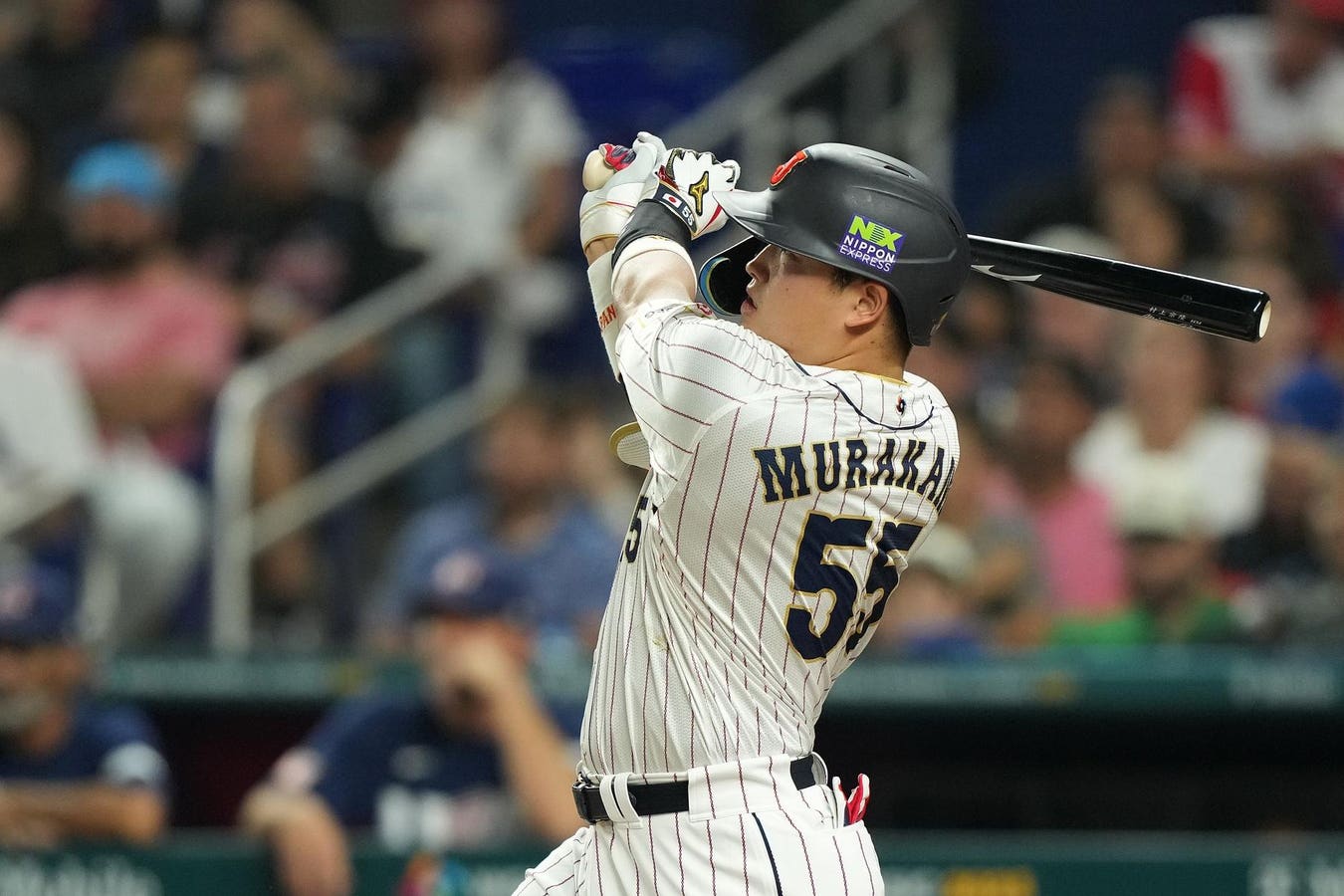
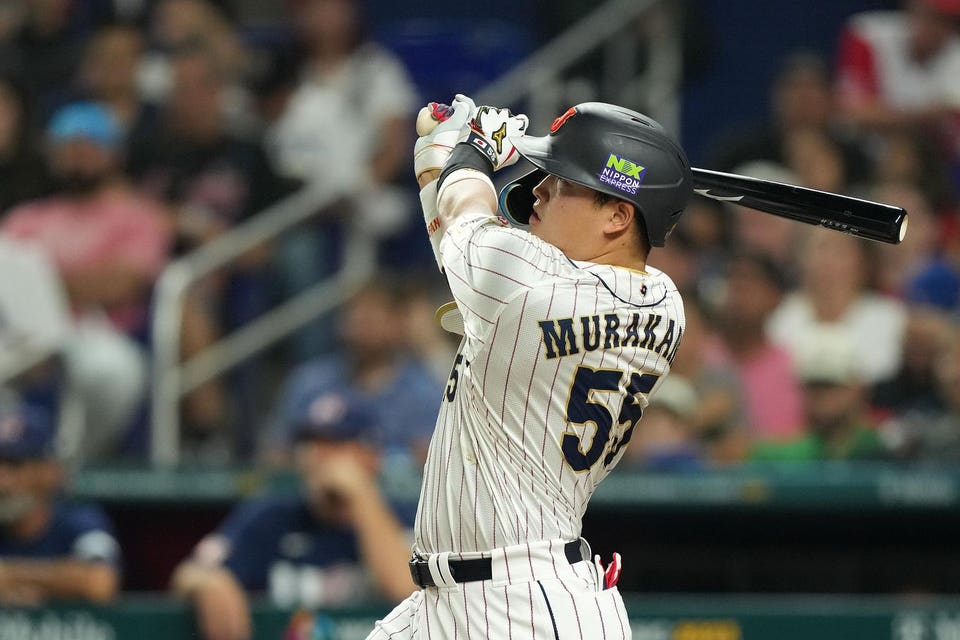
Newly-signed Chicago White Sox slugger Munetaka Murakami provides lethal left-handed power. (Photo by Eric Espada/Getty Images)
Getty Images
The Japanese Babe Ruth has found a new home in the American major leagues.
Facing a 5 p.m. Monday deadline to sign or return to the Yakult Swallows, Munetaka Murakami chose the Chicago White Sox – sending shock waves throughout the baseball world.
In picking the Sox, he opted to become a big fish in a small bowl rather than a small fish in a big bowl, which he would have been with the high-spending New York teams or World Champion Los Angeles Dodgers.
When free agent season began five days after the World Series, Murakami had been considered one of the top five players in the market, according to The New York Post.
Contract Terms
Initial reports indicated the Sox will pay him $34 million over two years plus a posting fee to be determined by the size of the salary.
Munetaka Murakami is adept at either infield corner but could also serve as a DH for his new team, the Chicago White Sox. (Photo by Megan Briggs/Getty Images)
Getty Images
Still just 25, Murakami is a corner infielder whose best position could be designated hitter. He is an offense-oriented player whose 56 home runs in 2022 were a record for Nippon Professional Baseball.
The four-time All-Star led the Swallows to the league championship in 2021, then followed with a Triple Crown season that featured a .318 batting average and 134 runs batted in plus those 56 home runs – one more than Sadaharu Oh’s previous NPB mark.
He spent eight years in the Japanese majors, one short of what he would need to become an unrestricted free agent free of the posting fee. He was just a teenager when voted Central League Rookie of the Year in 2019.
Schwarber Comp
The 6-2, 215-pound left-handed hitter reminds many scouts of Kyle Schwarber, whose 56 home runs in 2025 led both leagues. Like Schwarber, Murakami provides power plus plate discipline, drawing a healthy share of walks, but also a plethora of strikeouts.
His Nov. 7 posting opened a 45-day signing window for any interested major-league teams. But signing with the White Sox was a surprise because that team has not been a contender in recent seasons.
Chicago finished dead last in the American League Central, 28 games out of first place, with a 60-102 record and .370 winning percentage. But that was actually an improvement over 2024, when the Sox lost 121 times, a modern major-league record that was one defeat more than the original expansion Mets of 1962.
Andrew Benintendi led the Chisox in home runs last year. (Photo by Dylan Buell/Getty Images)
Getty Images
Only two players, Andrew Benintendi and Lenyn Sosa, reached the 20-homer plateau and Luis Robert, Jr. was a major disappointment with a .223 batting average and 14 home runs in 110 games.
Power Pace
Adding Murakami is a major jolt to that mediocre offense. Though hampered by an oblique injury last summer, he hammered 22 homers in 56 games while producing a .273 batting average, .663 slugging percentage, and 1.043 OPS.
Such numbers – or anything approaching them – would keep Bill Veeck’s exploding scoreboard spinning at Guaranteed Rate Field (nee Comiskey Park). Aside from signing left-handed pitcher Anthony Kay, the Sox had made no major moves this month before the Murakami bombshell. The team is expected to officially announce the move Monday, just hours before the expiration of the posting deadline.
The signing of Murakami, who has 246 career home runs, caps a season of superlatives for Japanese stars in the U.S.
One week after his induction into Japan’s Baseball Hall of Fame in January, Ichiro Suzuki was chosen for the American version, missing unanimous election by a single vote. When he was inducted in July, he became the first native of Japan to receive a plaque in Cooperstown.
Then Shohei Ohtani led the Los Angeles Dodgers to their second successive world championship and followed with his fourth Most Valuable Player Award – all by unanimous vote.
In addition, Ohtani teammate Yoshinobu Yamamoto was named MVP of the World Series after beating Toronto three times in the best-of-seven competition.
Other former standouts from Japan who thrived after jumping to the U.S. majors include Seiya Suzuki, Hideo Nomo, Hideki Matsui, Yu Darvish, Shota Imanaga, and Roki Sasaki.