
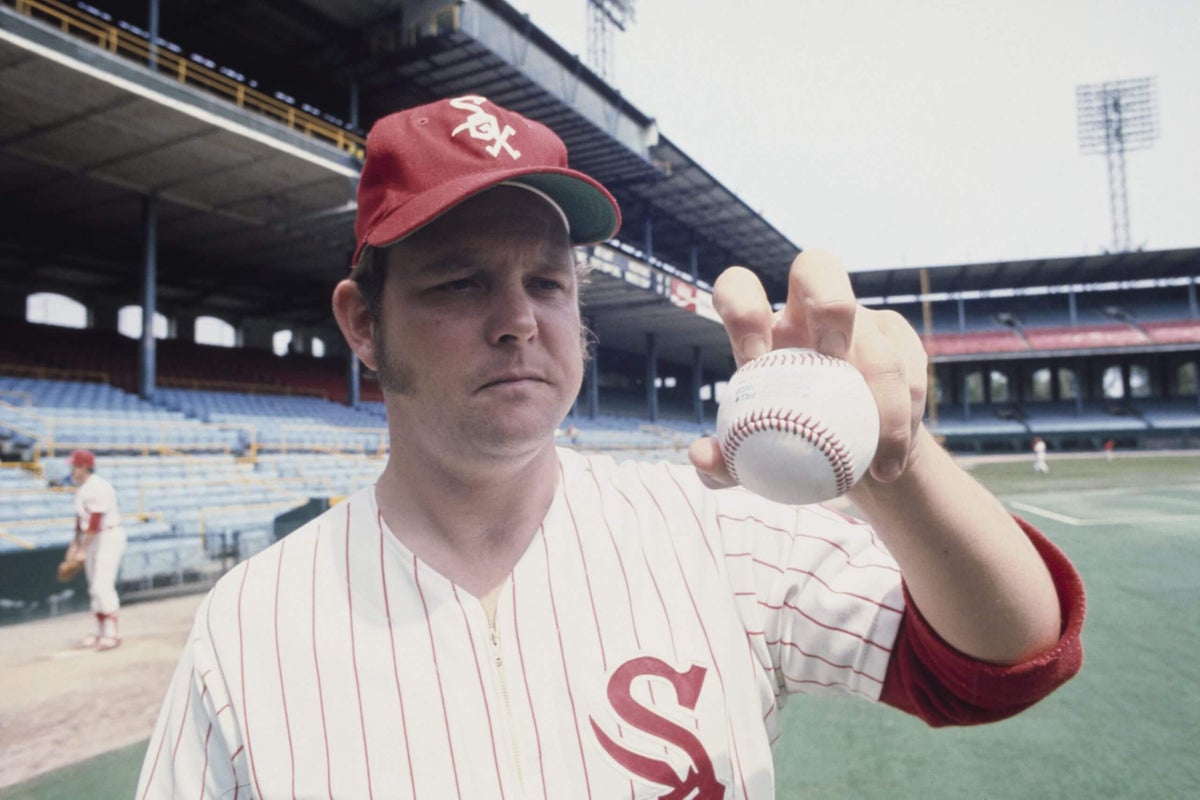
The knuckleball is the everyman pitch. You may never throw a blazing fastball or a wicked curve. But with guile and guts, you just might have magic in your fingertips.
“Everyone used to ask me, ‘How fast did you ever throw the ball?’” Wilbur Wood once said. “I told them, ‘90 miles an hour,’ and they’d look at me like I’m crazy. So I said, ‘I threw it 45 to the catcher and he threw it 45 back – that’s 90 miles.’”
Wood was 84 years old when he died Saturday in a hospital in Burlington, Mass. His wife, Janet, confirmed his death to The New York Times. It is safe to say that baseball will never see another pitcher like him.
From 1971 through 1975, with the Chicago White Sox, the left-handed Wood averaged 336 innings and nearly 45 starts per season. In 1972, he worked 376 ⅔ innings, the most by any pitcher since Grover Cleveland Alexander in 1917.
No pitcher since Wood has come within 30 innings of his staggering career high. Last year, only three pitchers even made it to 200 innings. And no full-time knuckleballers roam the majors anymore.
“Between the two of us, we started half our games,” Hall of Famer Jim Kaat said Sunday, referring accurately to the 1974 and 1975 seasons with Chicago.
“With that knuckleball, why, he could pitch every second or third day if they needed him to. He really didn’t have a lengthy career, but for that short period of time, he was very, very dependable. A good guy and a great teammate.”
As a prospect, Wood was so promising that his hometown Boston Red Sox promoted him at 19 years old in 1961. They did not use him much, and sold his contract three years later to the Pittsburgh Pirates. He pitched one year there, one year in the minors, then got traded to the Chicago White Sox. The game was telling Wood he was nothing special.
“I came up as a fastball/curveball pitcher,” Wood said in a 2016 interview for “K: A History of Baseball in Ten Pitches,” in an endearingly thick New England accent.
“I had a knuckleball, but I never used it as a pitch to speak of until (my) career wasn’t going too far. The fastball was a few yards too short. I had a good curveball, but you can only throw so many and they’re going to catch up to that, too. So I made a decision to switch, and then I just threw the knuckleball – and thank goodness I did.”
Wood’s father had taught him a no-spin palmball as a boy, and Wood adapted it to a knuckler, finding it could help him compete against older kids on the sandlot. But he never took it seriously until joining the White Sox and playing with Hoyt Wilhelm.
Wilhelm, a future Hall of Famer, was still baffling hitters with a knuckleball well into his 40s. He told Wood that his best chance to stick was to throw the pitch exclusively, and helped him keep a stiff wrist to minimize spin.
After four years as a tireless reliever, including three as the American League leader in appearances, Wood moved into the White Sox rotation in 1971. He instantly became an All-Star – and a source of curiosity for his roundish build and unusual pitch.
“On the mound, he displays a comfortable expanse of tum and the stiffish-looking knees of a confirmed outdoorsman, and thus resembles a left-handed accountant or pastry chef on a Sunday outing,” Roger Angell wrote of Wood in 1977. “Even the knuckler – which he throws, sensibly, on almost every pitch – looks almost modest, for it does not leap and quiver like Hoyt Wilhelm’s old hooked trout.”
Maybe so, but Wood’s modest pitch helped him post four consecutive seasons of at least 20 wins, including two with more than 10 WAR. Only four other pitchers have multiple 10-WAR seasons in the division-play era, the decorated quartet of Steve Carlton, Roger Clemens, Randy Johnson and Tom Seaver.
In an era when stalwarts like Carlton, Gaylord Perry and fellow knuckleballer Phil Niekro were expected to pitch around 300 innings per season, nobody worked as much as Wood. On July 20, 1973, at Yankee Stadium, he even started both games of a doubleheader (he lost twice).
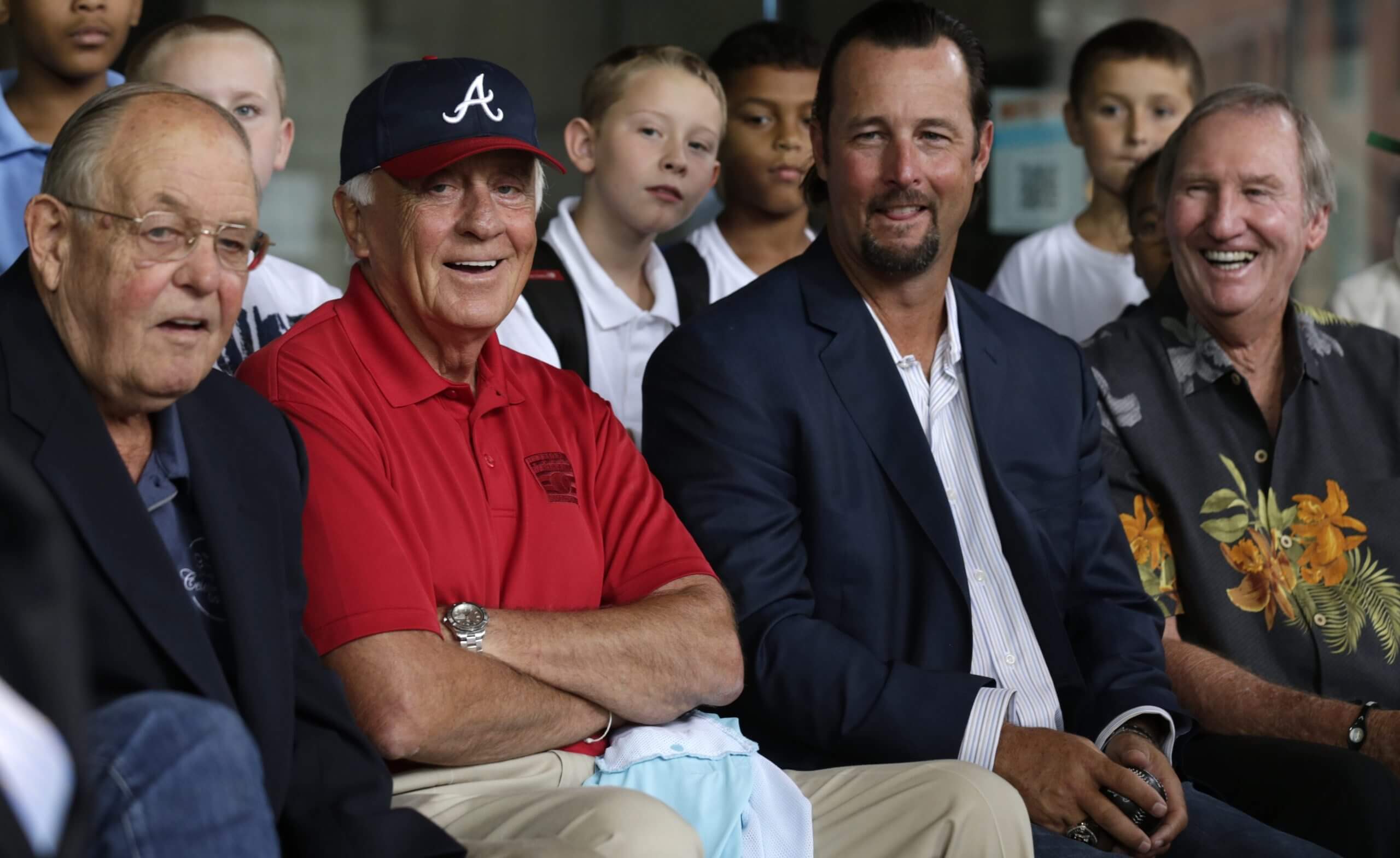
Wood (left) is joined by fellow knuckleball pitchers Phil Niekro, Tim Wakefield and Charlie Hough at a documentary premiere in Boston in 2012. (Charles Krupa / Associated Press)
“You’d get stiff and sore like everyone else, but not using that added pressure with the slider or a lot of breaking balls, that saved a lot of wear and tear on your arm,” Wood said. “Underhand is your natural way of throwing – not winding up and throwing over the top – but I was able to take a lot of pressure off my elbow and shoulder.”
Alas, there was nothing Wood could do about the injury that essentially ended his career. In May 1976, a line drive by the Detroit Tigers’ Ron LeFlore shattered Wood’s kneecap. Just like that, his season was over, and so was his status as an ace.
Since joining the rotation in 1971, Wood had pitched to a 3.05 ERA. In his two seasons after the injury, it was 5.11. He tried too hard to crowd hitters, he said, worried they would extend their arms and smash another one back through the middle.
Wood threw his last pitch in 1978, at 36 years old; at that age, other knucklers like Wilhelm, Niekro and Charlie Hough had another decade or more to go. He did not return to baseball, working in the pharmaceutical industry in Massachusetts.
In all, Wood finished with a 164-158 record and a 3.24 ERA. He also had a sound perspective on a career cut short but a prime to remember.
“I probably would have got several more years in had I not got whacked in the knee,” Wood said. “But I was fortunate to get what I got.”