
Image credit:
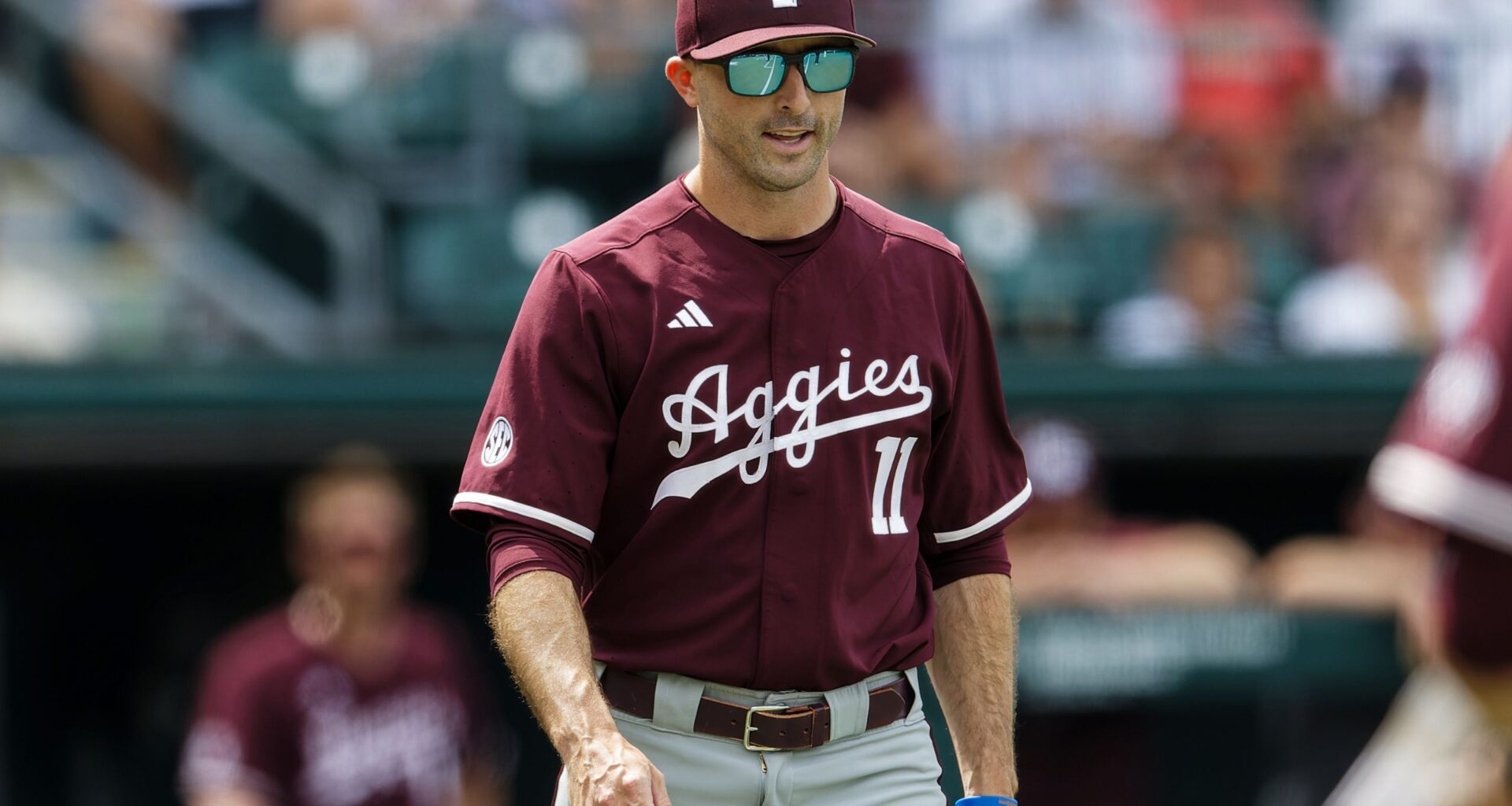
Michael Earley (Photo by Eddie Kelly/ ProLook Photos)
Baseball America released its preseason college baseball Top 25 on Monday, a snapshot of the teams best positioned to contend when the 2026 season opens next month. Just beyond that cut line sits another tier: programs with real substance, clear strengths and enough unanswered questions to keep them just on the outside for now.
The 10 teams below are listed alphabetically, not by proximity to the rankings. Each has a credible case for inclusion—and a specific reason they landed just short.
Alabama
Alabama returns enough high-end talent to warrant real preseason consideration, led by shortstop Justin Lebron, who is one of college baseball’s most impactful players and a potential first-round talent. An older lineup provides stability, while lefthander Zane Adams and righthander Tyler Fay give Alabama experience at the front of the staff and in flexible roles.
Our hesitation to rank the Crimson Tide is structural. The SEC placed 11 teams in the preseason Top 25, yet since 2018, the conference has never finished with more than nine ranked teams, even accounting for Texas and Oklahoma during that span. Alabama’s pitching staff, though experienced, finished 14th in the league in team ERA last season. The roster has enough substance to push into the rankings eventually, but until the pitching shows a meaningful step forward, Alabama remains just outside the cut.
Arizona
Arizona generated real momentum last spring with its run to the College World Series and reinforced it in the offseason with an aggressive transfer haul. The Wildcats added nationally-coveted arms Luc Fladda and Nolan Straniero along with infielder Tyler Bickers, while returning five of their top 10 pitchers from 2025. That group includes No. 1 starter Smith Bailey, power righthander Owen Kramkowski and second-team All-America closer Tony Pluta, giving Arizona a pitching foundation that remains both deep and proven.
What keeps Arizona outside the Top 25 is the scale of what it must replace. Nine players were drafted from last year’s roster and all signed, while none of the five offensive regulars who hit over .280 are back. Brendan Summerhill, Adonys Guzman, Mason White and Aaron Walton accounted for the only players to clear .300, while White and Walton were also the only double-digit home run hitters. All will play pro ball in 2026. That is a substantial amount of production to recreate, and until the new lineup shows it can absorb that loss, Arizona profiles as dangerous but unfinished.
Arizona State
Arizona State put together one of the most productive offseasons in the country, using the transfer portal to offset heavy draft losses on both sides of the ball. Lefthander Cole Carlon returns as a clear top draft 100 prospect, and outfielder Landon Hairston has emerged as one of the nation’s top position players in the 2027 class. The volume and caliber of incoming talent give Arizona State huge upside and kept it firmly in the preseason conversation.
What separates Arizona State from the Top 25 is how much of its roster remains theoretical. New talent is not the same as proven talent, particularly in a competitive Big 12, and the uncertainty is sharper on the mound. Ben Jacobs and Jack Martinez, the team’s top two starters from last year, are gone, and the replacements are far less established. Carlon entered the offseason as the assumed ace, but the fall did little to solidify that role, and it is believed he will open the year in the bullpen.
There is also the program’s recent track record to consider. In four seasons under Willie Bloomquist, now extended through 2028, Arizona State has made just one regional appearance (last year) and did so only as one of the final teams into the field. Until the pitching stabilizes and the results follow the talent, Arizona State remains just outside the rankings.
Dallas Baptist
Dallas Baptist remains one of the safest postseason bets in the country, having made a habit of controlling its league and pushing into the end-of-year Top 25. The track record under coach Dan Heefner removes most doubt, even in seasons with turnover, and the offense should again be a strength. Chayton Krauss returns after emerging as one of college baseball’s hardest hitters in 2025, while Keaton Grady gives the team a proven contact bat and table setter. Several other regulars are back, and the transfer portal added needed depth.
There is a level of uncertainty on the mound, though, that is unusual for the program. James Ellwanger, Micah Bucknam and Mason Peters, who accounted for two-thirds of the weekend rotation and the top bullpen arm, are all gone. Ryan Borberg, Luke Pettitte and Athan Kroll return, and the staff is optimistic about newcomers Jared Shaeffer and Russ Smith. Houston transfer Michael Benzor is also an intriguing variable. The pieces are there, but the pitching must now come together.
Kentucky
Kentucky was among the final teams discussed for the Top 25, buoyed by an experienced position group that reflects the program’s steady rise over the past several seasons. Shortstop Tyler Bell, a 2026 first-round hopeful, returns to anchor an offense that also includes Indiana transfer Tyler Cerny, second baseman Luke Lawrence, infielder Hudson Brown and sluggers Carson Hansen and Ryan Schwartz. It is a seasoned, physical group built to compete nightly—traits that have become staples in Lexington.
The separation point comes on the mound and, more broadly, in conference math. Lefty Ben Cleaver was outstanding last season but must again show that lower velocities and a limited preseason ramp-up from a non-baseball injury can hold up in the SEC. Jaxon Jelkin brings premium stuff after flashing it in bullpens late last year as he worked back from Tommy John surgery, though proving it in games is the next step. Nate Harris also returns after carving out a weekend role.
Kentucky easily could have justified a Top 25 spot, but with the SEC placing 11 teams in the preseason poll, the Wildcats ultimately became another casualty of a brutally crowded cut line rather than a reflection of their quality.
NC State
NC State landed on the wrong side of a difficult cut, which is more a reflection of conference depth than a lack of credibility. Ryan Marohn and Jacob Dudan return to stabilize the pitching staff, while outfielders Ty Head and Andrew Wiggins give the lineup experienced anchors. There is enough returning substance to keep NC State firmly in the national conversation entering the spring.
The obstacle is volume loss and league math. The draft stripped away Dominic Fritton, Shane Van Dam, Justin DeCriscio, Josh Hogue, Andrew Shaffner and Derrick Smith, while the transfer portal claimed catcher Alex Sosa, pitcher Jaxon Lucas and infielder Ryan Jaros.
Baseball America made a concerted effort this year to align preseason rankings with recent postseason conference representation, and the ACC placed seven teams in last year’s final Top 25, the most in the post-COVID era. NC State ultimately fell on that cut line, not because it lacks quality, but because replacing that much production while navigating one of the country’s deepest leagues leaves little margin for error.
Oregon
Oregon again looks well positioned offensively, with shortstop Maddox Molony set to drive the lineup. Molony brings proven production to a group that should sit a tier above most of the Big Ten from a run-production standpoint, giving Oregon a clear offensive identity and a high floor.
The questions are concentrated almost entirely on the mound. Former ace Grayson Grinsell is gone to the draft, and while there is no shortage of arm talent, there is limited evidence it can translate against power-conference lineups. San Diego transfer Cal Scolari and Gonzaga transfer Miles Gozstola have shown promise internally, and Will Sanford has premium stuff, but he walked more hitters than innings pitched as a freshman. If Oregon pitches well, it has the profile of one of the league’s toughest outs, with only UCLA clearly stronger on paper. However, that remains a sizable “if” for a preseason Top 25 case.
Texas A&M
There is no talent-based explanation for Texas A&M sitting outside the preseason Top 25. The Aggies return an abundance of impact pieces, from Gavin Grahovac at third base to outfielders Caden Sorrell and Terrence Kiel, along with a pitching core that includes Shane Sdao, Weston Moss and Clayton Freshcorn. The additions of shortstop Chris Hacopian and outfielder Wesley Jordan only deepen a roster that, on paper, looks comfortably like a Top 25 group.
So, what’s the holdup? The decision to hold Texas A&M out is rooted entirely in last season’s outcome. A year ago, a similarly talented roster opened the season ranked No. 1 and missed the NCAA Tournament altogether. Michael Earley retooled his staff this offseason and early returns have been positive, but until the Aggies translate that talent into consistent results, the benefit of the doubt is withheld. The expectation is not whether Texas A&M belongs in the rankings, but whether or not it will prove it does.
UC Santa Barbara
UC Santa Barbara brings one of the best rotations in the country, full stop. Jackson Flora returns as the ace and will spend the spring making his case as the top starting pitcher in the 2026 draft, a distinction several evaluators told Baseball America is well within reach. Lefthander Cole Tryba and righthander Calvin Proskey give the Gauchos legitimate follow-up arms with top 200 draft upside, while sophomore Nathan Aceves adds another premium option capable of impacting weekends or dominating midweeks.
The separator is offense, as this is neither a powerful nor a proven lineup. Infielder Jonathan Mendez stands as the most reliable returning bat, but he’s more a contact-oriented presence than a true driver of run production. That imbalance has defined recent UCSB teams, including last season, when elite arms were paired with limited offensive punch. If the Gauchos hit even at a modest national rate, their pitching makes them a nightmare in a three-game series. Until that happens, their resume falls just short of the Top 25.
Wake Forest
Wake Forest’s omission is less about what it lost than what it still has to reestablish. The draft removed cornerstone pieces in shortstop Marek Houston and outfielder Ethan Conrad, forcing the lineup into a new shape. The addition of UNCW transfer Cam Bagwell gives the staff an immediate stabilizer on the mound, and Blake Morningstar’s return and underlying traits remain enticing, but both the newcomers and the returnees are being asked to convert projection into production.
Wake Forest should hit, with Kade Lewis and Dalton Wentz back to anchor the lineup. But that expectation still needs to be validated in games with so much responsibility shifting to new roles. In an ACC crowded at the top and compressed at the cut line, the margin for assumption is thin. Wake Forest has the pieces to move quickly, but until both the returning core and the reinforcements establish consistency, the resume was one we felt fit best just outside the rankings.