
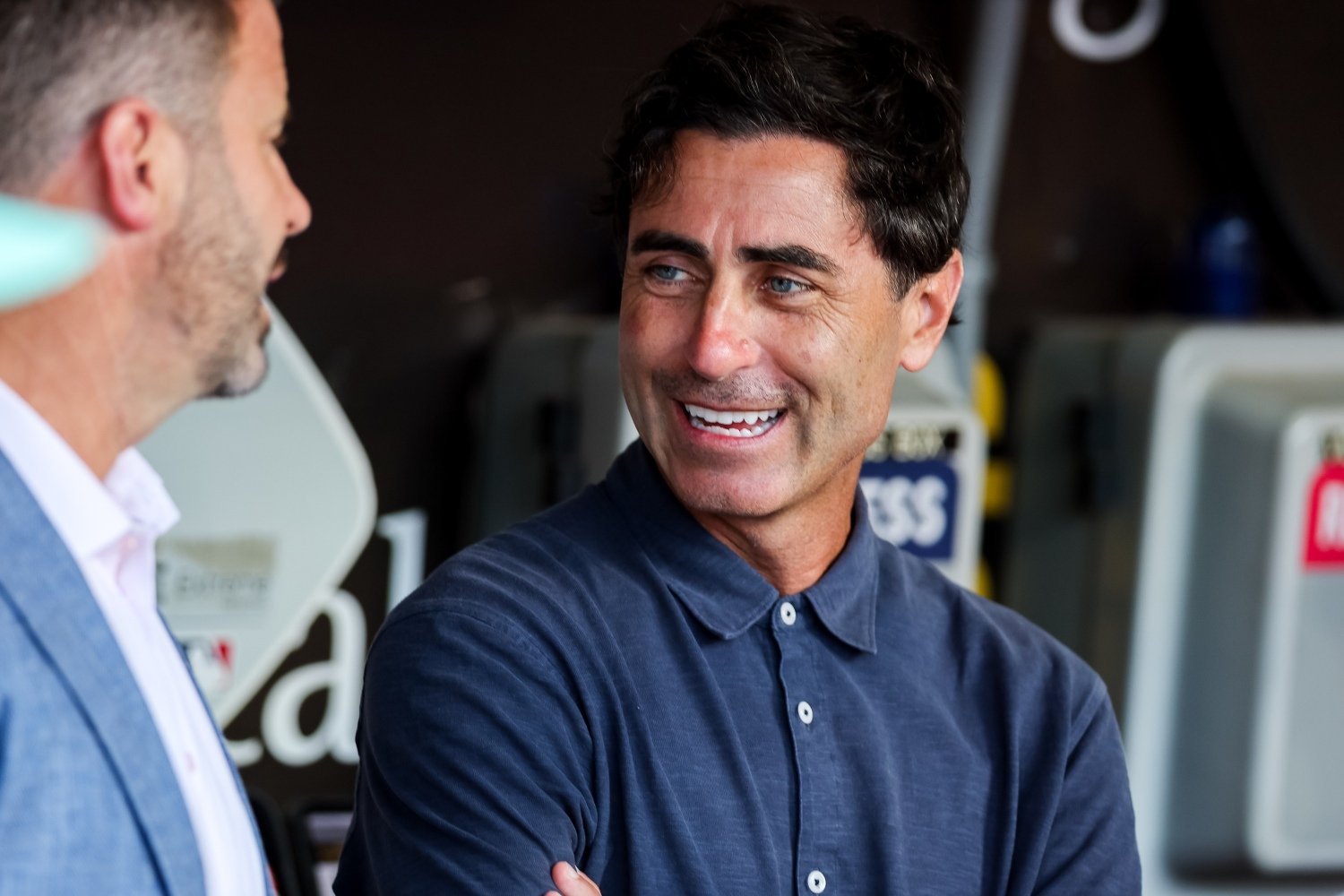
The Milwaukee Brewers have found common ground with the San Diego Padres multiple times during the tenure of Padres executive A.J. Preller. The extremely aggressive Preller is budget-constrained, but not in the same ways the Brewers are, and the two teams share enough overlap in the way they evaluate players to match up on deals when their specific needs don’t compete with each other too much to allow it.
In late 2019, the Crew swapped Trent Grisham and Zach Davies to San Diego, landing Luis Urías and Eric Lauer. In early 2022, they filled their emergent need for catching depth by acquiring Victor Caratini from San Diego, and that summer, they dealt Josh Hader to the Padres for four players. Last July, Milwaukee shipped Nestor Cortes and Jorge Quintana for Brandon Lockridge. It’s hardly surprising, therefore, that the Padres have become a dark horse in the race for Freddy Peralta, whom the Brewers continue to shop as spring training draws near. Ken Rosenthal of The Athletic reported their interest this week, which affirms reporting we brought to you here in mid-December.
In this case, though, no perfect fit exists for the two teams. San Diego’s farm system has been hollowed out by trades and aggressive promotions, and their roster is loaded with talented but expensive players. The Padres’ only prospects with substantial appeal are at least a year away from helping in the majors, which the Brewers rightfully consider disqualifying in Peralta negotiations. The only solid big-leaguers San Diego is willing to move are those beyond the Brewers’ means, in terms of short- and medium-term payroll. There’s just no way for the clubs to align on a deal by themselves.
That doesn’t mean Peralta couldn’t end up on the Padres. It just means that any trade sending him there would have to include three teams. Given the situation San Diego finds itself in, there are two ways that could happen.
Scenario 1: One In, One Out
Along with rumors of their hope to add a starter before spring training, the Padres have expressed at least a willingness to consider subtracting one, according to two league sources. Starter Nick Pivetta had a sparkling first season in San Diego, with a 2.87 ERA in 182 innings, but he’s owed $19 million for 2026. He can opt out of his deal after either 2026 or 2027, but is guaranteed $14 million and $18 million, respectively, if he elects to stick around. Though Peralta would be a one-year rental, that’s effectively the situation with Pivetta, as well, and Peralta comes at a much lower price tag, with a better long-term track record. Unlike Pivetta, Peralta would also be eligible to receive a qualifying offer in November, as long as a deal gets done before Opening Day.
Thus, one version of this potential trade would send Peralta to the Padres and Pivetta to a contending team looking to finish building their rotation. Unlike some other deals structured the way it is, Pivetta’s is eminently tradable. He made just $3 million in 2025, so the competitive-balance tax salary number for him is $13.75 million per year. That’s very affordable for a pitcher of his skills, and whereas similar deals for other pitchers have left would-be suitors worried about holding the bag if the hurler got hurt, this one contains conditional options for either 2027 or 2029, should Pivetta suffer a major injury and spend a prolonged period on the injured list. Those options give the team the chance either to retain him on the cheap or (even if he won’t be available for much of the season in question) to further deflate the tax hit of the deal.
The team from suburban Atlanta would be interested in Pivetta. So would the Orioles, the Yankees or the Mets. It might require the Padres sending one of their prospects who remains far from the majors to Milwaukee to complement a lower-ceiling but MLB-ready piece from Pivetta’s new club, but that’s one way this framework could play out. If the Padres and Peralta agreed to an extension as a condition of a deal, it could further goose the return for Milwaukee.
Scenario 2: Finding a Talent Sink
The big obstacle in matching up the Padres and the Brewers is less the quality of the former’s top prospects than their inability to help Milwaukee defend its run of three straight NL Central titles or push forward toward their next World Series appearance. In another variation on this deal, then, the two teams would seek out a team who isn’t ready to compete in 2026, but who has one or more controllable players who can help a contender this year and beyond. That team would ship a young, valuable player to the Brewers, getting multiple good but far-off prospects from the Padres, while Peralta would join San Diego.
After a leadership change last year, the Nationals are taking a step back to prepare for contention in the long term. MacKenzie Gore has just one more year of team control than Peralta, but he’d certainly let the Crew stay in the fight for the Central. Infielder CJ Abrams has three years of team control left and a dynamic offensive profile. That’s one high-profile example of a team in the right competitive spot, but not the only one. The Rays have signaled a willingness to move backward this season and surge forward thereafter. The Athletics are trying to get the timing right on a return to contention, as they plot their move to a permanent home in Las Vegas. The Rockies, Angels, Marlins and Cardinals all clearly fall into this bucket of teams; the Twins might be drawn into it for the right deal.
Because there are fewer complications surrounding their pursuits, the Mets, Dodgers, Diamondbacks, and Giants are more likely landing spots for Peralta than the Padres. Still, a deal between the Brewers and San Diego is possible, because when Preller wants a player badly enough, he often finds the dexterity to thread the needle and sew up the transaction.