
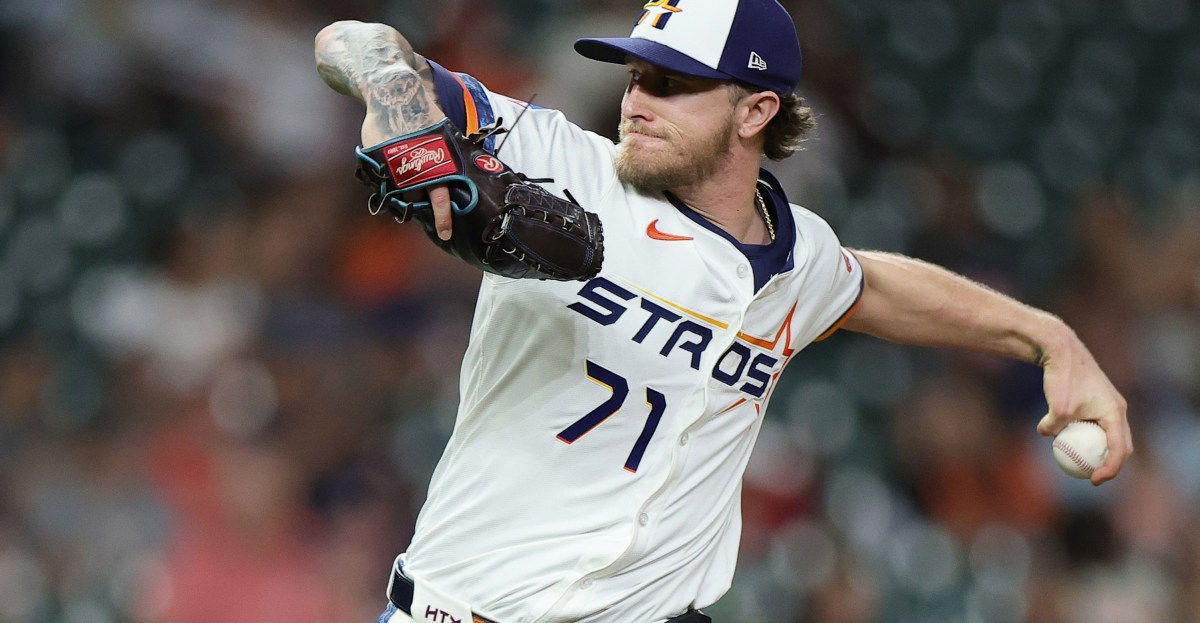
We looked at Astros hitter projections a couple of weeks ago and the natural follow up would be pitchers. However, I specifically waited on them because some projection systems had not released their projections yet. There are still some (like ZIPS) that are not universally available yet. However, there are now enough to get a good idea of what the industry as a whole thinks about the Astros rotation this year.
I should note a couple of things first. The main thing is that projection systems seem to do better with rate statistics like ERA, WHIP, K/9, and BB/9. They don’t do as well with innings, wins, strikeouts, and total walks. So, we are only looking at ERA today. It should also be noted (like we did with hitters) that it is Joe Espada’s job to marshal his resources to maximum advantage. That means choosing who gets to start, how often they start, and how deep into games he allows them to pitch. That will have more of an impact on counting numbers than ERA.
The second thing we should keep in mind is that projection systems are based primarily on batted ball statistics and ERA predictors like FIP, xERA, and SIERA. Those all based their numbers of the type of contact (and amount) a pitcher allows and usually they assume league average fielding and league average luck factors. Statistics like batting average on balls in play (BABIP) and left on base percent (LOB%) vary from year to year even with the same pitcher. Pitchers can control some of that by inducing weaker contact, more groundballs, or more pop flies, but there is a ton of variance there as well. Astros pitchers seem to outpace the projections on a routine basis. Of course, we can look at that in the lab at another time as well.
SteamerATCThe BatOOPSYB-refAggregateHunter Brown3.633.563.593.343.363.50Mike Burrows4.224.164.334.004.014.14Tatsuya Imai4.374.22——4.40——4.33Ryan Weiss4.314.384.404.35——4.36Nate Pearson4.324.544.754.004.854.49Spencer Arighetti4.554.644.834.344.454.56Lance McCullers4.384.594.614.455.114.63Jason Alexander4.304.515.144.714.454.62Cristian Javier4.964.814.844.804.284.74
You don’t have to be a math whiz to figure out the positives and negatives from the table above. I count nine starting pitchers there. Obviously, the max rotation the Astros will go with will be six. So, three of these guys will either be in the bullpen or in the minors. I should note that every projection system had Nate Pearson slated for the bullpen. He is on this list because the Astros have publicly said that he will be a candidate for the rotation coming out.
Once you get past Brown, you could put a blindfold on any of us and ask us to point at a name and we will come out with a similar pitcher in projected quality. Some of these are reasonable surprises. I think most observers are more hopeful that Javier and Imai will pitch better than their projections. I think most fans would be elated if McCullers managed to get close to this projection this year.
The rest are about what we would expect. The clear weakness is a lack of a number two pitcher. Framber Valdez routinely came in with ERAs of 3.50 or lower. He faded down the stretch last year and still came in under a four ERA. So, the math nerds at those various sites are telling us the Astros have not filled that particular role. That brings us to elephant in the room.
When we start talking additions, we are looking at free agents and trades. There is quite literally an infinite possibility when it comes to trades, but the free agents are dwindling. There are two names coming to the forefront on both counts due to rumors circling Isaac Paredes and a potential reunion with a former Astros legend.
SteamerATCThe BatOOPSYB-RefAggregateBrayan Bello4.394.324.384.323.854.25Justin Verlander4.444.474.644.324.284.43
Obviously, Bello is part of a rumored return for Paredes. It would likely be either Bello, Jarren Duran, or Wilyer Abreu. We could get into those specifics at another time, but a part of the calculus on Bello is that he came up with a 3.35 ERA last season in Boston. Those aforementioned ERA projectors all came in considerably higher than that. So, this is one of those push and pull situations where we can fall on one side or the other.
On the one hand, he does not project to be any better in quality than the other Astro hurlers. One of the reasons why you make a trade is that it allows you to improve your team in some area. That can be through a player for player swap or financial considerations that allow you to spend elsewhere. Bello would not save you money and based on the numbers above it would not remarkably improve your prospects.
However, Brown is the only pitcher above that hurled more than 100 innings last season at the big league level. Arighetti’s elbow is being held together by chewing gum and bailing wire. We don’t know what Imai’s workload will be and Javier barely came back from TJ surgery last season. When we throw in McCullers’ frequent ailments we can see that durability does have value. The deciding factor will likely be whether the scientists in the pitching lab think they can unlock something in Bello. We won’t know that until a deal is made.
As far as Verlander is concerned, there are two primary positives and one negative. The negative is the same as Bello. His numbers do not present a considerable bump over what is there. However, he would be another arm that would give the Astros a track record of innings. Adding both pitchers would be impractical, so it would be one or the other depending on what happens with a theoretical Paredes deal.
The main advantage Verlander brings is leadership and public relations. He probably doesn’t increase your winning odds materially through his pure numbers, but his impact on the clubhouse would be a factor and he would be a revenue generator for the franchise. They would need to move around some money to make that work, so it is an open question as to whether that is getting the best bang for your buck. Of course, that is also another topic for another day.