
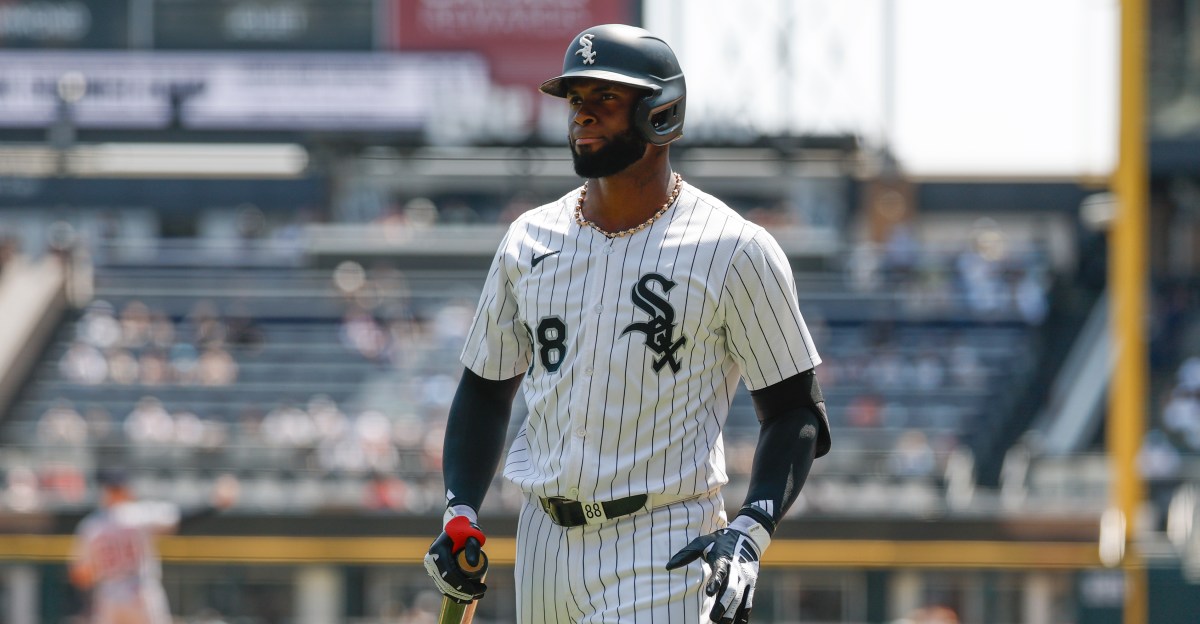
In true Chris Getz fashion, the White Sox are once again in a position that warrants more questions than answers. On a cold and random late January night, the Sox dealt Luis Robert Jr. to the Mets for prospects Luisangel Acuña and Truman Pauley. This trade is anything but straightforward, so let’s dive into it.
Financials
With the trade, the Sox set themselves up for plenty of economic flexibility. With New York footing the bill for Robert’s $20 million option exercised back in November, Chicago won’t risk overpaying a player who slashed .223/.288/.372 in 210 games over the last two seasons. In most circumstances, this financial relief would be welcome. But the Sox aren’t like most teams.
Although Getz hinted that the Sox will spend their freed-up $20 million on players, fans know better than to set their expectations too high. Realistically, rather than pursuing qualified free agents, Jerry Reinsdorf will put roughly $17 million toward Munetaka Murakami’s contract this year — one that required a hard sell from Getz and Brooks Boyer in the first place — and likely spend the remaining $3 million on a pair of one-year relievers.
While dealing Robert makes economic sense, money shouldn’t be the sole driver of trades.
The Return
Acuña headlines a lackluster trade package that doesn’t immediately fill the South Siders’ many needs. Acuña, MLB’s No. 66 overall prospect in 2024, is best known for his glove and quickness on the base paths. He pairs 60-grade speed with impact defense, generating four baserunning runs in 2025 and posting a +2 fielding run value and three Outs Above Average in 2024. For him to stay in The Show, Chicago must help Acuña improve the quality of his contact, which dropped significantly last season to less than 5% for solid and barrel events. Though he didn’t blow anyone out of the water in 2025 with his production (.234/.293/.274 in 95 games), Acuña has proven he can be a faster version of Brooks Baldwin.

Luisangel Acuña’s contact quality on Statcast
Pauley, a 2025 draft choice with scant pro innings under his belt, has more unknowns but leaves fans with plenty of wishful thinking. His stats shouldn’t be heavily weighed in his evaluation, as he has tallied fewer than 50 games between two years of summer and college ball, plus half a season in Single-A. However, the 20 inches of vertical break on his fastball puts the pitch’s dominance in the conversation with hurlers like Chris Sale and Logan Webb — which may be a strong sign of future success if he can keep the ball in the zone.
Acuña and Pauley both bring plenty of unlocked potential to a team that still needs to prove it can successfully develop players.
Short-Term
It’s hard to see how the Sox took a step forward in their rebuild with this trade. Although no one expected it to get an All-Star given Robert’s faltering production, Chicago also didn’t acquire a dependable player who can slot in right field for more than 100 games. In fact, dealing away Robert without a ready replacement coming back now creates a hole in center field.
Another concern with bringing in an inexperienced utility player like Acuña is that it will be hard to guarantee him enough playing time to justify trading away a starter. While Robert’s various injuries sidelined him for 62 games, it will be much harder to carve out a spot for Acuña with several other qualified bench players chomping at the bit for a starting job. In terms of immediate impact, Acuña and Pauley won’t increase the win total dramatically if at all.
Long-Term
The best way to spin this trade is that the Sox are preparing to be in their prime by 2028, which is earlier than many expected. Chicago added depth to a team whose shallow end of the pool is overcrowded — but they’re edging their young guys closer to the deep end with every at-bat. With a surplus of prospects and an abundance of infielders, the Sox can quickly make a few trades to propel them from a fringe playoff contender to a dominant division threat in the next two years, especially if the Chicago takes Roch Cholowsky 1/1 in the 2026 draft.
Overall
For the first time in nearly a decade, the White Sox are straddling the immediate and long-term future rather than past and present. While this is refreshing, patience is still key for a team whose payroll always sits in the bottom third of the league.