
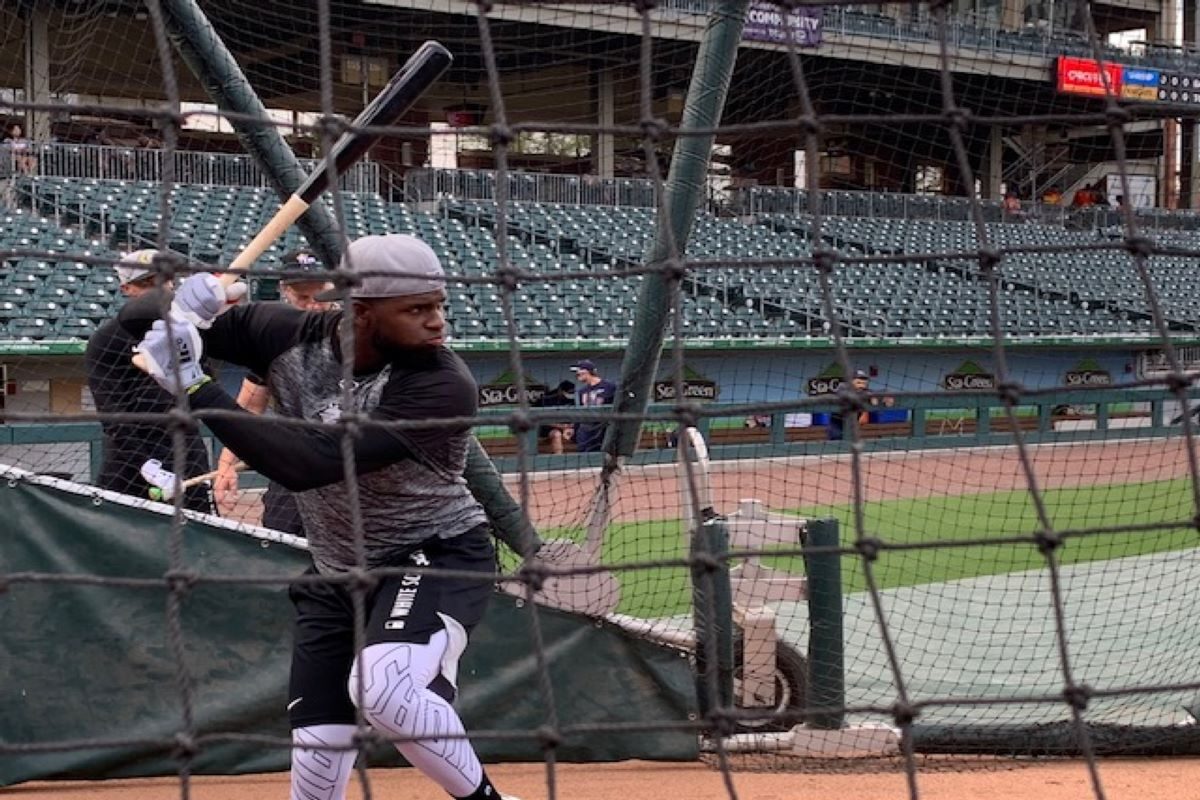
Luis Robert Jr. had been in trade rumors for so long that they had become background noise until the White Sox finally made the move and sent him to New York. For months, this felt like the eventual endpoint. Robert sat at the center of speculation across multiple trade windows while the Mets and Yankees searched for answers in center field. Over the past couple of weeks, the market tightened as preferred options came off the board, leaving one New York club to pivot. Those paths finally aligned. The return falls short of what once felt realistic when Robert trade talk first emerged.
The Mets take on the full 2026 salary and make a calculated bet on Robert’s defense and upside at a modest trade cost. The White Sox move on from the unpredictability and bring back Luisangel Acuña, an up-the-middle athlete whose speed and versatility provide immediate roster utility, along with right-handed pitcher Truman Pauley, a developmental arm with traits the organization believes it can build on. This is not a clean one-for-one talent exchange or a large prospect-haul. It reflects a shift toward keeping options open and managing risk, rather than chasing peak value.
Chris Getz acknowledged that payroll room was part of the calculus once the Mets were willing to absorb the contract. “All things being equal, it really came down to the player return, do we like where this is at, and then there was a bonus, of course, with some financial flexibility,” Getz said. The move leaves Chicago with room to stay active while continuing to target athletic profiles like Acuña, who fit the direction of the roster.
Trade Details for White Sox
The White Sox traded outfielder Luis Robert Jr. to the New York Mets in exchange for infielder Luisangel Acuña and right-handed pitcher Truman Pauley. As part of the deal, the Mets will assume Robert’s full $20 million salary for the 2026 season. Robert also has a $20 million club option for 2027 with a $2 million buyout.
The financial structure was a defining element of the agreement. By moving the entire contract, Chicago cleared both a roster spot and a significant portion of payroll, which factored directly into how the front office evaluated the return. Rather than spreading the value across multiple lower-level prospects, the White Sox prioritized a positional piece they liked in Acuña, along with an arm in Pauley, while fully offloading the salary obligation.
From New York’s perspective, absorbing the contract allowed the Mets to acquire a true center-field option without surrendering a premium prospect package, turning money into the primary leverage point that finalized the deal.
Market Dynamics
The White Sox picked up Robert’s option heading into the offseason. Some evaluators argue that getting rid of Robert earlier would have created flexibility sooner and returned similar player value while addressing the financial side ahead of time, but the White Sox ultimately waited until a club was willing to resolve both at once.
By the time the deal came together, the market had already done much of the shaping. Teams looking for certainty in the outfield were facing escalating costs, and the path to a clean solution narrowed quickly as top options came off the board.
This was ultimately a timing trade. Chicago did not sell Robert at peak value, and New York did not buy him at peak cost. The deal landed in a narrow window where urgency on one side met financial tolerance on the other.
That reality mattered for both sides. New York was willing to tolerate volatility in exchange for a true center-field profile, especially with contention pressure increasing. Chicago, meanwhile, had little incentive to keep carrying uncertainty without a clear inflection point. Robert’s value had become tied as much to availability as ability, and waiting for a perfect sell-high scenario was no longer the priority.
Once a team emerged that could resolve the financial side outright, the equation changed. The White Sox no longer needed to stretch the return across multiple speculative pieces or hold out for a version of the market that might never return.
The outcome reflects that pivot. Waiting no longer improved the return. It only extended the uncertainty. Rather than chasing peak value, Chicago chose a cleaner exit that reduced risk and widened its decision tree moving forward. It is less about replacing Robert’s production directly and more about reshaping how the next phase of the roster is built.
Why the Mets Bet on Luis Robert Jr.
For New York, the appeal lies less in chasing a ceiling season and more in bringing structure to a position that has rotated through short-term fixes. Center field has been addressed piecemeal in recent years, often with defense-first placeholders, and Robert offers a higher-impact profile. His glove and speed immediately raise the baseline, and the upside still exists if the environment helps stabilize his output.
David Stearns said the Mets had been in contact with the White Sox for an extended period and viewed Robert as a defensive center-field solution whose upside justified the financial commitment.
The Mets are not acquiring Robert under the assumption that he will carry the offense. For Chicago, Robert’s value had become inseparable from his availability. For New York, that same volatility was acceptable because his role would be narrower and his usage more controlled.
“We were in contact with the White Sox for a long period of time.”
David Stearns spoke on the recent Mets trade with the White Sox for Luis Robert Jr. last night pic.twitter.com/UnuvqAokmw
— New York Post Sports (@nypostsports) January 21, 2026
The bet is that a reduced spotlight and deeper lineup can allow his tools to play more consistently than they have during the past two seasons. In that setting, Robert does not need to be the focal point to justify the move, only a reliable contributor whose defense anchors the position. Since 2021, Robert appeared in roughly half of Chicago’s games, a pattern that increasingly shaped how both sides evaluated his role.
From Chicago’s perspective, the urgency became clear late in the process. Chris Getz said the Mets’ interest sharpened quickly once other paths closed. “When you sense urgency and know something is real, you usually want to engage on it,” Getz said.
Financially, this is a calculation few clubs are positioned to make. Luxury tax penalties are already part of the Mets’ operating reality, and the added cost does not materially alter their competitive posture. Absorbing the contract gave New York a way to address center field without sacrificing premium young talent.
Getz acknowledged that timeline directly. “They have had interest in Luis for a while,” Getz said. “Yesterday morning is when they felt like they were at a decision point.”
This was not a first-choice outcome. As higher-certainty options came off the board earlier in the winter, the market compressed. The Mets are paying to take on variance, not because they are cornered, but because they can afford to bet on upside where others could not.
Luisangel Acuña
Luisangel Acuña arrives in Chicago with a profile that has been closely tracked for years. He is the younger brother of Braves All-Star Ronald Acuña Jr. He was also the centerpiece of the 2023 Max Scherzer trade when the Mets acquired him from Texas.
Acuña was ranked 66th on MLB Pipeline’s Top 100 list in 2024. He entered the league viewed as a high-end athlete with defensive value and speed. The bat has remained the variable. In 2025, Acuña showed both sides of his game. He earned NL Rookie of the Month honors early in the season. His production faded as the year went on, and consistent playing time was difficult to secure.
“Last year with the Mets, my ground-ball rate was too high,” Acuña said via interpreter. “That’s why I’ve been trying to stay behind the ball a little bit longer and trying to use more of my right leg in order to put the ball more in the air.”
Defensively, his versatility has continued to expand. He has played across the middle infield and logged more outfield time this winter in the Venezuelan league. That usage reflects how teams view his athletic range rather than a lack of position.
#WhiteSox trade acquisition: UTL Luisangel Acuña
2025:
.234/.293/.274 | 65 wRC+ | 0.4 WAR
23-year-old, + speed & defensive versatility across SS, 2B, & CF. Impact runner w/ range & arm strength. Bat remains the question, but athleticism and glove give him a clear utility floor. pic.twitter.com/fpRNSiccye
— Adrian White (@AdrianWhiteSox) January 21, 2026
Chicago has been attached to Acuña before. The club explored him in trade talks as far back as last season’s deadline. This deal provided the access they had been monitoring. General manager Chris Getz emphasized that point after the trade. “We’re talking about a player with five-plus years of control,” Getz said. “One of the younger, exciting players in our game who hasn’t really gotten a runway at the major league level.”
Acuña also arrives with strong organizational endorsements. He said he has a close relationship with former White Sox manager Ozzie Guillen. Guillen told him he spoke with Getz in November and praised Acuña’s makeup and ability.
Getz on Acuna: “I know they didn’t want to get rid of him. I know that. That’s because of how valuable he can be to the team. Now, he was on a roster that didn’t really allow him to let him go out there and show what he could do on a regular basis. We’ll be able to provide that.”
Opportunity will define this chapter. With consistent reps and positional freedom, the White Sox can finally evaluate whether his tools translate over time. For a roster built around options and patience, Acuña fits both the timeline and the approach.
Truman Pauley
The 22-year-old was selected in the 12th round out of Harvard and signed for over-slot money closer to fifth- or sixth-round value. That investment reflected belief in the raw ingredients. Pauley’s traits are the type teams identify and circle during the draft process. His nine-inning, 13-strikeout finale against Columbia likely helped push him onto boards as a draft-eligible sophomore, a profile that usually carries value.
Pauley works primarily with a mid-90s four-seam fastball that can touch 96 mph and features strong vertical carry. The pitch plays above its velocity and gives him a margin in the zone. His breaking ball mix is headlined by a low-80s slider that misses bats and flashes multiple shapes depending on intent. Some evaluators also see cutter and sweeper traits within that slider family.
The underlying metrics help explain the intrigue. Pauley generates whiffs at an above-average clip and shows solid spin across his breaking pitches. His pro debut was brief but effective and reinforced the bat-missing profile. Command remains the swing skill and will determine how far the profile ultimately goes.
At this stage, the most likely outcome points toward a bullpen role. Starting isn’t outside of the question, and it will be interesting to see which role and affiliate he starts with. The White Sox will focus on tightening strike throwing and further separating his breaking ball shapes. There is also room to add an arm-side offering to round out the mix. Even modest gains in those areas could move him quickly.

Getz said Pauley was Chicago’s choice from a “pool” of options the Mets offered as a second piece. Once the financial leverage was settled, the White Sox focused the secondary return on an arm with traits their development group believes it can stabilize, rather than a volume prospect without a defined pathway. Pauley also spent much of his childhood receiving personal lessons from former White Sox pitching coach Ethan Katz.
In the context of the deal, Pauley represents a low-cost upside play. He is the type of arm teams target once the money is handled and the secondary return comes into focus. The White Sox are betting their development group can turn movement and spin into something more stable over time.
Roster Construction for White Sox
The Robert deal offers a clear look at how the White Sox are approaching the next phase of the roster. Rather than anchoring decisions to a single outcome, the front office is leaning into adaptability. The priority is keeping pathways open while evaluations continue, especially in areas where certainty has been hard to find.
Getz framed the next phase as a roster-wide build rather than a single replacement. “You don’t just need to break down certain pockets of the team,” he said. “It’s really as a whole, a 26-man roster if not a 40-man.” He said that flexibility is not limited to one area of the roster. “That could come in starting pitching, relievers, balancing right-handed versus left-handed,” Getz said. “So we are very open-minded and excited in getting to work in being creative and bringing in that talent.”
“We’re talking about a player with five-plus years of control, one of the younger, exciting players in our game who hasn’t really gotten a runway at the major league level.”
Chris Getz on Luisangel Acuña: pic.twitter.com/SImwSPbNHD
— White Sox on CHSN (@CHSN_WhiteSox) January 21, 2026
That approach shows up most clearly in how the outfield now takes shape. Moving Robert leaves center field unresolved in the short term, but it also removes a fixed point that carried risk on both the performance and availability fronts. Instead of rushing to replace that role externally (although that remains on the table), Chicago has created space for competition and internal solutions to emerge on their own timelines.
Andrew Benintendi also can’t be treated as a set-it-and-forget-it left field option if he’s going to need DH days with the Achilles situation, and the club would happily move him if an opportunity develops. Getz pointed to defense as an early foundation in the outfield. “Look at our outfield and the defense with [Everson] Pereira and Acuña, those are really strong defenders,” he said.
Acuña fits cleanly into that environment. His athleticism and defensive feel allow the roster to stay fluid as younger pieces continue to develop. He gives the staff options without forcing immediate answers, allowing the club to adjust as the picture clarifies rather than committing prematurely. He becomes especially valuable on a roster still sorting through long-term fits.
The same philosophy extends to the pitching side. Pauley represents a controllable arm with traits worth developing, added without closing off future avenues. These are the types of bets that allow the system to absorb upside without crowding more established paths.
The financial component ties the construction together. Clearing the full contract creates room to act without urgency and preserves the ability to add without subtracting elsewhere. It also keeps trades available as a tool rather than a necessity as the roster continues to take shape.
This move is not about replacing Robert’s production directly. It reflects a shift toward building a roster that can adjust as information changes. Around the league, certainty has carried a premium. Long-term commitments have become the price of stability, often with limited wiggle room on the back end. Chicago chose a different path here, one that trades immediate clarity for the ability to adjust as the roster evolves.
What Comes Next for White Sox
With the trade complete, the focus shifts from transaction value to evaluation. This move reframes the questions rather than answering them. The success of this trade will not be measured by what Robert becomes in New York, but by how effectively Chicago converts the payroll room it created into playable talent and clearer evaluations over the next year. Chicago is now positioned to learn in real time without having to manage the volatility that followed Luis Robert Jr.
For Luisangel Acuña, the question is not where he plays but how often he plays. The White Sox can let him work through mistakes and see which adjustments last once the season settles. That type of runway was not available in New York, and it will define how his value is measured here.
Truman Pauley’s path will be quieter but no less revealing. His progress will be judged by command and role clarity rather than surface results. The organization can afford patience with an arm that misses bats and still has room to be shaped.
There is also a broader significance tied to this move. The trade closes the final chapter of the 2021 core and removes one of the last anchors to that era. That matters inside the building because it aligns the roster with players who are still forming rather than stabilizing.
The front office now operates with more control. “In general, I think we are going to be very active,” Getz said, signaling that the roster remains in motion beyond this deal. “We’ve already been talking to agents and clubs and anticipate a roster that’s going to continue to evolve,” he said, adding that the money freed by moving Robert’s contract can be put back into the roster.
That control is not expected to sit idle. The White Sox have indicated that conversations are already ongoing across the trade and free agent markets, with rotation depth and bullpen options still on the board. The move only carries weight if that room turns into action. According to FanGraphs, the White Sox project to an $85 million payroll once current costs are accounted for, an identical number to where they finished last season. That context tempers how much room actually exists, and it leaves open how far ownership is willing to let that number move. With pitchers and catchers reporting in a couple of weeks, the follow-through will matter more than the language used to describe it.
This was not a trade designed to replace production directly. It was designed to widen the margin for error. The White Sox chose time over certainty and range over rigidity. What follows will determine how much that choice ultimately matters.
Post Navigation