
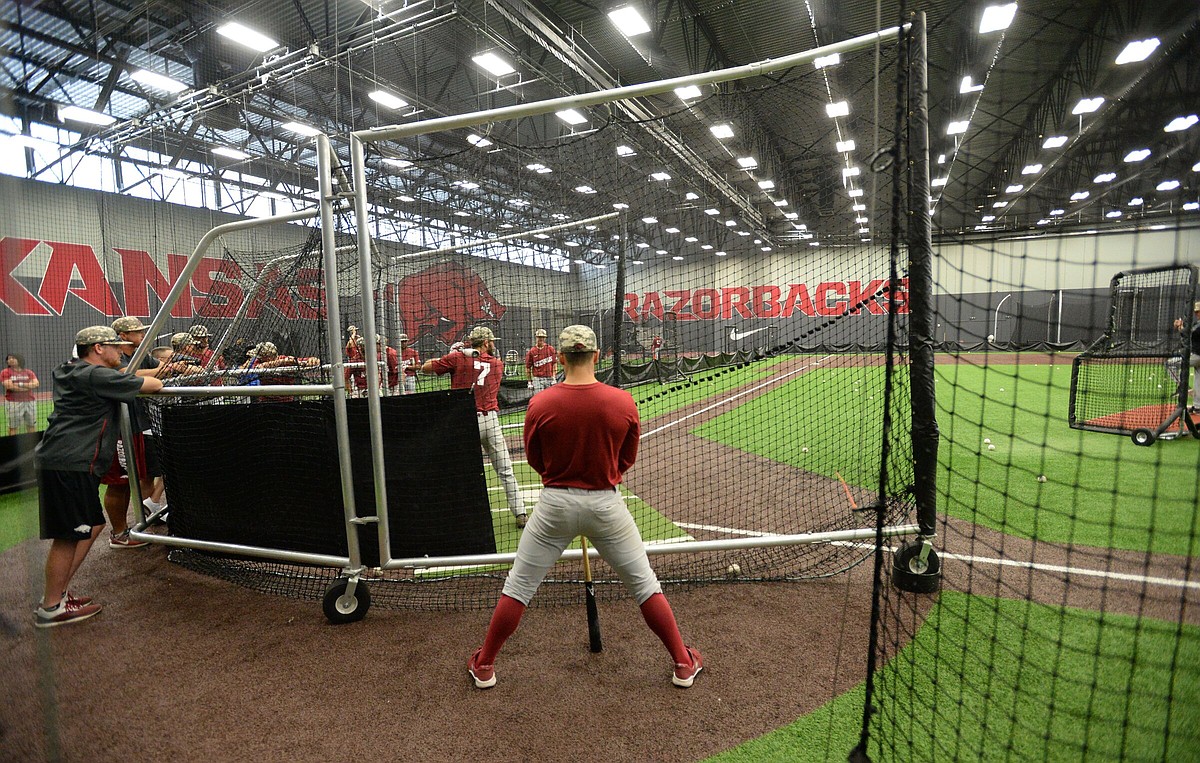
FAYETTEVILLE — When the NCAA approved a longer preseason for college baseball teams beginning this year, it also increased the likelihood teams would deal with more frigid weather in their lead up to the season.
Such is this case for the Arkansas Razorbacks this week. The temperature barely made it above the freezing mark over the weekend when the team was scheduled to have its second preseason scrimmage. Temperatures are forecast to be even colder this week, and there is a chance for snow this weekend.
Baseball weather, this is not.
Fortunately for the Razorbacks, they have sufficient resources to practice on days like these, notably the 52,000-square foot Fowler Family Training Center. It includes a full-sized infield and areas for pitchers and hitters to do individual work.
“If it’s cold, if it’s snowy or whatever, and here in Arkansas we have to fight that a little bit … it’s better than not being able to get on the field at all,” Arkansas assistant coach Bobby Wernes said. “We’re so freaking lucky to have that building. You can work on all facets of the game.”
The Fowler Center opened in the fall of 2014, meaning the Razorbacks have had use of it for 10 full baseball seasons. During that time, Arkansas has ascended from a program that challenged for a College World Series every 2-3 years on average to one that is nationally expected to end each season in Omaha, Neb.
The Razorbacks have been a national seed seven times, been to the College World Series five times, and won two SEC championships and five SEC West championships since the Fowler Center opened. Beginning with 2018, every Arkansas team has been presented with some type of ring, and the expectations are high again in 2026.
Coaches can point to the benefits of the Fowler Center in multiple areas, but it begins with what has become a hallmark of the program under Coach Dave Van Horn: Strong defensive play. The numbers back it up.
Van Horn’s first 12 teams at Arkansas had an average fielding percentage of .965 from 2003-14. Since the Fowler Center opened, the Razorbacks’ 10 teams that played a full season had an average fielding percentage of .977.
Arkansas committed 1.36 errors per game during the Van Horn era before the Fowler Center but has cut that number to 0.82 errors per game in the past 10 seasons. None of Van Horn’s first 12 teams had fewer errors than total games played, but since 2017 each Arkansas team played more games than it committed errors.
Before the Fowler Center opened, the program record for fielding percentage was .974 in 1989. Seven teams have eclipsed that figure since 2015.
Last year’s team, a national semifinalist, had a single-year program record percentage of .983 in the field, which ranked second nationally. The Razorbacks committed 37 errors in 65 games in 2025.
To put that number in perspective, consider that Van Horn’s first CWS team at Arkansas in 2004 fielded .959, with 111 errors in 69 games (1.61 per game).
The Razorbacks are on an impressive five-year run defensively, with an average fielding percentage of .981 and 76 errors in 316 games (0.24 per game). Arkansas has fielded .980 or better each season since 2021 and has ranked first or second in fielding percentage in the SEC each year during that time.
“We’ve had really good players the last 10 years and just some really good infielders — some kids that I feel like they take their infield play, their defense really serious,” Van Horn said. “Before that we had good players, but we didn’t have (the Fowler Center) and it took away reps and practice time.”
In the days before the Fowler Center, Van Horn’s teams had to make do with whatever resources were available for them to practice inside this time of year. There were trips to the Razorbacks’ indoor football facility, as well as an indoor facility at Fayetteville High School.
Walker Pavilion — which houses Arkansas’ regulation indoor football field — is spacious, but it was not designed for baseball, especially not with its white walls that make baseballs hard for fielders to see.
What sets the Fowler Center apart is that it was designed with baseball in mind. There is adequate lighting, color, netting and space to simulate a baseball game, and it is almost always available to players.
Wernes was the Razorbacks’ third baseman in the final season without the Fowler Center in 2014 and the first season after it opened in 2015.
“For whatever reason, it’s like guys are just more willing to do defense on their own in a building like that,” Wernes said.
Nate Thompson, the Razorbacks’ ninth-year hitting coach, recalled seeing the Fowler Center as a visiting coach from Missouri State. From 2015-17, Thompson coached teams that played at Arkansas during the postseason twice.
“I remember being on the other side of it in the regional back in 2017 and thinking, ‘I’d rather hit in here than out on Baum (Stadium),’ just because you’ve got more than a full infield,” Thompson said. “You’ve got three separate (batting) cages right next to it, and you can get all kinds of work done in a short period of time. It’s pretty versatile.”
New players on the team learn quickly that indoor practice days are not light on work.
“They’re intense,” Arkansas first baseman Reese Robinett said. “Outside, you’ve got a breeze and you can feel the weather. Inside, it gets hot and it gets tiring, but it’s good for us.”
As valuable as the Fowler Center is, it cannot totally replicate a practice outside at Baum-Walker Stadium. Outfielders are unable to play in the field during indoor scrimmaging, and Van Horn and Wernes both noted the turf field requires some coaching points.
“I get to talk to them about playing on turf, because it can make you a little lazy,” Van Horn said. “When we go in there, I’m really on them about moving their feet. ‘Don’t let the ball just come to you. Go get it.’ “
The pluses, though, far outweigh any drawbacks of working indoors.
“It just gives us an opportunity to never slow down defensively — fielding the ball, handling the ball,” Van Horn said. “It just kind of pushed us over the top, I think.
“I truly believe that since that building was built that we’ve reaped the benefits of being a better defensive team.”