

After Gunnar Henderson missed the first week of the regular season last year, the Orioles shortstop never left the field again. But that wasn’t because he was fully healthy.
Henderson dealt with a shoulder impingement that included inflammation in that area after he dove for a ball early in the season. The 24-year-old played through the issue and produced decent offensive numbers in 154 games, but Henderson can be added to the long list of Orioles who faced injury setbacks last year.
“Dove for a ball at some point pretty early in the season and had an impingement, and it had some inflammation in there as well,” Henderson said after a Birdland Caravan event in which players and fans volunteered for Blessings in a Backpack.
Henderson first noted his injury during an appearance this month on WBAL’s “Orioles Hot Stove Show.” He also suffered a strained right intercostal muscle in spring training, which is why he spent opening day on the injured list.
The shoulder impingement likely played a role in what Henderson would consider a more pedestrian season.
“I think some of that kind of stemmed to where I couldn’t plane out as early as I wanted to and just kind of chopped down on the ball,” he said.
When Henderson describes his plane, he means the tilt of his swing and how quickly his bat gets into a position that mirrors that of the pitch. While the pitch is moving high to low out of a pitcher’s hand, a batter’s swing ideally moves low to high (not extremely but noticeably).
It should be somewhat of an uppercut to better lift the baseball. For instance, Statcast characterizes the ideal attack angle of a swing as 5 to 20 degrees at the point of contact. That upward angle is flat enough to produce line drives but steep enough to pop home runs.
The benefits of getting the bat on an ideal attack angle earlier are multifold. It can increase the chances of contact, in that, even if a batter’s timing is off, the bat is in the zone long enough to where late or early movement isn’t as penalized. Finding an early plane can increase hard contact and power numbers, too.
With the shoulder impingement, Henderson’s swing was subtly different. His average attack angle remained within the 5-to-20-degree range, but it dipped to 7 degrees in May, compared to 10 degrees the first month of the season. In 2024, Henderson’s average attack angle was as steep as 12 degrees in April.
His average swing path tilt dipped, too. A 0-degree tilt would be perfectly flat, while a 90-degree tilt would be like a golf swing. The average bat tilt is about 32 degrees, Statcast says, but Henderson’s tilt flattened slightly to 28 in August 2025, down from 31 in May 2024.
All of that may have played a role in what Henderson has described as somewhat of a down season, even though he led the Orioles in multiple offensive categories. He hit 20 fewer home runs than 2024 (37 vs. 17), and his on-base-plus-slugging percentage dropped from .893 to .787.
“But looking back on it,” Henderson said, “I’m proud of the way it turned out at the end, being able to put together that season with not feeling 100%. Looking forward to getting back to feeling 100% healthy this year.”
Henderson will begin playing meaningful games earlier this year because of his participation with Team USA in the World Baseball Classic. He said coaches for the national team told him he will move around the infield some and that “whoever is swinging it best” at the time will start games.
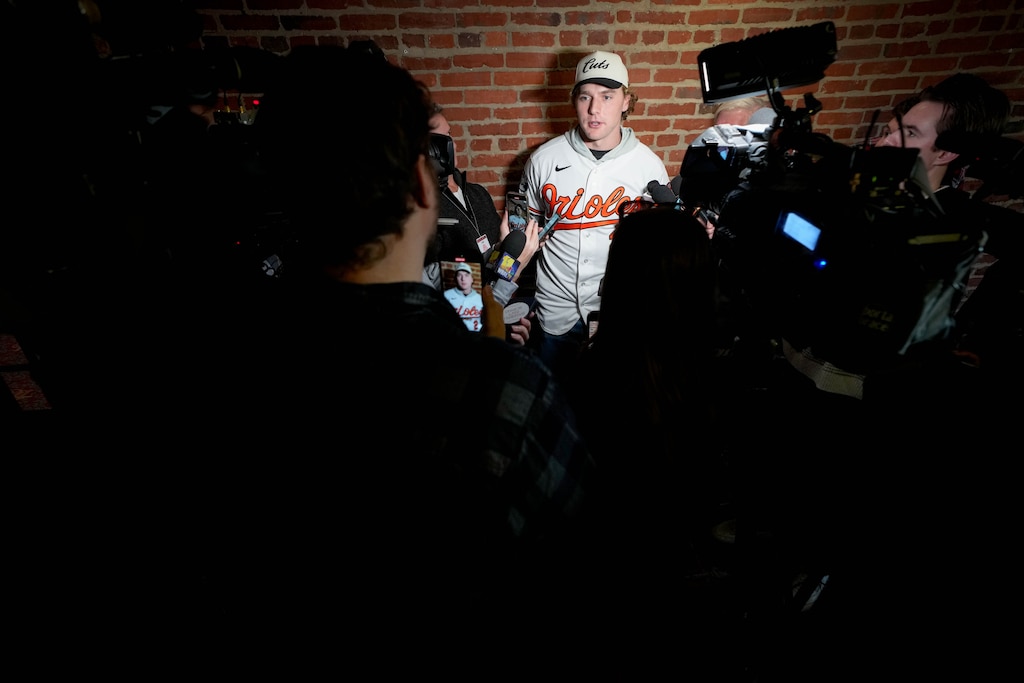
Gunnar Henderson will play for Team USA in the World Baseball Classic. (Ulysses Muñoz/The Banner)
It’s a crowded infield on Team USA. Alongside Henderson are shortstop Bobby Witt Jr., third basemen Alex Bregman and second baseman Brice Turang. Ernie Clement, a utilityman, is also on the roster.
“I’m super honored to be able to wear our country across our chest,” Henderson said.
Perhaps a championship there will only be the first for Henderson in 2026.
Kjerstad returning
The path for outfielder Heston Kjerstad has been arduous, but he is expected to be a full participant in spring training next month, manager Craig Albernaz said.
Kjerstad missed the second half of last season with an undisclosed issue. The team initially described it as fatigue. A source with direct knowledge declined to specify what caused Kjerstad’s absence but noted that he is “completely healthy” and the issue is “fully resolved.”
Kjerstad has faced multiple setbacks early in his professional career. After Baltimore selected him in the first round of the 2020 draft, Kjerstad was sidelined due to myocarditis, which is inflammation of a heart muscle. He didn’t play in the minors until 2022.
Kjerstad played parts of 2023, 2024 and 2025 in Baltimore, but a concussion in 2024 prevented him from appearing more. Early in Albernaz’s reign, the manager said his conversations with Kjerstad have been positive.
“He’s itching to get back to where he can get back to,” Albernaz said. “He had to prove how good he was in the minor leagues. And going to the [Arizona Fall League] and winning an MVP, that’s not an easy league to do that in. It was a great conversation. He’s very thoughtful. He knows what he has to do to get back, and it’s our job as a coaching staff to support him.”