
Not having added a back-end reliever so far this winter has been a choice, of sorts, for the Diamondbacks and general manager Mike Hazen.
He would have liked to have signed one off the free-agent market. But having done so would have come with a tradeoff, he said.
Advertisement
“I wouldn’t have Merrill Kelly,” Hazen said.
The Diamondbacks are coming off another season in which a flawed bullpen was an outsized factor in why they missed the playoffs. Hazen acknowledges this — and has said repeatedly that the Diamondbacks need better results from their relievers.
But he also pointed to a roster that had other areas in need of attention — and decided to deploy his resources to address those needs.
For a rotation that had only three healthy starters, Hazen signed Kelly to a two-year, $40 million deal and added Michael Soroka on a one-year, $7.5 million agreement. For a lineup that lost two corner infielders at last year’s trade deadline, he acquired third baseman Nolan Arenado, taking him on at the cost of two years and $11 million.
Advertisement
His only bullpen addition has been the modest signing of right-hander Taylor Clarke to a one-year, $1.55 million deal.
Hazen said there were several high-profile, free-agent relief arms his group liked and pursued. But when their prices grew beyond a certain range, he went a different direction.
“Walking into the season with three starting pitchers, that (would have been) a problem,” Hazen said. “As far as the talent that I have right now at the major league level and sub-major league level, we have a group of really good arms.
“Some of them are going to emerge as really good bullpen pieces. We don’t have a lot of guys ready to step into our rotation. If I had spent $15 million on one of those good bullpen arms (in free agency), I wouldn’t have Merrill Kelly.”
Advertisement
Since the start of the offseason, 12 relievers signed deals with an average annual value of at least $10 million. The vast majority have extensive experience in the ninth inning. At this point, nearly all of the top free-agent relievers have come off the board, including right-hander Seranthony Dominguez, who landed a two-year, $20 million deal with the Chicago White Sox on Friday, Jan. 23.
That said, Hazen noted that the Diamondbacks are still looking to add.
“I will just tell you this: The bullpen market isn’t done,” he said. “There’s trades out there. They’re still out there. I don’t know what’s going to happen, but I don’t think this is a dead position as it relates to what we’re doing moving forward.
“There are still active conversations all over the place in this area.”
Advertisement
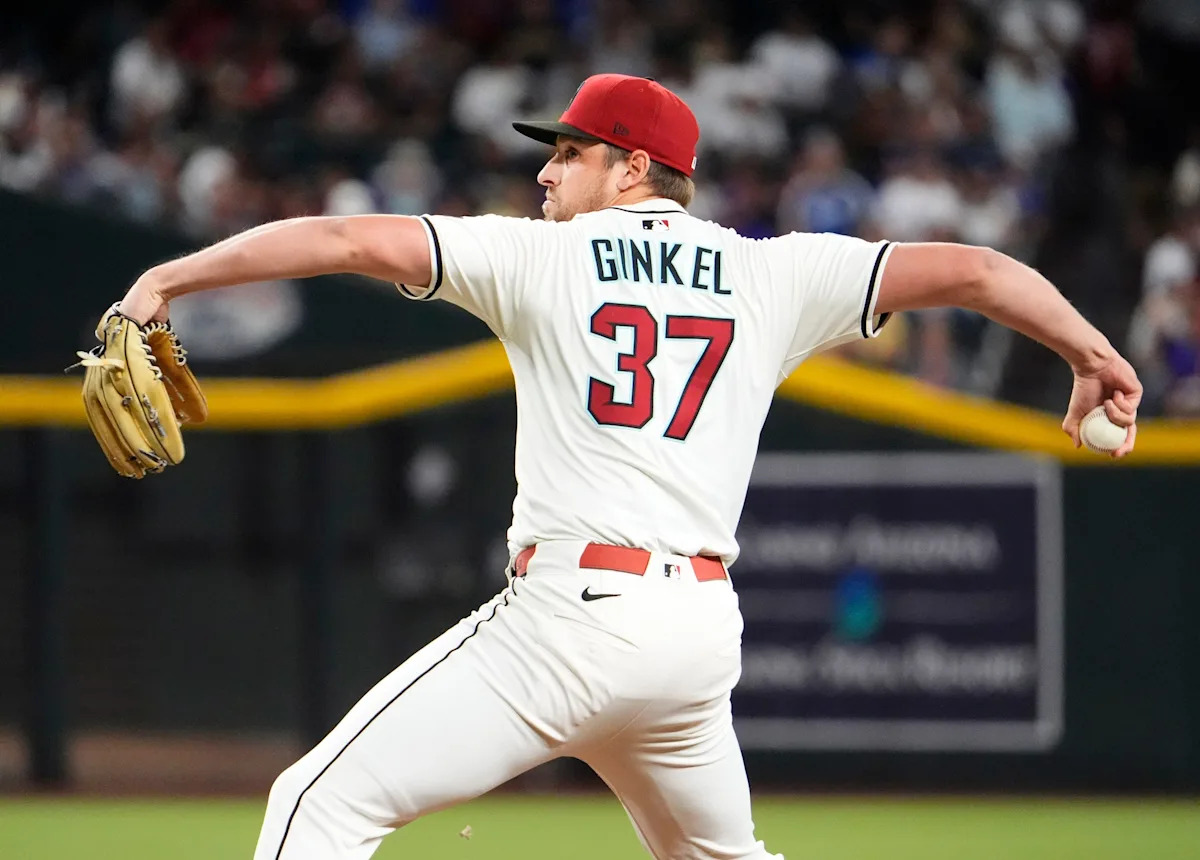
The Diamondbacks’ hopes for an improved bullpen are pinned in a variety of places. Perhaps Kevin Ginkel and Ryan Thompson can be healthier and more consistent. Maybe hard-throwing right-hander Juan Morillo can take another step forward. Maybe Drey Jameson can stay healthy, Yilber Diaz can throw more strikes and Andrew Saalfrank can put together a full, strong season.
Two late-inning options should be back at some point during the season. The club is hoping left-hander A.J. Puk will return from elbow surgery sometime in the first half and that right-hander Justin Martinez will return from his own elbow procedure in the second half. Both pitchers ranked among the better relievers in the majors in 2024.
As Hazen noted, the Diamondbacks also have an assortment of promising young arms at or near the big-league level. Lefty Brandyn Garcia impressed down the stretch last season. Right-handers Andrew Hoffmann, Juan Burgos and Taylor Rashi and lefty Philip Abner all touched the majors last year, as well. Others, including right-handers Kyle Amendt and Hunter Cranton, might not be far away.
The club also will have opportunities for non-roster signees, including right-hander Jonathan Loaisiga, a former late-inning reliever for the New York Yankees who has battled arm problems in recent years.
Advertisement
Hazen can always add to the bullpen as needed ahead of the trade deadline — assuming the Diamondbacks remain in the playoff hunt. He had success taking that path in 2023, when he acquired closer Paul Sewald.
Historically, the bullpen has been a repeated trouble spot for the Diamondbacks, who have long struggled to develop their own power-armed pitchers.
The club spent time and resources in hopes of addressing that this winter, adding a high-ranking official, Jeremy Bleich, to focus on pitching development, and discussing ways of revamping the club’s approach to strength and conditioning.
This article originally appeared on Arizona Republic: Why the Arizona Diamondbacks haven’t added a late-inning reliever