
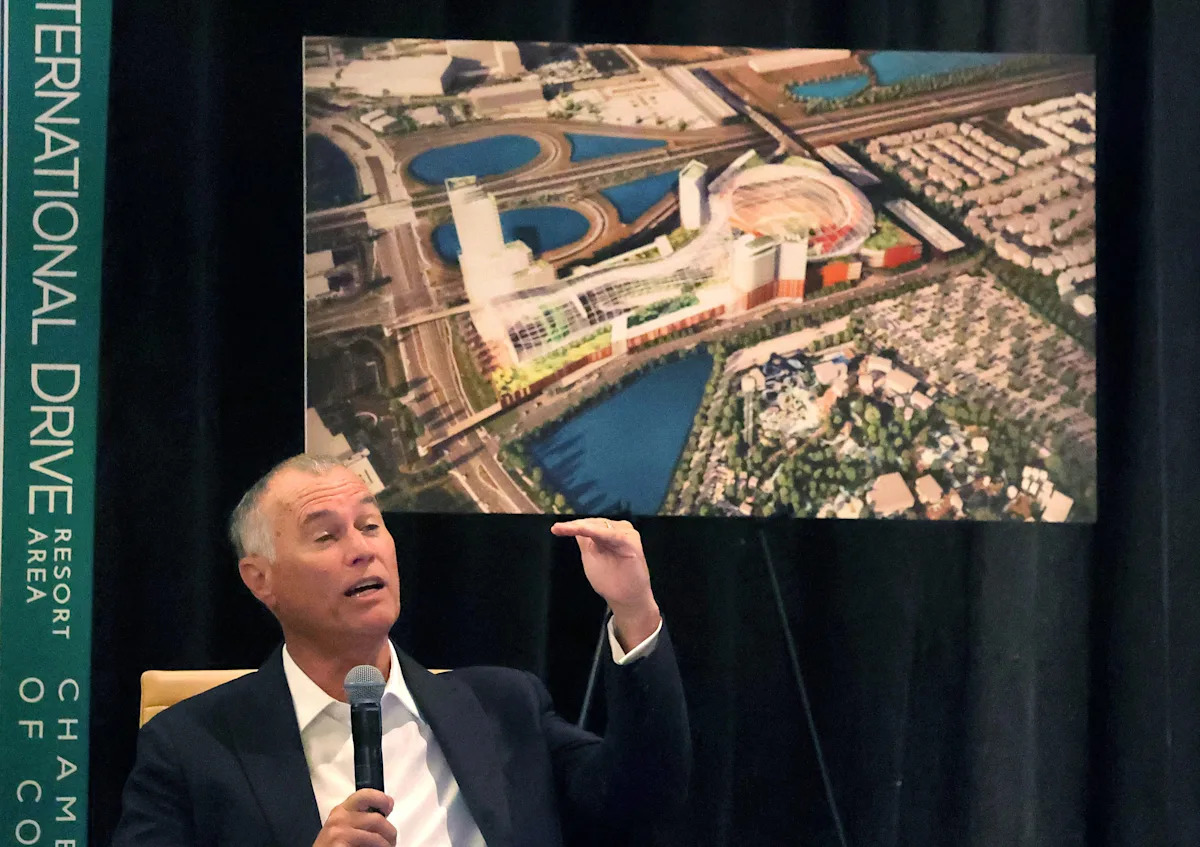
The chatter around the Tampa Bay Rays and their ever-elusive new baseball stadium has taken on an all-too-familiar rhythm — one that sports fans, politicians and taxpayers across the country have heard before.
It goes like this: a team wants a new stadium, the host city hesitates, and suddenly a new city appears on the horizon, eager and willing, whether genuinely or artificially. In this case, Orlando has stepped into that role, and it’s no secret that the Rays’ new ownership group is simply using Central Florida as leverage to extract a better deal from Tampa Bay.
Advertisement
But you know what?
Orlando shouldn’t shy away from that role. We should embrace it.
Go ahead, Tampa Bay Rays, use us.
Use us loudly, proudly and publicly.
In fact, will somebody cue up the song from late, great soul singer Bill Withers:
“Yes, I wanna spread the news,
That if it feels this good gettin’ used,
Oh, you just keep on usin’ me,
Until you use me up.”
Use us up, Rays, just like Hillsborough County Commissioner Ken Hagan — a longtime advocate for getting a stadium built in Tampa — is doing. He went on Tampa’s biggest sports station (WDAE) earlier this week and put out a red alert that if Tampa fails to get a ballpark built soon on a proposed 100-plus acre site at Hillsborough College, then Orlando is ready to pounce.
Advertisement
“I believe that [a new ballpark] is either going to be located at [Hillsborough College] or the team’s going to be in Orlando,” Hagan warned. “The reality is that they have significantly more bed tax revenue than we do, and they’ve been pushing for a team.
“It [Orlando] is an inferior market,” Hagan added. “Their TV market is below ours. People think traffic is bad here? It’s horrible over there. Orlando couldn’t keep the Atlanta Braves spring training team, if you remember that. But the reality is if a deal can’t get reached here, I firmly believe [Orlando is] where they’re going to be playing.”
Do you see what Hagan did there?
He not only sounded the alarm that Tampa might lose the Rays, but then he challenged Tampa’s manhood by saying Tampa may lose the Rays to an inferior Mickey Mouse baseball town like Orlando.
Advertisement
Brilliant.
Hagan is obviously the Rays’ requisite political mouthpiece, providing the new ownership group with the perceived leverage that every team needs when seeking a new stadium. Professional sports franchises have mastered the art of manufactured urgency. They dangle relocation, knowing that cities fear losing cultural relevance, economic activity and civic pride. Fans recoil at the idea of betrayal. Politicians feel the heat.
Ah, the playbook is old, but it still works.
And Orlando has become the Rays’ newest bargaining chip. However, what makes this situation particularly fascinating is the involvement of Rick Workman, the dental magnate and longtime Orlando resident who had been the major money man in the Orlando Dreamers’ effort to lure the Rays (or an MLB expansion franchise) to Central Florida. If you’ll recall, Workman unexpectedly left the Dreamers and became part of the ownership group that ended up buying the Rays in September.
Advertisement
That detail alone complicates the narrative. This isn’t just an outside interest poking Tampa with a stick; it’s a foot planted firmly in both camps. As I wrote when Workman became part of the Rays’ new ownership group, this is actually a good thing for Orlando’s effort to lure the Rays. Workman’s presence blurs the line between leverage and legitimacy. If Orlando were merely a ghost city being floated by Rays owners, skepticism would be justified. But when real money, real business leaders and real ownership ties are involved, the conversation changes.
Critics such as Sentinel colleague Scott Maxwell and high-powered attorney John Morgan argue that Orlando is being played; that the Rays are simply using Central Florida as a pawn. And they are absolutely right. But sometimes you have to start out as a pawn to become the king. I say being “used” in this context isn’t a negative; it’s a positive. Cities don’t have to be naive participants in these games. They can be willing ones.
History supports this idea. St. Petersburg and Jacksonville know it well.
The only reason the Rays have ever existed in St. Petersburg in the first place is because the city was used as a relocation pawn for years and even built a stadium (Tropicana Field) without the promise of ever getting a team. The Trop was 8 years old before MLB finally decided that St. Pete had paid its dues and deserved an expansion franchise.
Advertisement
For years before the Jaguars arrived in the 1990s, Jacksonville was dismissed as a bargaining-chip city — too small, too regional, too implausible. NFL teams floated it in negotiations elsewhere, and skeptics laughed. But Jacksonville stayed in the conversation. It kept its infrastructure plans alive, cultivated business support and made it clear that if the bluff ever became real, the city was ready. Eventually, the league came knocking for real, and Jacksonville was no longer the leverage; it was the destination.
Orlando is in a much better spot now than Jacksonville and St. Pete were then. We are the largest media market in America without an MLB or NFL team and we have a reliable financial mechanism (the tourist development tax) to help fund venues.
I believe our city — even from within its own leadership circles — is often underestimated as simply a tourist hub rather than a major-league sports town. Let’s hope our city and county leaders are doing their due diligence in letting the Rays know that we are willing to do business if Tampa can’t get a stadium deal done. In other words, if the Rays want to point at Orlando while negotiating with Tampa, Orlando should point right back — but with intention.
Being Plan B doesn’t mean being a sucker. It means being prepared. It means doing what the Orlando Dreamers have been trying to get our politicians to do for years now. It means having serious conversations about stadium locations, transportation, public-private partnerships and long-term economic impact. It means assembling business coalitions that aren’t just theoretical but ready to act. If Tampa balks, Orlando shouldn’t scramble; it should already be standing at the podium.
Advertisement
Orlando is not being victimized here; we are being validated. No, we don’t have to beg or overextend ourselves, but we need to let the Rays and MLB know that we are, at least, a credible alternative.
For Tampa, the mere fact that Orlando is viable sharpens the urgency. For the Rays, Orlando’s interest strengthens their hand. And for Orlando itself, the process forces a long-overdue reckoning with how the city sees its future. Are we content to be Tampa’s envious little brother, or do we want to claim some major-league relevance of our own?
And if the Rays ultimately stay in Tampa Bay, so be it. It doesn’t mean we lost; it means Orlando helped our neighbor keep its team. But it also means Orlando demonstrated seriousness, ambition and readiness. Those signals don’t disappear after one negotiation cycle. They linger. They attract attention from leagues, from investors, from future opportunities that haven’t even surfaced yet.
Let’s put our ego aside and remember that every time Orlando’s name enters the conversation, our city moves one step closer to being more than a fallback plan.
Advertisement
Being the leverage city of today can mean being the expansion city of tomorrow.
Email me at mbianchi@orlandosentinel.com. Hit me up on social media @BianchiWrites and listen to my new radio show “Game On” every weekday from 3 to 6 p.m. on FM 96.9, AM 740 and 969TheGame.com/listen