
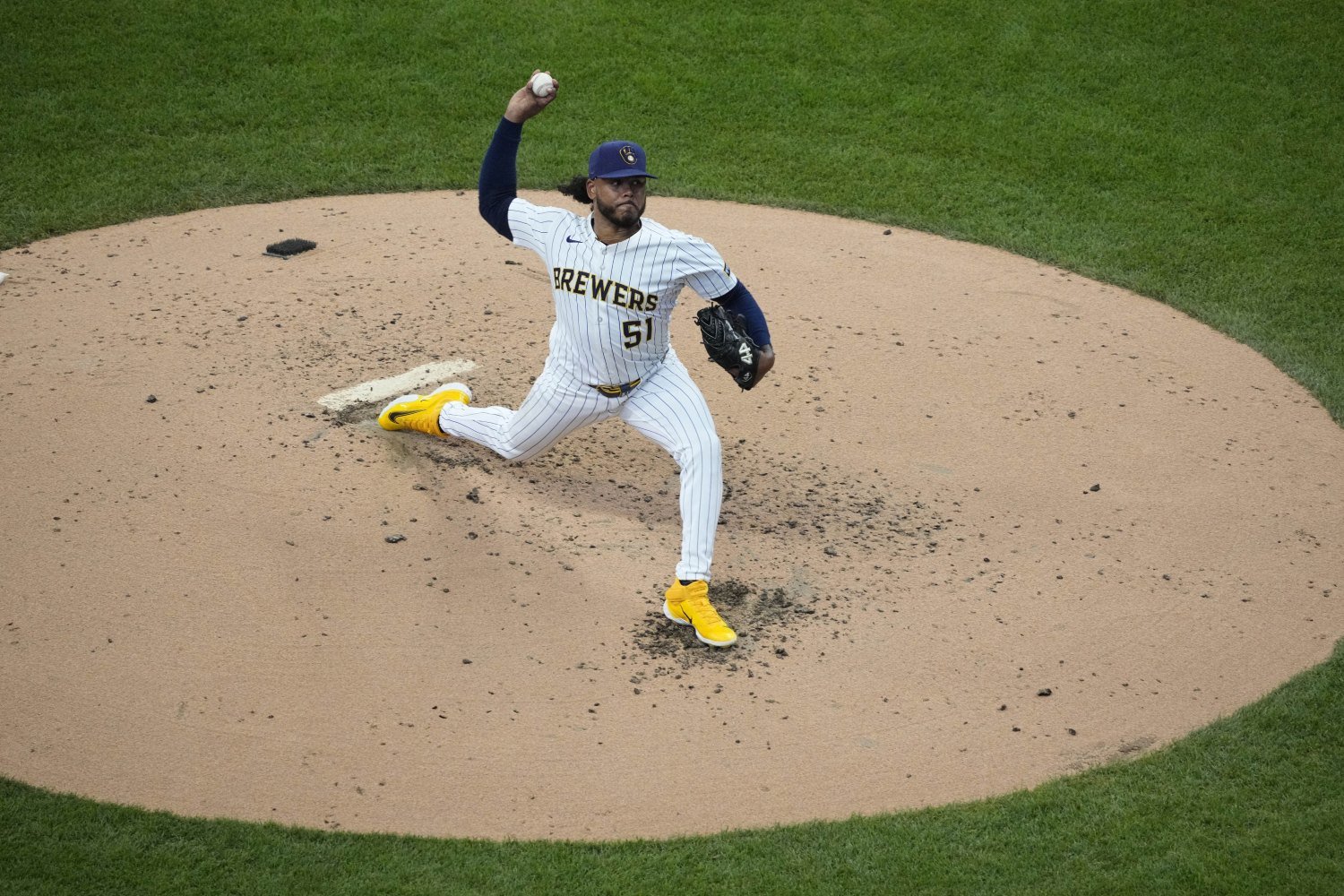
Brewers fans continue to react and accustom themselves to the Freddy Peralta trade that took place last week. Milwaukee got utility man Jett Williams and right-handed pitcher Brandon Sproat for Peralta and Tobias Myers, which has far reaching and overlapping implications. Let’s break them down a bit more.
The Good
Perhaps the biggest benefit the Brewers got was the reinforcement of the farm system. On the face of it, it looks to be similar to the return in the Corbin Burnes deal, in which the Brewers got DL Hall and Joey Ortiz, plus a Competitive Balance pick that became Blake Burke.
The difference? This time, the Brewers got two players from the Mets’ farm system, both of whom landed in the top six slots of MLB Pipeline’s Top 30 list for Milwaukee. Sproat is a better version of Quinn Priester, who should fit in well with Jacob Misiorowski, Logan Henderson, Priester, Chad Patrick and Robert Gasser as long-term pieces in the starting rotation.
Williams is arguably the more intriguing of the two. He appears to be a more potent version of Isaac Collins, a highly versatile infielder-outfielder who could play second base and the outfield. Unlike Collins, Williams has some real pop in his bat and also plays a passable shortstop, should his readiness for the majors coincide with further regression by Ortiz. Had he not been traded, Collins could have spelled Brewers starters at multiple positions. Williams could easily fill that role for Milwaukee, making him a crucial asset in 2026, even with a raw bat.
Bulking up the farm system isn’t an objective worth trading good players for, in itself, but really, it’s just one way to see that the Brewers got two more players who look likely to be solid contributors in the short and medium term, and who are under team control past the end of this decade. Sustaining the winning machine in Milwaukee requires this kind of refueling.
The Bad
On the face of it, the bad includes the fact that the Brewers traded their ace. Even with a very deep rotation, which had a dozen viable options, Peralta is a major loss. It makes Brandon Woodruff the team’s number one starter, unless Misiorowski harnesses his stuff or Henderson can stay healthy. While Brandon Sproat has a chance to be very good, he’s not the proven commodity Peralta was. So the Brewers’ rotation has suffered a slight downgrade.
Nor was Peralta the only useful arm the Brewers surrendered. Myers, a mainstay of the 2024 rotation, will not be arbitration-eligible until after 2027 and would be under team control through 2030. The Brewers probably didn’t have much more use for Myers, given their depth, and the Mets were unwilling to send both Williams and Sproat without getting a second arm in return, but there’s opportunity cost (at least) in giving up Myers as a second piece, and he could yet blossom into a mid-rotation starter.
The Ugly
The Peralta trade is just the latest in an ugly cycle that’s been hitting Milwaukee for decades, whereby the team finds itself priced out of the market to keep the stars it has developed in its farm system.
Major League Baseball has a problem. Any baseball fan who doesn’t root for a big-spending, big-market club can see it clearly. While the Brewers have clearly had an excellent run since 2017, in each of the last four seasons, the team had to trade a top-of-the-line player because it’s effectively priced out of the premium free-agent market. Some of that is a choice by the Attanasio family and the rest of the Brewers’ ownership group, but some of it, too, is a harsh and inexorable economic reality. One way or another, the league needs to better distribute revenue and even out the pain of spending (if not the spending itself) among the 30 teams. Until that happens, these moves will remain annual occurrences, and while it can be fun to watch the Brewers nail it over and over again, that they feel the need to do so is an ugly truth.
What are your thoughts about the positive and negative aspects of the Freddy Peralta trade? Let us know in the comments below!