
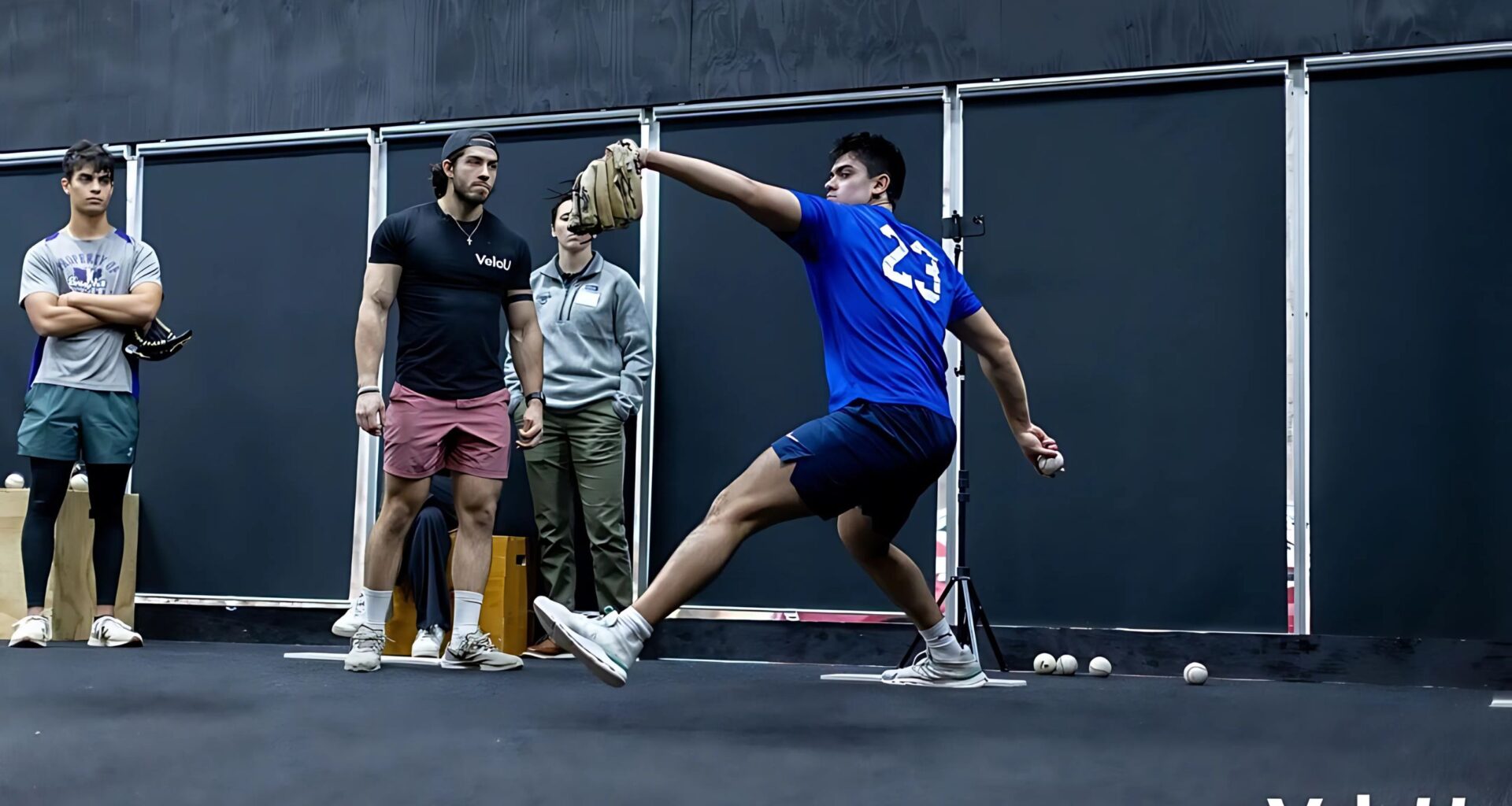
Image credit:
(Photo Courtesy of VeloU)
Dr. Nick Serio is the founder and president of VeloU, a baseball performance and pitching development company focused on improving velocity, mechanics, strength and arm health through data-driven instruction.
Every year, thousands of high school pitchers chase the same dream: a Power 4 Division I scholarship, a chance to play immediately on the biggest stage and, perhaps, a shot to play professionally.
For the past decade, that dream has hinged on whether pitchers could reach a specific velocity threshold by their junior year. Fail to do so, and they risk being invisible to college recruiters. In recent years, that bar has only crept higher, with 90 mph no longer standing as such an impressive benchmark for a high school pitcher.
None of this is new. But the downstream consequences are discussed far less frequently.
From 2010 to 2019, just over 54% of all UCL surgeries were conducted on high school athletes ages 15-191. Many parents and players, though, have a misguided understanding of what an early elbow injury actually means for an athlete’s career.
Despite mounting evidence to the contrary, many parents and athletes maintain a dangerously optimistic view of Tommy John surgery. This perception, unfortunately, is often shaped more by media-driven comeback stories than by statistical reality.
Yet, studies have found that pitchers who have Tommy John surgery before 20 years old have less than half the odds of reaching the major leagues compared to those who tear later in their careers2. This misguided interpretation of injury ramifications, combined with the pressure to throw hard early and prove it often, has led high school athletes onto an injury merry-go-round that, until recently, seemed to offer no way off.
But something unexpected is happening as the landscape for college athletics makes tectonic shifts. The transfer portal, NIL, and the potential for new eligibility regulations are changing when and where athletes are recruited to play college baseball.

The Old Rules No Longer Apply
Now, many Power 4 programs are prioritizing proven production from experienced athletes over long-term development. That shift is driven by the compounding effects of NIL money, along with coaching security demanding immediate results. Teams can simply purchase production, and the transfer portal makes it easier than ever to acquire ready-made talent.
The average age of a Division I college baseball player has jumped from 20.1 in 2022 to 21.9 in 2024, according to the NCAA. Final-year players (seniors and graduate students) now take up roughly a third of all Division I innings, while freshmen barely crack 15%. The incentive structure has clearly flipped. Why recruit a high-ceiling high schooler when you can acquire a 22-year-old with three years of college stats, a mature body, and the ability to contribute immediately?
This shift creates a cascading talent clog throughout college baseball. Players who would typically have been able to compete at higher-level schools are now being pushed to Division II and Division III programs. The dream of playing college baseball has become that much more unreachable for some, especially those who had their hearts set on playing Division I.
The performance trends support the new reality.
In 2024, Division I freshman pitchers collectively posted a 6.95 ERA with 5.72 walks per nine innings. Seniors posted a 5.97 ERA and 4.45 walks per nine. While role, sample size, and usage patterns can all influence those numbers, some coaches view the difference in walk rate as the gap between a reliable contributor and a liability. Older pitchers are, on average, more consistent.
There’s a physical and experiential gap between freshmen and seniors, but some of it is also neurological. The male brain continues maturing well past 18, particularly the prefrontal cortex responsible for decision-making, emotional regulation, and risk assessment. This matters tremendously for pitchers who need to manage fear, make rational choices under stress, and maintain composure when game demands rise. A 23-year-old vs. an 18-year-old in this scenario is immensely lopsided.
None of this suggests freshmen lack talent. But it does help explain why coaches are increasingly choosing to construct teams of players ages 22 or older.
While this may seem like a tremendous blow to high schoolers, what if it’s not all bad? What if a new path is emerging, one that could help curb the UCL injury epidemic while affording athletes the time to make career decisions when they are actually equipped to do so?
The Injury Epidemic Is A Youth Problem
It would be easy to attribute early injuries to poor mechanics for young pitchers, and that certainly matters. A 2018 study comparing high school and professional pitchers found that when high schoolers threw harder, their elbow torque increased proportionally3. Their velocity was directly tied to joint stress. Professionals showed no such relationship. They generated more velocity without a corresponding rise in elbow load. While coordination, proprioception, and movement strategies played a large role in this, are those the only causes?
More recent research adds another layer that shows it’s more complex.
A 2025 study examining the impact of pitching volume found that adolescent pitchers were significantly more impacted by the stress of volume than older pitchers. After just four innings, or roughly 64 pitches, more than half the adolescent pitchers showed significant strength loss in the dynamic stabilizers of the medial elbow, despite producing lower velocity and torque than older cohorts4. In essence, their arms were experiencing less stress but breaking down faster.
Consistent with these findings, another study found that underclassmen from warm-weather states and athletes who had thrown year-round through high school experienced 1.35 times higher rates of UCL reconstruction in their first two years of college than cold-weather peers5.
So while mechanics play a role, there may be a more obvious answer. Older athletes typically weigh more, produce more force and have tissues that are far more adapted to the stresses of baseball. The issue may not simply be how the velocity is generated, but the timeline it’s being demanded on.
Early Injuries Destroy Careers
Getting hurt young doesn’t just delay a career, it shortens it.
A landmark 2023 study tracking 611 pitchers selected in the first five rounds of the MLB draft over seven years found that pitchers who underwent UCL reconstruction at or before age 19 reached the majors 48.1% of the time. Those who had surgery at age 25 or older reached MLB at an 86.2% clip2. That’s a significant gap.
The same study found that for every additional year a pitcher delayed UCL injury after reaching 90 mph, his odds of reaching the majors increased by 24%. Pitchers who suffered early injuries also played 1.5 fewer pro seasons on average. Getting surgery early in an athlete’s career does not give them a competitive advantage. It just means they are recovering while everyone else is developing.
This reframes the entire conversation. The goal is not to avoid velocity. Velocity is still the almighty equalizer for powerful offense. It wins games, gets athletes recruited and, ultimately, drafted. The problem arises when the need to develop velocity becomes necessary before the body has built the infrastructure to support it. The evidence is very clear: Every year an athlete delays that stress, his odds improve.
What If Pitchers Don’t Have To Chase It So Young?
So what do we do with this information? For years, the prevailing model was clear: Develop velocity early, showcase often, get recruited to a major Division I program by 16 or 17 and figure out the rest later.
That model filled operating rooms.
The new landscape, whether by design or accident, is offering a different path. And it might be exactly what young arms need.
If the pressure to reach 90 mph by a pitcher’s junior year is lifted, they can become more patient with their velocity development. For some, junior college baseball can serve as the starting point for their career, providing a more patient development environment to refine their craft and gain invaluable collegiate experience without the consequence of a restrictive timeline.
Two additional years suddenly become available for development rather than desperation. We have strong evidence that velocity is not the enemy, as research shows that its significance to injury actually decreases as age rises. Which means the real issue all along has been the timeline we are forcing upon its development.
The Optimized Path
Baseball remains arguably the most difficult sport to forge a professional career, with only 20,000 major league players in history. Plenty of athletes and parents forget that the true purpose of the collegiate experience is to better their future through targeted education in a subject they could potentially pursue as a career.
I’ve long had issues with forcing 17- or 18-year-old kids into making a decision like that in the first place. The new shifting landscape of college baseball can also allow an athlete to maximize their collegiate experience for life after baseball.
Consider the alternative trajectory. A high school pitcher graduates without a major Division I offer and, in turn, enrolls at a junior college. This allows invaluable time for development, getting core college courses out of the way, and likely at a much lower cost than traditional four-year colleges.
Now, after two years, he has strong collegiate-level stats, his body has physically matured, and he has a majority, if not all, core credits out of the way. He can transfer to a reputable school that carries his desired major and graduate with a bachelor’s degree in two years. In a perfect world, his baseball accolades are now good enough to land a Division I scholarship, paying for most of his undergraduate degree. At this point, he has only utilized two years of eligibility and is 21 or 22 years old. His arm has had time to adapt to high-velocity demand, his mechanics and movement capacities are likely more efficient and his mind should be significantly more equipped to handle the psychological demands of high-level competition.
If his upward trajectory continues over those two years, he’ll still have two more years of Division I eligibility left and an undergraduate degree. If lucky enough, his playing ability has risen to the point where he can gain another offer to play out his final two years of eligibility. If he performed well, he may be granted a graduate scholarship, allowing him to complete his master’s for free while finishing out his collegiate career.
The shift of this rule change has now afforded this athlete the opportunity to compete at the highest levels later in his career, graduate with an advanced degree and put himself in a position to either be drafted or begin his post-baseball career, all while taking on minimal debt.
Many argue that this shifting landscape is actually hurting the American-born student-athlete because he is not being recruited by higher-level Division 1 schools out of high school. If the NCAA allows this ruling to go through, I would completely disagree, as it could eradicate an injury epidemic and fortify student athletes’ careers long after the sport has passed them by.
What About the Elite Talent?
Some will argue that elite talent will always find a way to Power 4 programs regardless of age. I don’t disagree. Top-level talent typically has become physically more mature at a younger age anyway, which is precisely why they are top-level early on and get recruited. But even those athletes are not immune to the injury data. The Kriz study showed that for every additional year a pitcher avoided UCL injury after first hitting 90 mph, their odds of reaching MLB increased by 24%2. So even the kid who touches 94 at 17 benefits from not blowing out his elbow at 18.
The message is not that no one should go to Power 4 schools young. It is that the new landscape removes the pressure to force that timeline, which protects the majority of athletes who were chasing something their bodies were not ready for. You will likely see less and less of the early recruitment path, and that is not necessarily a bad thing.
A New Lens
For years, we have told young pitchers that the path to success is narrow and urgent. Throw hard now. Get noticed now. Commit now. That urgency filled showcase fields with 15-year-olds chasing radar gun readings their bodies could not sustain.
The new landscape is loosening that grip. Not because anyone planned it, but because the economics and incentives shifted. Power 4 coaches want sure things. That means older players. That means the 17-year-old who does not get the offer is not a failure. He has been handed time. Time to grow. Time to develop. Time to let his arm catch up to his ambition.
The question for parents, coaches and athletes is whether they will see that time as a setback or an advantage. The data suggests it should be the latter. The athletes who delay high-velocity stress, let their bodies mature and build careers on a foundation of readiness rather than desperation are the ones who last.
I genuinely believe we would see injury rates drop as the pressure to be so developed so young is lifted. The best thing to happen to young pitchers might be the thing that feels like rejection. It might be the closed door that keeps them healthy long enough to walk through a better one.
References
Solomito MJ, Kostyun RO, Sabitsky JT, Nissen CW. Trends in ulnar collateral ligament injuries and surgery from 2010 to 2019: An analysis of a national medical claims database. Orthop J Sports Med. 2024;12[11]:23259671241290532.
Kriz JP, DeFroda S, Staffa SJ, Kriz PK. Effect of high school showcase exposures and timing of ulnar collateral ligament tear on professional baseball careers in elite pitchers. Am J Sports Med. 2023;51[5]:1194-1202.
Luera MJ, Dowling B, Magrini MA, Muddle TWD, Colquhoun RJ, Jenkins NDM. Role of rotational kinematics in minimizing elbow varus torques for professional versus high school pitchers. Orthop J Sports Med. 2018;6[3]:2325967118760780.
Mullaney M, Kwiecien S, Fink A, Brown K, McHugh M, Nicholas S. Fatigue of the dynamic stabilizers of the medial elbow in baseball pitchers. Orthop J Sports Med. 2025;13[1]:23259671241312487.
Pescatore SM, DeShazo SJ, Weiss WM. Frequency of Tommy John surgery in NCAA Division I college pitchers versus weather conditions. Orthop J Sports Med. 2025;13[2]:23259671251316892.