
With roughly two weeks until pitchers and catchers report, the offseason is starting to narrow for much of the league. Many of the largest chips have moved over the past couple of weeks through free agency and trades. Even with several notable free agents still unsigned, teams now have a clearer picture of their payroll limits and what their rosters are likely to look like once camp opens.
The White Sox are operating in that same window. Trading Luis Robert Jr. removed the club’s largest variable. Signing Seranthony Domínguez addressed a clear need while still leaving room to maneuver. Together, those moves reduced some of the uncertainty around the club and created a more defined range in which Chris Getz and the front office can operate as spring approaches.
Contract details have been released and it’s not a straight annual average value of $10 million for the veteran reliever. Dominguez will receive $7 million in 2026 with a $1 million signing bonus. Theoretically, Chris Getz and the White Sox should have some more room to operate while re-allocating the Luis Robert Jr. savings.
“We’re still fairly active both in free agency and in talking with other clubs.”
White Sox GM Chris Getz is not done making moves 👀 pic.twitter.com/yX0AMZCKcP
— White Sox on CHSN (@CHSN_WhiteSox) January 29, 2026
Chicago has added players to the edges of the roster through minor league signings and early non-roster invites, setting up some camp competition and giving the staff options once camp begins. This weekend, the organization hosts SoxFest Live at Ramova, offering an early snapshot of how the club is framing 2026. FutureSox will be in attendance.
As spring training nears, this is where the offseason stands. Here are some of the key developments and notes that frame where the White Sox stand heading into spring.
Non-Roster Invites for White Sox, MiLB Signings, and Claims
LHP Ryan Borucki:
Veteran left-hander Ryan Borucki joins the White Sox on a minor league deal to add competition to the bullpen. He split last season between Pittsburgh and Toronto and logged 39 appearances with a 4.63 ERA across 35 innings. He struck out 22% of hitters but also missed time with a back injury. With few established left-handed options behind Sean Newcomb, Borucki has a clear chance to compete for a role if he stays healthy. His slider-heavy mix and ground ball profile (54.4%) fit the type of innings the Sox still need to cover.
OF/1B LaMonte Wade Jr.:
LaMonte Wade Jr. arrives as an on-base-oriented depth bat after a difficult 2025 season. From 2021-2024, he was a steady contributor built around plate discipline and production against right-handed pitching. That performance collapsed last year between San Francisco and Los Angeles, leading to his release by both clubs. Chicago will treat Wade as a bounce-back candidate. A strong spring could put him in the mix as a corner option with patience and positional flexibility.
RHP Tyson Miller:
Right-hander Tyson Miller adds experienced relief depth after a strong 2024 season with the Cubs. He posted a 2.15 ERA over 50.1 innings before a hip injury derailed his 2025 campaign. Now healthy, Miller will try to reestablish himself after limited rehab work in Triple-A. His recent track record suggests he can handle meaningful innings if his stuff returns. He likely opens in Charlotte but could work into the bullpen picture with a clean spring.
LHP Rylan Kaufman:
Rylan Kaufman is a high upside flyer coming off Tommy John surgery. Once a top prospect in the Royals system, he missed all of last season but has shown encouraging velocity in his return. Standing at 6′ 4″, his fastball has climbed back into the upper 90s with strong extension. Command has been the separating factor throughout his career. The White Sox will focus on health and strike-throwing as he works back into game action. He’s expected to begin with Winston-Salem or Birmingham.
RHP Jacob Heatherly:
Former 3rd round pick in 2017, Jacob Heatherly profiles as a longer-term evaluation arm after multiple lost seasons. He did not pitch in 2025 and has not reached the upper minors since his time with Cincinnati. When healthy, Heatherly has shown power stuff but also extreme control issues. Chicago is betting on some recovery. His path likely begins in Double-A as he tries to rebuild consistency.
RHP Michael Gemma:
Michael Gemma earned a contract after standing out at a Tread Athletics pro day. The 6-foot-5 right-hander showed a fastball into the mid 90s and a breaking ball that generated a ton of swings and misses. He also displayed a 91 mph splitter and an offspeed pitch he calls the “snapdragon.” His college results were modest, but scouts were drawn to the raw arsenal. Gemma is expected to open in the complex league or Kannapolis.
RHP Anthony Patterson III:
Anthony Patterson III also joins the system after a nice showing at a Tread Athletics pro day and a dominant NAIA season at Georgia Gwinnett. He posted a 2.52 ERA with 75 strikeouts in 75 innings and helped lead his team to a World Series appearance. Patterson’s NAIA World Series outing included seven scoreless innings with eight strikeouts against six hits and two walks. Patterson went undrafted but impressed scouts at the pro day. He brings durability and strike-throwing. His early assignment will focus on translating performance to professional hitters.
LF/2B Darren Baker:
Darren Baker is reportedly nearing a minor league deal with Chicago as a versatile depth option. He has spent most of the past three seasons in Triple-A Rochester and produced a steady on-base profile with elite baserunning value. Baker offers little power but plays both second base and left field. His speed and contact skills give him utility appeal. A strong camp could put him on the radar as bench depth.
LHP Trey Cooper
Left-hander Trey Cooper enters the White Sox system after earning an affiliated opportunity following a recent bullpen session. Cooper pitched in the Appalachian League during the summer of 2024 with the Burlington Sock Puppets before returning to Liberty for his final college season in 2025. After that spring, he appeared in the MLB Draft League with the West Virginia Black Bears, where the swing-and-miss profile continued to show up in short outings. Cooper has experience working both as a starter and out of the bullpen, giving Chicago flexibility in how he is deployed early. The focus going forward will be on improving strike efficiency and sharpening pitch usage as his stuff is tested against affiliated competition.
Ben Cowles:
Ben Cowles was designated for assignment and claimed by the Cubs after a brief stint in the organization. His Triple-A production regressed in 2025. Cowles never appeared in the majors for Chicago. He will join other North-side claimants this winter, Ryan Rolison.
Trey McGough:
McGough has since signed a minor league deal with the Mets after stepping away from the game. Acquired in the Eloy Jimenez trade, he put up a 9.00 ERA in 15 innings, across 7 appearances for the Knights last year.
Free Agent Focus
With Harrison Bader off the board after signing with San Francisco on a deal nearly identical to the one the White Sox gave Seranthony Domínguez, the shape of the remaining free agent market is clearer. Bader was one of the few available outfielders who fit a true everyday role, and he also carried some risk, coming off production that outpaced his expected numbers. Once he landed elsewhere, the market behind him tilted even more toward part-time bats and narrower profiles.
Luisangel Acuña increasingly looks like the organization’s working answer in center field for 2026 after the White Sox targeted him as part of the Luis Robert Jr. return. If Acuña holds down center, the remaining outfield question becomes more focused. It shifts from finding a middle-of-the-diamond solution to identifying a corner bat that can take real at-bats without forcing a rigid platoon or compressing evaluation windows for younger players.
Among fans, Austin Hays has emerged as the clearest perceived fit after Bader, largely because he checks the box of an established major league outfielder with some everyday credibility. A bat that is best deployed primarily against left-handed pitching does not necessarily solve the larger playing-time puzzle. That same concern applies across much of the remaining outfield market.
Michael Conforto has been rumored as a possibility and the White Sox have been connected to him since December, but the fit reads less clean when cost and usage are weighed together. A cheaper version of the Hays idea, such as Starling Marte or a reunion with Austin Slater, is easier to square, as are short-term veterans like Tommy Pham or Mike Tauchman who can rotate through a corner without dictating lineup construction, although not ideal. Miguel Andújar fits the same theme, adding some infield utility while still living primarily in a corner role. Randal Grichuk would be a Royal-familiar type as a platoon veteran if the club goes that route.
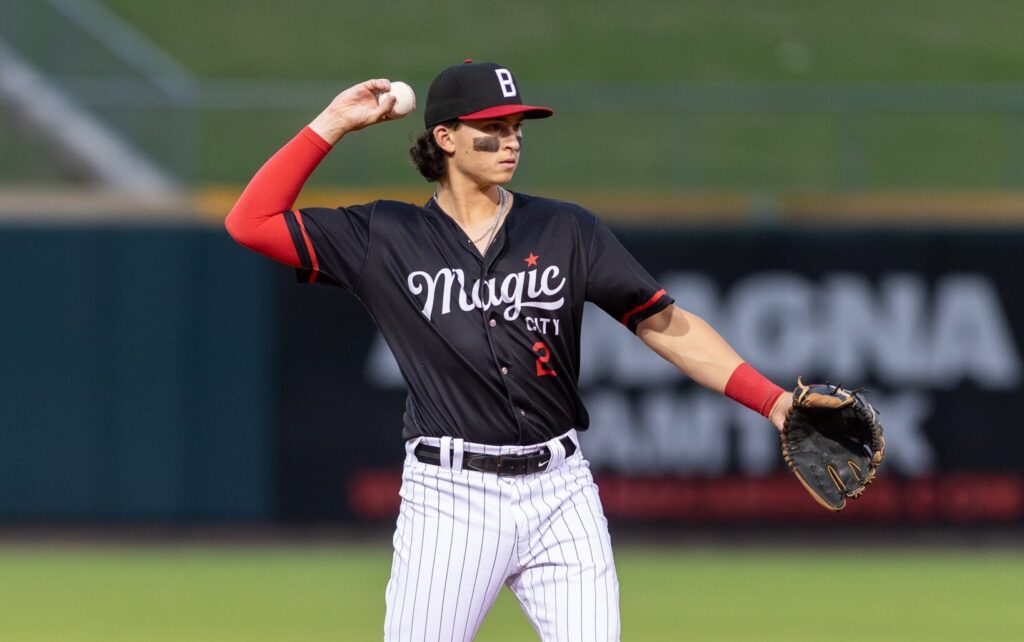 Credit: Birmingham Barons
One common thread across the hitters the White Sox have been linked to or already added is bat speed, with recent targets and options like Randal Grichuk, Harrison Bader, Everson Pereira, Michael Conforto, and Luisangel Acuña all grading out well by that measure, suggesting it remains a quiet point of emphasis in how the front office is filtering offensive fits. The broader takeaway is that there are few clean, non-platoon outfield fits left, which naturally caps how aggressive the White Sox are likely to be.
That reality pushes the clearer spending opportunity back toward pitching. The remaining starter pool offers more viable paths than the outfield market at this stage, and an addition there would bring immediate structure. One more starter would provide innings protection and allow Sean Newcomb to move back into the bullpen. The White Sox have been rumored in that mid-tier starting pitching market, where movement has begun. Zack Littell’s market has appeared to heat up, and pitchers like Littell or Nick Martinez make sense as inning eaters who can toggle between starting and relief if needed. Familiar options such as Aaron Civale or Martín Pérez still fit the same coverage profile.
There is also a group of right-handed reclamation bets that align with how the White Sox have operated in recent years. German Márquez has not been the same arm post-injury, but his performance away from Coors Field has been more competitive than the surface numbers suggest. Miles Mikolas and Chris Paddack fall into a similar category as veterans who may need workload management more than reinvention.
On the higher end, Chris Bassitt remains the ideal tone-setter for a young staff given his durability and experience, and the White Sox connection is there, but he still feels more likely to land with a contender at a price Chicago may not meet. Buzz around Max Scherzer, Justin Verlander, and potential interest in Lucas Giolito from multiple AL Central rivals reflects how teams are still hunting for innings, even if those names do not cleanly match the White Sox’s winter approach.
The broader read is that Chicago is not finished. With pitchers reporting soon, the roster still looks like it needs one more arm and likely one more outfield piece, with the more meaningful investment more likely to come on the pitching side. The White Sox have consistently found usable starters on the margins, and another rebound addition would fit that pattern. If they can add innings without overspending, it may also give them more flexibility to address the outfield with a modest veteran rather than forcing a fit in a thin market.
Infield Logjam
One of the more unresolved questions for the White Sox as spring approaches sits in the infield, where too many players are competing for too few paths to everyday roles. Miguel Vargas, Lenyn Sosa, and Curtis Mead are all out of options, while Luisangel Acuña projects primarily as a center fielder but remains a viable infield option. That combination alone creates pressure, even before performance enters the equation.
Around the league, teams have called on Miguel Vargas in recent weeks. The interest appears exploratory, but it is notable given how crowded Chicago’s infield picture has become. Vargas profiles as the cleanest fit at third base and the easiest player to place into a defined role, which is why he remains part of the plan entering camp. At the same time, if the infield has to be reshaped next year, Vargas looks like the most realistic piece to move.
FutureSox has learned that Lenyn Sosa has drawn far less traction in those conversations. While his bat continues to play, teams appear hesitant to take on the lack of a clear defensive home and the accompanying roster inflexibility. Without a defined everyday position, Sosa’s value is harder to translate into clean solutions, both internally and on the trade market.
Curtis Mead is more central to the equation than Ramos was at this stage. His offensive track record and ability to move around the infield gave him a stronger claim to at-bats, even if his long-term defensive fit remains unsettled. The 23-year-old Ramos was recently designated for assignment for the club and his future seems tepid at best with the organization.
Acuña, meanwhile, is viewed more as an outfield solution with infield coverage rather than a primary infielder, which adds elasticity without resolving the congestion.
The through line is that the group lacks separation. The White Sox are not forcing a decision now. Spring performance will matter, but the real inflection point likely comes beyond 2026, when roles narrow, and the organization has to decide which skill sets it believes in most. Some of it may also unfortunately work itself out in the spring with injuries, something Chicago is all too familiar with.
White Sox Prospect Notes
Billy Carlson offered one of the more telling notes earlier this month in an interview with Scott Merkin. Speaking about his defensive outlook, Carlson said, “Honestly just infield in general has come really easy to me growing up. I think wherever I’ll be at, I’ll be pretty successful, whether it’s second, third or short. I told one of our infield coaches, I was shagging out in the outfield, and I was like ‘Hey if worst comes to worst, I’m a center fielder.”
The comment read less as a positional forecast and more as a glimpse into Carlson’s approach. He is still viewed as the organization’s best defensive shortstop long term, but his willingness to move, even to center field, expands the range of ways the club can deploy him. The value is not in predicting a destination, but in knowing adaptability will not be an obstacle if roster needs shift over time.
There have also been positive signs surrounding Noah Schultz. Merkin reported in December that Schultz’s offseason work at the Boras Sports Training Institute in Miami had drawn strong internal reviews. That assessment was echoed by Chris Getz and reinforced again in January when farm director Paul Janish said he recently spoke with Schultz and that everything is on track for him to be ready when pitchers and catchers report February 10. After an uneven 2025 shaped by knee issues, the focus entering camp is simply health and continuity as Schultz prepares for a pivotal season.
Blake Larson represents another encouraging development on the pitching side. Coming off Tommy John surgery, Larson has resumed throwing in Arizona and is reportedly stronger than he was prior to the injury. Janish noted that Larson’s rehab year was productive and that he has positioned himself well heading into his return, with the organization viewing him as a potential breakout candidate once he is fully back into competitive action.
Tyler Schweitzer will be in Major League camp this spring, with his role still open-ended. The organization has not committed to a full-time bullpen move after using him in a piggyback role, but a shift to shorter stints remains a possibility. That path is intriguing given reports that his fastball ticked up slightly during offseason training, a change that could play up in relief. If deployed in a short-inning role, the underlying stuff profiles to take on added impact, making camp an important evaluation window.
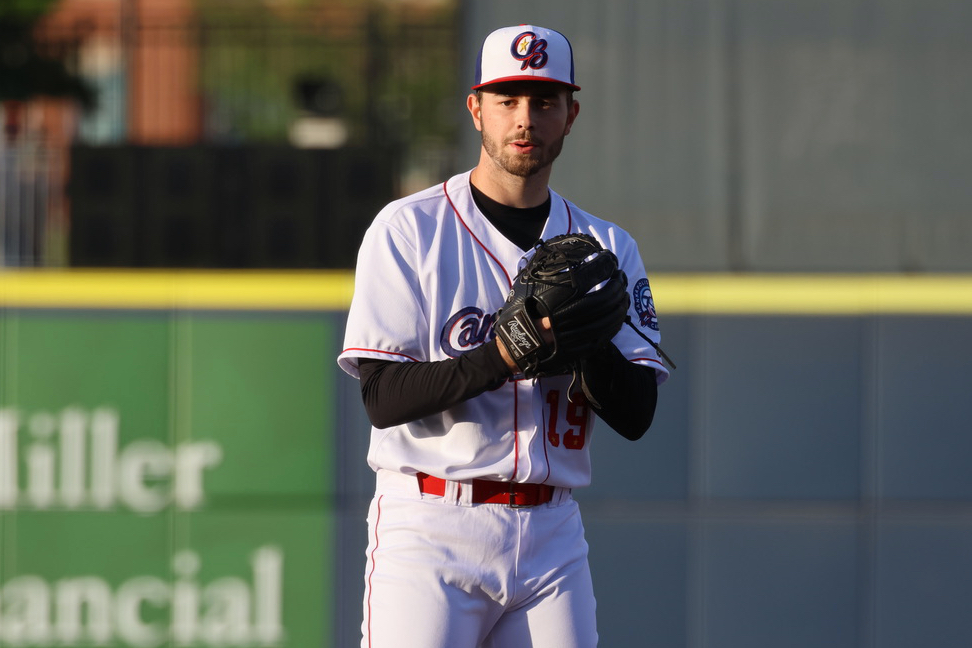 Tyler Schweitzer – Credit: Dan Victor/FutureSox
Truman Pauley is the quieter piece of the Luis Robert Jr. return, but not an insignificant one. Acquired from the Mets alongside Luisangel Acuña, Pauley was a draft-eligible sophomore out of Harvard who signed for $400,000, a bonus that signals more conviction than his 12th-round label suggests. That figure sits closer to sixth-round money and reflects prior interest from the White Sox, whose area scout and East Coast supervisor had already flagged him during the draft process.
Pauley has thrown only a handful of professional innings so far, which makes him easy to dismiss as a throw-in, but the organization views him differently. The appeal lies in pitch shape and underlying characteristics rather than résumé, and the lack of mileage cuts both ways. If he shows well once fully stretched out, he could move quickly onto the prospect radar. The expectation is that Pauley opens in Kannapolis or Winston-Salem, where the focus will be on building innings and seeing whether that pre-draft interest translates into something more tangible over the course of the season.
It was a small but interesting thread to emerge this offseason. Samuel Zavala spent the winter with Cardenales de Lara, sharing the field with Everson Pereira and Luisangel Acuña, both of whom were later acquired by the White Sox in separate moves. Pereira arrived earlier in the offseason in a trade with the Rays, while Acuña was added more recently as part of the Luis Robert Jr. deal.
Zavala remains the lone in-house prospect of the group, but the overlap stands out. Having a White Sox prospect embedded in that environment while two future acquisitions played alongside him underscores how closely the front office monitors winter leagues and secondary markets, and how information gathered there can quietly inform decisions that surface months later.
Other News and Notes
SoxFest Live returns to the Ramova Theatre on January 30 and 31. The event includes player conversations and on-stage programming. With members of the 2026 clubhouse scheduled to appear and front office voices expected to help frame the season. Guests include Sam Antonacci, Chris Getz, Bo Jackson, Anthony Kay, Davis Martin, Tanner McDougal, Chase Meidroth, Colson Montgomery, Shane Smith, Grant Taylor, Kyle Teel (who has confirmed he will compete with Team Italy in the World Baseball Classic this year), Miguel Vargas, and Will Venable.
MLB Network released its Top 100 Right Now ranking, and the White Sox landed a single but meaningful entry with shortstop Colson Montgomery debuting at No. 88. For a player this early in his big-league career, the inclusion is a strong signal and another indicator that Chicago’s young core is gaining national recognition. MLB Network highlighted Montgomery’s offensive impact during his rookie season, noting that he joined Gary Sánchez and Matt Olson as the only rookies to hit 20-plus home runs in fewer than 75 games.
The defensive outlook is just as encouraging. Public projections peg Montgomery at +4.9 defensive runs above average at shortstop in 2026, placing him among the top defenders at the position, while he also grades out as a top-three option at third base with a projected +7.1. That versatility suggests a potential infield shift could enhance his overall value rather than limit it. There was real doubt when Montgomery first reached the majors, but his early performance has flipped that evaluation. He has proven himself both on the dirt and in the box, reshaping the narrative and emerging as one of the clearest success stories of the White Sox youth movement.
A new era of Knights baseball is officially underway. Chad Pinder has been named the Charlotte Knights’ manager for the 2026 season, continuing the White Sox’s emphasis on development carrying through Triple-A. Pinder moves up after managing Kannapolis and has already made it clear that growth does not stop at the upper levels. For a full breakdown of the White Sox’s 2026 player development staff, coaching assignments, and organizational direction across every affiliate, make sure to check out James Fox’s deep dive on FutureSox.
The White Sox were among the teams in attendance at a recent Driveline pro day in Tampa, where left-handed reliever Cionel Pérez threw and impressed evaluators. Pérez sat 95-96 mph with his fastball and looked sharper across his arsenal after a full offseason of work. He posted an 8.31 ERA last year, but the underlying numbers suggest that there is something there (3.93 xERA). Mike Clevinger also threw at the event, but, notably, Chicago continues to track a higher-upside relief option like Pérez. With multiple teams reportedly showing interest, it suggests the Sox are widening their bullpen search
Scott Merkin also helped put an offseason question to rest regarding the White Sox and Japanese right-hander Tatsuya Imai, who ultimately signed with the Astros on a three-year, $54 million deal. In a recent conversation, Merkin reported that Chris Getz characterized Chicago’s involvement as minimal, saying the club was “not close” and confirming that while interest had been expressed, it never progressed beyond that point. The clarification effectively ends speculation that the White Sox were serious players in the Imai sweepstakes.
Something interesting on the MacKenzie Gore trade: Beyond the size of the return, it stood out for what it says about how front offices operate. One of the players Washington acquired was Gavin Fien, a name that had been consistently tied to Boston in draft conversations. The connection is not incidental.
The president of baseball operations for the Nationals is Paul Toboni, the same executive who ran those Red Sox drafts, and when given another opportunity, he finally got his guy. That kind of continuity matters. Evaluations do not disappear when executives change organizations, and prior convictions often resurface in trades, waiver claims, or free-agent decisions. It is a reminder that relationships and institutional memory frequently drive outcomes more than public-facing speculation.
Post Navigation