
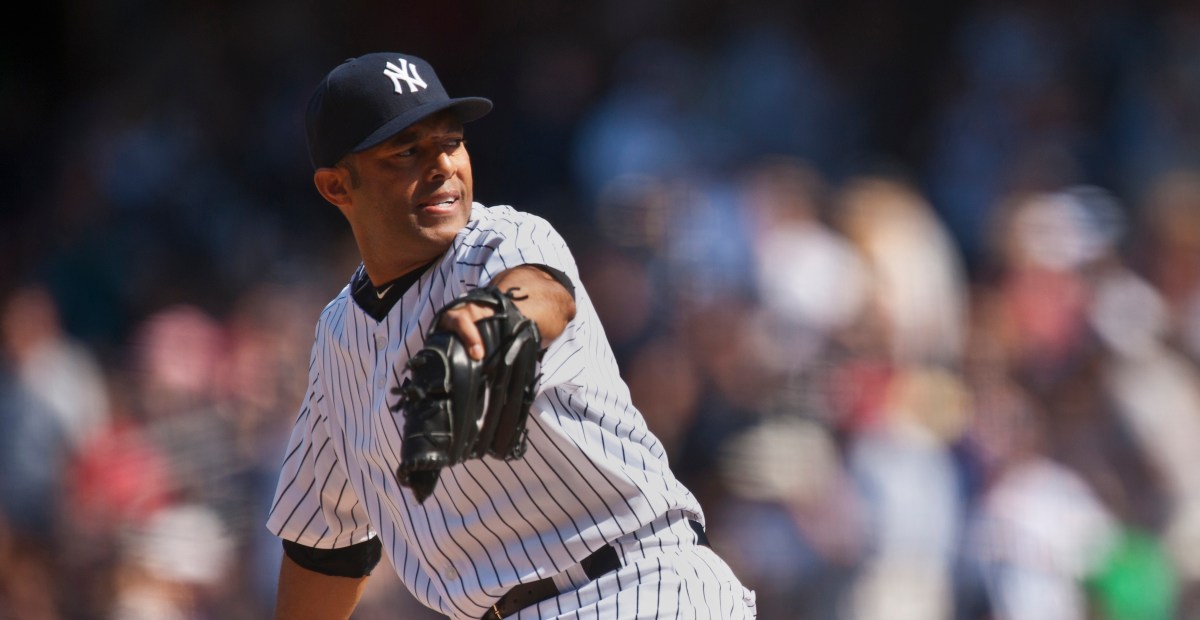
Everything comes down to winning. This is something we hear constantly in the world of sports—the sacrifices to win, the ability to do so, all of it. But, in some instances, one might argue there are bigger things than winning, and for the Yankees in the 2010 offseason, bringing back Mariano Rivera meant more than just improving their chances at a World Series in 2011 and beyond. It meant keeping intact a part of history, a part that’s now looked back on fondly by the player, the fans, and the organization. Rivera stayed a Yankee his whole career, like it was meant to be, and you can’t put a price on that.
Mariano Rivera
Signing Date: December 14, 2010
Contract: 2 years, $30,000,000
The man with the single most lethal pitch in the history of the sport, Mariano Rivera, had already built an entire career as the best closer ever when he reached the open market at the end of the 2010 season. Already into his 40s, Rivera hadn’t missed a beat, having pitched to the tune of a sub-2.00 ERA in each of the past three seasons, accumulating over 110 saves during that period.
Reviewing the Yankees bullpen in 2010, it was particularly reliant on Rivera’s outstanding performance as Joba Chamberlain and Chad Gaudin severely underwhelmed as two of the team’s top setup options, leaving it to the resurgent Kerry Wood to carry a decent chunk of the load. Losing Wood in free agency, the Yankees didn’t have many options, and as we know now, Rivera came much closer to potentially leaving than it originally appeared. An example of these teams’ shortcomings on the pitching side of things came in the 2010 ALCS, when Yankee pitchers accumulated an ERA of 6.57 as they were eliminated by the Texas Rangers in six games. Rivera, as it was customary, did his thing, tossing three scoreless frames, but Phil Hughes struggled as a starter, and a few blowups by the bullpen were enough to kill the Yankees’ chances.
Having spent over 15 years with the Yankees, still pitching at the highest level and for a contender with the biggest pockets in the league, and one that needed him quite desperately, all the pieces seemed to be there for a return without fuss. The only problem was that the rest of the league was also very aware of Rivera’s outstanding abilities, even as a 40-year-old. Previously having spoken about a desire to take things one year at a time, Rivera was entertaining multiyear offers, and while the Yankees topped out at two years, some other teams offered him a three-year commitment.
One can never fully tell what’s exactly going on in a player’s head, and the reasons are there to choose any path they’d like, but there is a certain disconnect in the story of how these events unfolded. While Rivera did receive offers for a longer contract to sign elsewhere, the whole narrative after he re-signed was that he felt compelled to stay with the Yankees, given his long history with the club and all that came with it. Then again, speaking on it shortly thereafter, the Hall of Fame closer was rather open about how close he came to signing with the Red Sox, who—according to Jon Heyman—gave him a three-year offer.
Having already re-signed with the Yankees, Rivera could’ve easily been dismissive about his possibilities of ever leaving, yet he chose to be upfront about discussing the possibility of a contract that wouldn’t have been just any other contract. Rivera pitching for the Red Sox, for however long it could’ve been, would be the type of thing etched in baseball history, given the magnitude of this rivalry, not to mention the impact on the field for that particular period, as he was still the best in the business.
Remember that classic image of Rivera striking out Chris Parmelee looking on a backdoor 0-2 cutter to isolate himself atop the all-time saves leaderboard with 602?
Imagine not only not having that moment but also seeing Rivera set this historic mark in a Boston Red Sox uniform. Thankfully, it didn’t come to pass.
Back for the 2011 season, Rivera wasn’t able to help the Yankees get over the hump through no fault of his own, once again delivering an outstanding campaign. This time, the Yankees were knocked out earlier in the postseason, losing the ALDS to the Tigers in five games. Rivera recorded 44 of the team’s 47 saves, tying a season-high since his 53 saves back in 2004, all of it with a 1.91 ERA, the last of his 11 seasons with a sub-2.00 ERA. What was different from the 2010 season was that Rivera had a superior supporting relief cast, propelled by David Robertson’s breakout campaign, with the then-young right-hander even earning MVP votes with a 1.08 ERA in over 60 innings.
During the second year of his two-year deal, Rivera looked set for another dominant campaign, when a freak injury in Kansas City ended his season early and even threatened his career, given he was already 42 at the time of it. Before a game on the road against the Royals, Rivera was playing around in the outfield tracking fly balls when he felt something in his knee, suffering a torn ACL, ruling him out for the remainder of the campaign. In his early 40s, the all-time saves leader, Rivera, could’ve walked away with nothing left to prove, but the right-hander wouldn’t be denied one more season. Speaking on the subject later on, Rivera made it clear he didn’t want to go out like that, with an injury, instead attempting to return and be able to leave on his own terms.
While the Yankees ultimately dealt quite well with Rivera’s absence in 2012, having Rafael Soriano bounce back from a solid albeit unspectacular 2011 campaign to put up outstanding numbers in 2012, he was a free agent in his own right. Before Soriano signed with the Nationals on a two-year deal, the Yankees had already inked Rivera to a one-year contract to return as the team’s closer this time without all the fuss of other potential suitors. Even in his age-43 season, Rivera drastically outperformed Soriano in 2013, pitching to a 2.11 ERA, a full run lower than Soriano’s 3.11 mark.
Sadly, despite a 13th All-Star campaign, Rivera couldn’t make one final postseason appearance with the Yankees, as the injury-riddled and aging club missed the playoffs in 2013 for only the second time in the 21st century. Still, that return in 2010 lives on as one of the more fortunate, correct, and whatever other adjective you can sum up, decisions the Yankees have made on the open market. At the same time, regardless of the specifics, it’s equally fortunate that Rivera decided to stick around. These free-agent negotiations were, and always are, a two-way street.
See more of the “50 Most Notable Yankees Free Agent Signings in 50 Years” series here.