
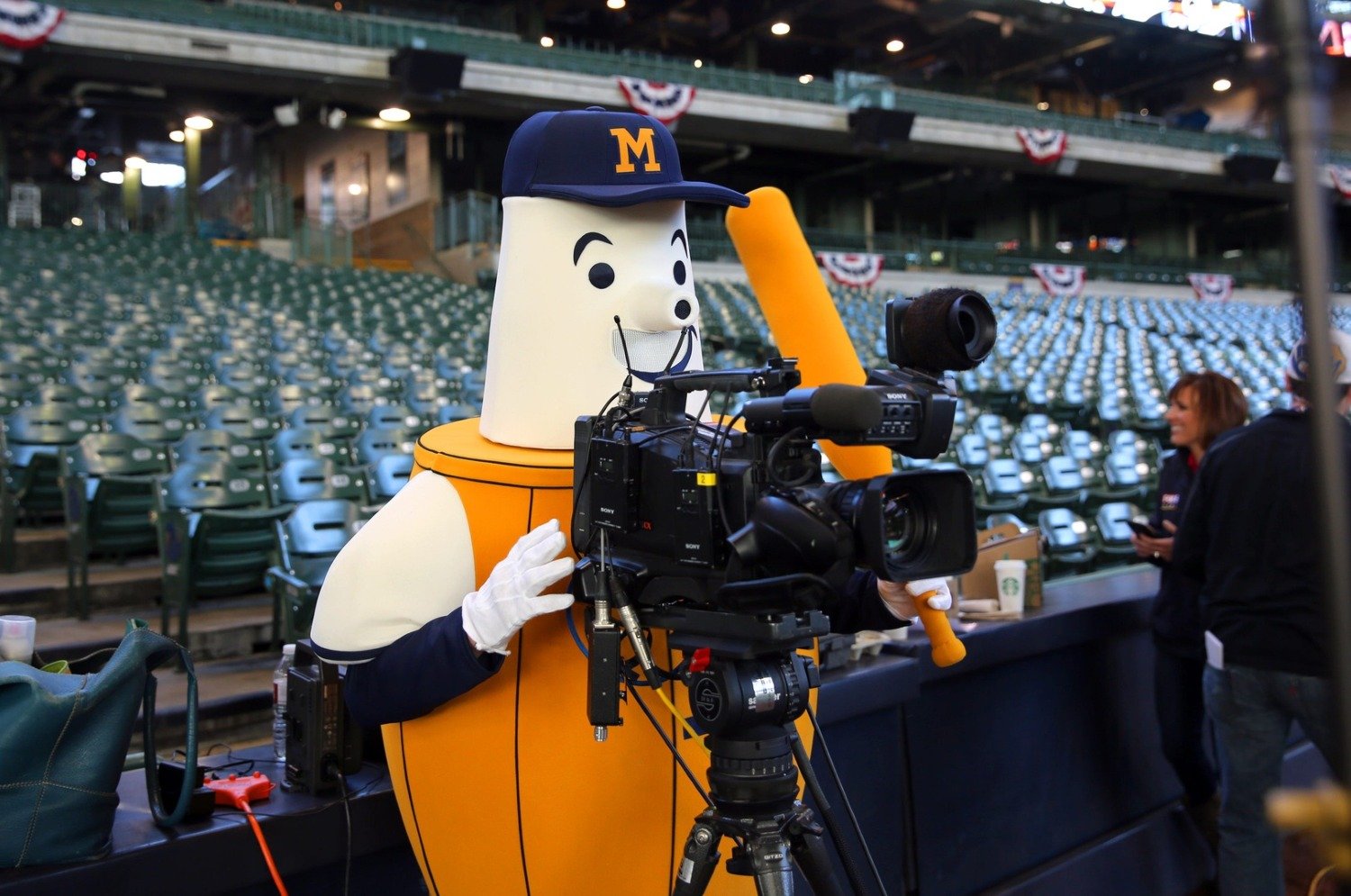
This news was just this side of inevitable, but it still registers as a major development. With their game broadcasts orphaned by the need to terminate their contract with Main Street Sports earlier this offseason, the Brewers join a fistful of other teams in turning over the production and distribution of those broadcasts to the league. If the pattern established by the previous rounds of migration to league-operated broadcasts repeats itself, most of the names you know and love—Brian Anderson, Bill Schroeder, and Sophia Minnaert, for starters—will be invited back, and many of the same people will make the broadcast happen behind the scenes. How the games can be found and a plan purchased, however, will change.
Expect the Brewers to find a home on the major local cable and satellite providers, but they’ll no longer receive any significant amount of revenue from those deals. Instead, they’ll make money almost exclusively by selling direct-to-consumer streaming packages, through MLB.TV. In the short term, this will reduce the team’s income, and that’s unlikely to change for at least a few years. It could, of course, have an effect on payroll, though there’s no reason to assume it will make a meaningful difference in the team’s budget for 2026 or (as some will say) that the knowledge that this was coming prompted the team to trade Freddy Peralta last month.
The regional sports network (RSN) model has been slowly dying for a decade. The Brewers have made less money than in the halcyon days of that system even over the last few years, as they’ve flirted with cutting ties with what was first called Bally Sports Wisconsin, then FanDuel Sports Network but ultimately reunited on short-term deals. They delayed the leap off the financial cliff of the RSN model’s demise for as long as possible, but now, they’ve gone over the edge.
Generally, fans of other teams (including the Rockies, Padres, Twins, Guardians and Diamondbacks) have found the production values on the league-run broadcasts to be solid. However, this transition usually comes with a reduction in ancillary programming, like pre- and postgame shows. Team-run broadcasts have always been largely propagandist outlets, but it’s even harder to convey any measure of criticism when the system is under team or league control, end-to-end. Again, there’s no broad reason to expect the team to change its core broadcast team, but the Brewers are a special case. They have Anderson, Jeff Levering and Lane Grindl, all of whom do other work, too, and Anderson has increasingly ducked out for stretches of the season to perform national duty as a play-by-play broadcaster for basketball, golf, and more. The league and the team could opt to pivot to a primary TV voice with 162-game availability.
More details will emerge over the course of spring training, but Monday’s news gives us a bit more clarity about the Brewers’ future on TV. It also gives us a bit of reason to wonder whether the team can still spend money this winter to round out the roster. After all, they’re likely to make less money this year (if only incrementally) than if their deal had held together for one more season on the RSN model.