
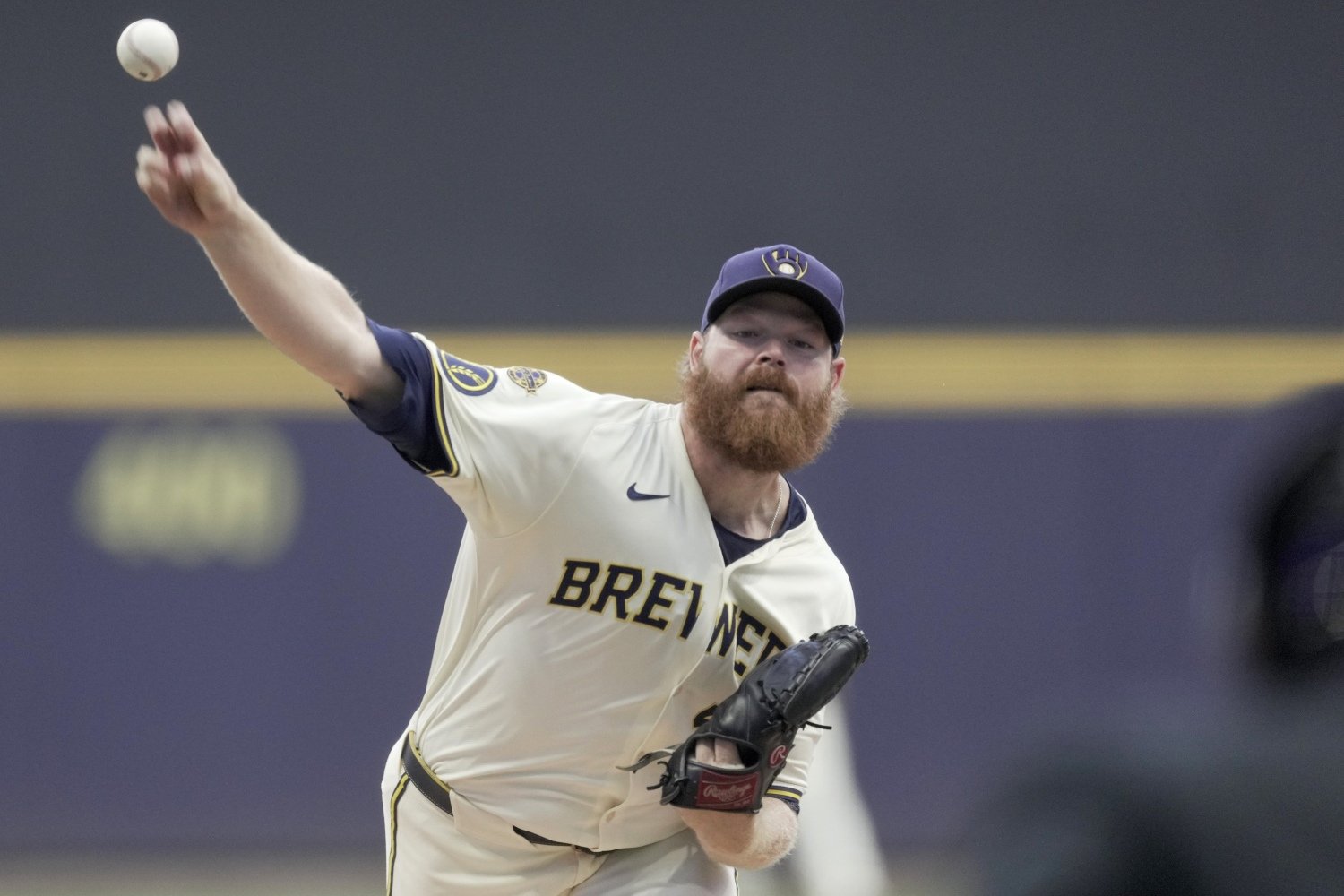
Brandon Woodruff had to transform in 2025, to make up for diminished velocity. Averaging between 96-97 mph since his debut on his four-seam fastball, there were concerns he might be sitting at 91-92 mph in 2025, and that mandated a total change in his arsenal. Instead of blowing fastballs past hitters with impunity, Woodruff had to add wrinkles to his arsenal. The main alteration was to separate his slider into a hard cutter and a sweeper.
Instead of leaning more into his breaking pitches (as you might expect with the lower average velocity), Woodruff continued to lead with his two primary fastballs—the sinker and four-seamer—to begin the year. However, as the season progressed,an interesting change occurred. From the middle of August on, Woodruff’s cutter usage surged:
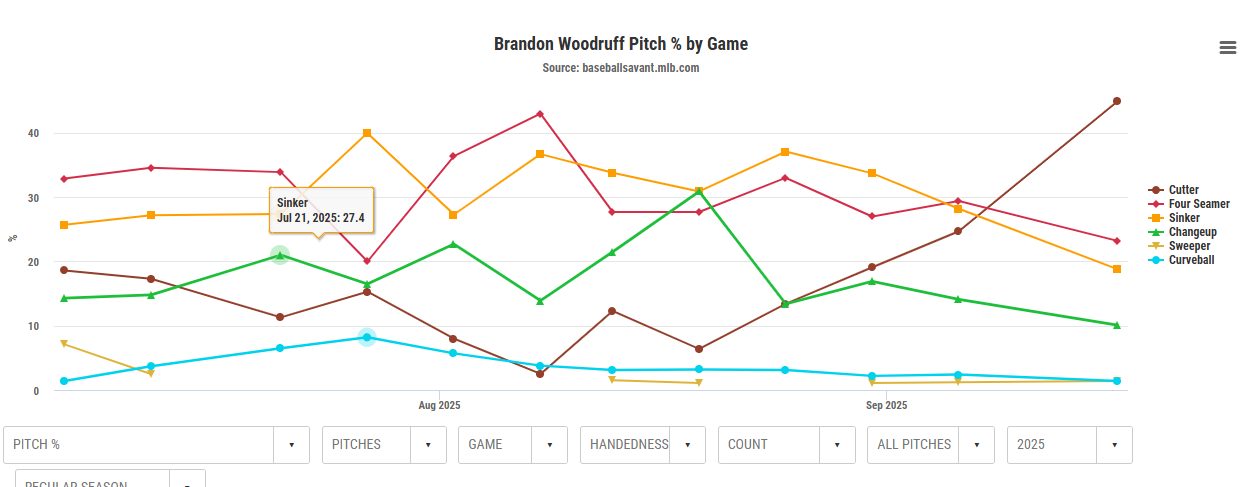
Despite his marvelous surface-level numbers upon returning to the majors, there were some lurking problems. His four-seamer was proving tough to make contact with, but when hitters managed to touch it, they were doing more damage than one would like. In fact, both the sinker and four-seam fastball regressed in August, showing higher xwOBAs in the time during which Woodruff reduced his cutter usage.
The Tunnelling Effect
The main reason for the hard slider/cutter’s introduction was to give hitters a third hard pitch for which to look, loosening their focal point and making it harder to barrel him up. If we look at Pitch Profiler’s match+ diagram and decision point matrix below, you can see two things:
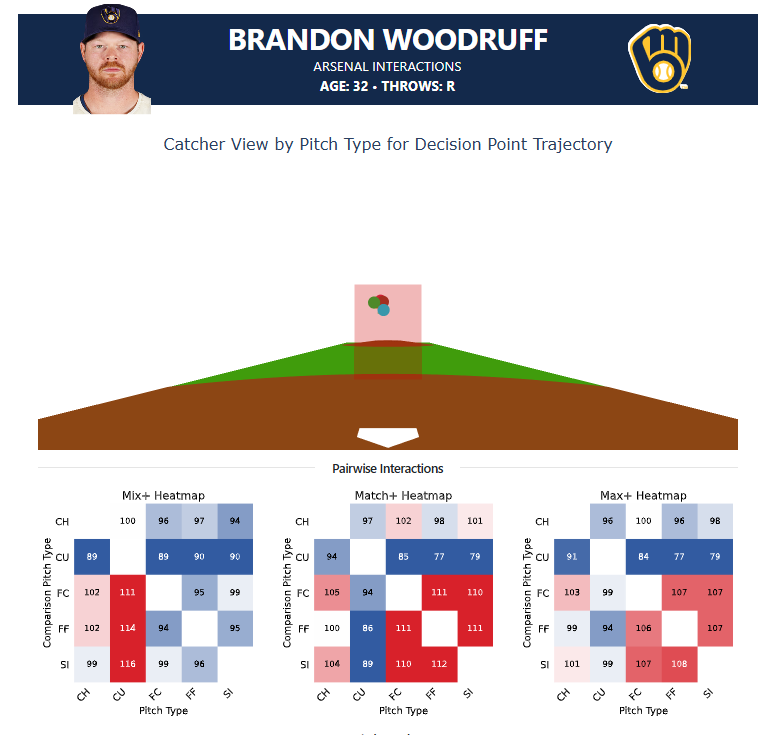
The first observation is that, at the decision point, if all pitches begin at the same location, the only slight deviation is in the changeup (green) and curveball (blue). The other three pitches are so on top of one another that you can hardly differentiate which is which. If we see the same arsenal at the point the pitch passes the plate, all three fastballs are in vastly different locations.
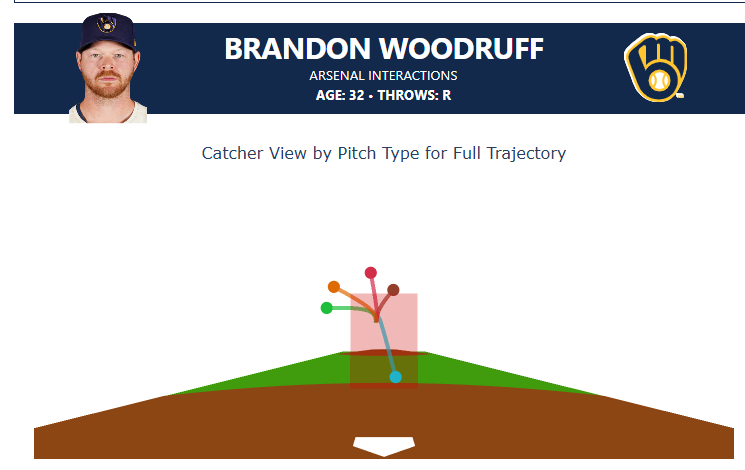
Secondly, studying the Match+ heatmap, you can see a glowing red box in the bottom right, which shows how each fastball (FC, FF, SI) interacts with its counterparts. This model estimates that the deceptiveness of these offerings is 10-12% above league average.
In short, the cutter worked in its initial role as a wrinkle, helping both his sinker and four-seam fastball play up. At that point, the Brewers and Woodruff appeared to realize that the shape and command of the cutter was far better than they had expected.
Just How Good Is Brandon Woodruff’s Cutter?
Over the last month of the season, Woodruff’s cutter emerged as his primary fastball, culminating in his positively cutter-happy final September start. It’s possible he relied on the pitch partially because of fatigue that day, but even prior to that, we saw it with around the same usage as his other fastball variants.
Out of all cutters that comprised at least 15% of a starting pitcher’s arsenal and were thrown over 150 times in 2025, Woodruff’s ranked 15th in whiff rate. That would place him in the 82nd percentile—not bad for a player throwing the offering for the first time.
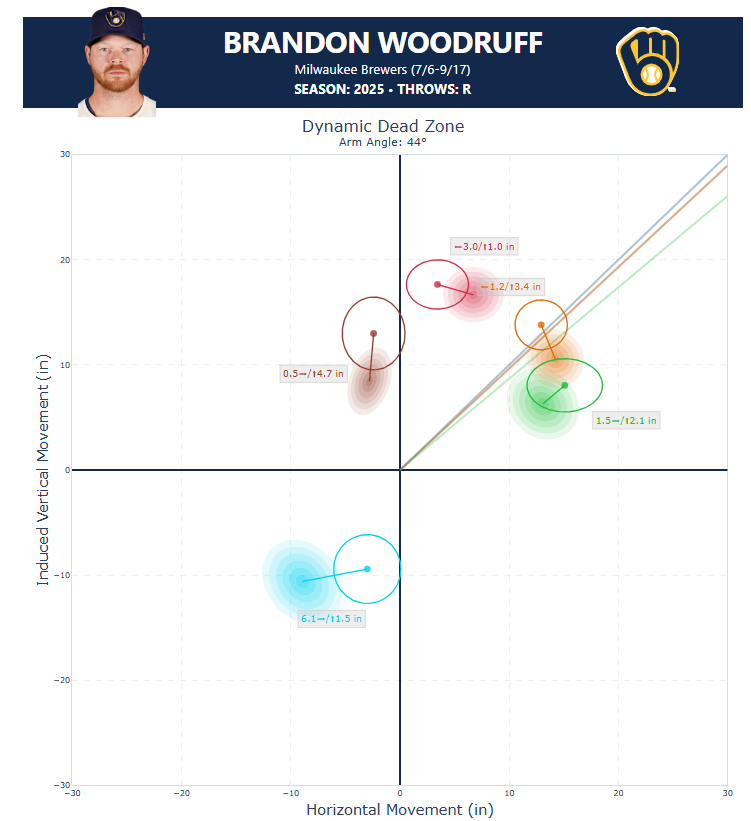
Above, you can see the expected movement (shaded areas) compared to the actual movement (circles) for his pitches, and note the cutter, in brown. Woodruff has a tendency to get more rise on nearly all of his offerings than expected based on his velocity and arm angles. That’s one reason for the massive swing-and-miss rate he can get, even when pounding the strike zone.
Woodruff’s cutter leads the way with almost five inches more induced vertical break than the model would consider “dead zone” for his physical characteristics—a figure that will directly correlate with more swings and misses, even when hitters pick up the pitch.
As a standalone pitch, he doesn’t have many plus grades, coming in around a 50 grade across the stuff+ metrics on average, but again, it’s how the pitch plays with the rest of his arsenal, especially the four-seam fastball:
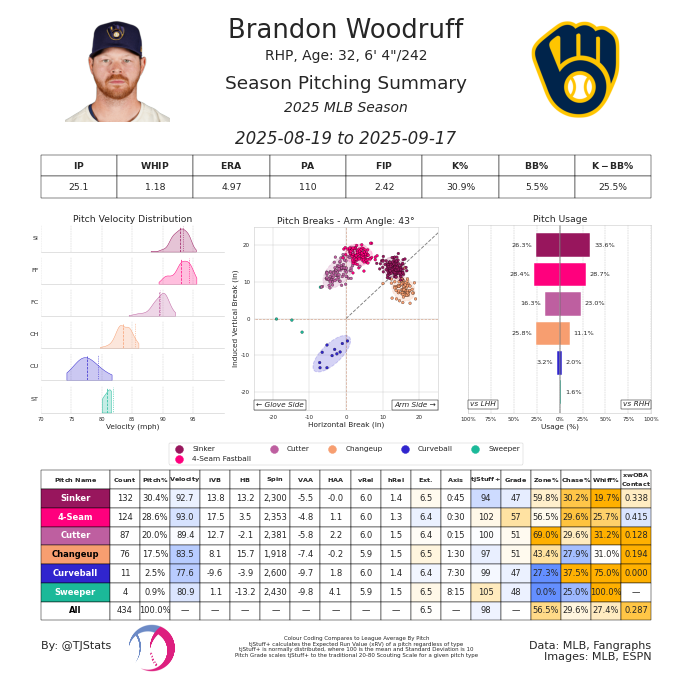
The cutter tunnels beautifully, but comes in roughly 4 mph slower than his four-seamer, with five inches more drop and five inches more movement to the glove side. Over this period (the chart above is over his final month), hitters were routinely making weaker contact with the cutter, while they were getting underneath the four-seamer for lazier fly balls. It also opened up the strike zone with some routine targets:
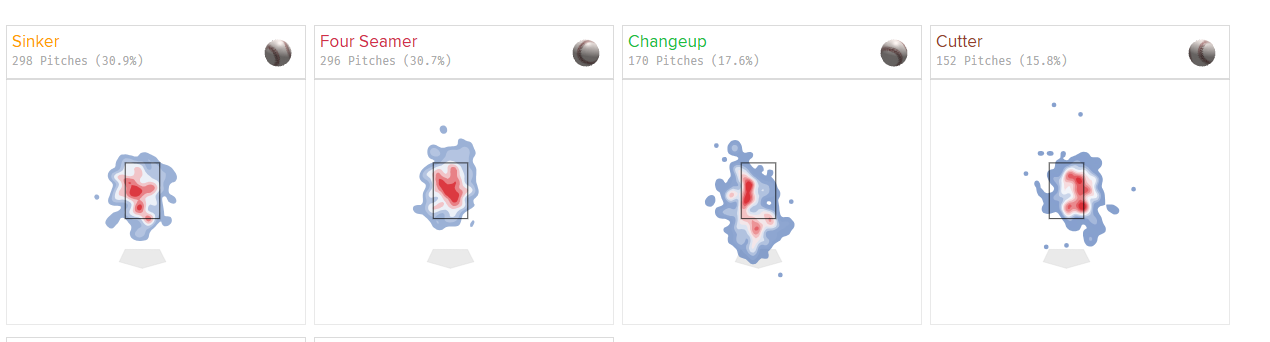
Woodruff appears to start nearly all of his pitches over the heart of the plate, and let the movement do its magic from there. The cutter breaks in toward left-handed batters, the sinker away from them, and the four-seamer has enough movement to avoid barrels and still garner whiffs even on meatballs down the middle. He might like to throw the four-seamer higher in the zone, but his three-fastball mix gives him a lot of cover. To put all of this in perspective, Woodruff’s cutter had a better whiff rate and better quality of contact metrics in 2025 than Corbin Burnes managed in 2024.
What Can We Expect In 2026?
Losing Woodruff to a lat injury near the end of the regular season was tough to bear for the NLCS-bound team, but the conversations suggested that this was an injury bound to occur at some point in the rehab process. The timing was merely unfortunate.
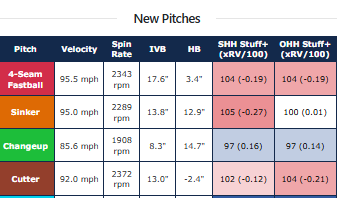
There’s hope of a resurgence in his velocity, similar to what Aaron Ashby experienced in 2024 in the wake of a very similar procedure on his shoulder. Factoring that across his three fastballs suggests a very fascinating mix for Woodruff to play with, should it come to fruition in 2026, with just a couple of extra ticks to each fastball and the changeup:
Even with his diminished arsenal, Woodruff ranked fifth among starters with over 500 pitches thrown in 2025 for in-zone whiff rates, putting him in the company of pitchers like Blake Snell, Tarik Skubal, Paul Skenes and Zack Wheeler.
If Woodruff can stay healthy, the ceiling could be even greater than what we saw in 2021. Even if the velocity never fully returns, Woodruff has showcased the variety and command to be a successful leader of the rotation, producing the lowest expected batting average, slugging, wOBA and wOBACON of his career, as well as a career-low walk rate. He’s older, and his raw stuff has been diminished by his age and injuries, but he’s also learned quite a bit about his craft and evolved into a better overall pitcher. With the return of his arm speed,. the sky is his only limit.