

CLEARWATER, Fla. — At first, Orion Kerkering wanted to feel it. He’s a Florida man, and he had never encountered a real autumn. “I know it’s cold, but I’d rather enjoy the cold and, like, experience it,” the Phillies reliever said. There was nowhere to run after what happened that night at Dodger Stadium. Two days later, he cleaned out his locker at Citizens Bank Park and said goodbye to his teammates, none of whom were staying in the Philadelphia area for the offseason. Everyone would have understood if Kerkering wanted to hide.
He started taking long drives around South Jersey in his gray 2021 Ford F-150. There was no reason he stayed this fall for the first time, but Kerkering wanted to explore. So much of October was a blur. He searched for random coffee shops within a 30-minute radius of his condo. Sometimes, when he was at the grocery store or a gas station, a stranger recognized him. Kerkering didn’t know what to expect. The interactions were always brief. It wasn’t your fault. Keep your head up. If they were going to hurl insults, they’d have to do it to his face.
In November, Kerkering started going to a Crunch Fitness in Moorestown, N.J. He’s 6-foot-2 with tattoos down his left arm. He was not just another guy at the gym. A few people approached him. The interactions would last 30 seconds, maybe, and no one was rude. He just wanted to blend in. So he wore a hoodie. He went to work.
The season-ending error will hang over Kerkering as long as he’s in Philadelphia, and probably longer than that. How do you not let one moment define you? That idea lingers, even months after he panicked and flung a baseball toward home plate rather than opting for a sure out at first base in the 11th inning of Game 4. The Phillies did not lose the National League Division Series to the Los Angeles Dodgers because of that play. But it was the last play.
“Everyone knows it,” Kerkering said. “Everyone knows that it’s there. The more you think about it, the more it’s going to drain you away.”
Kerkering looks different now. He’s in better shape, the result of a diligent winter. He sounds different. More than three months later, he is clear-eyed about the challenges that await him.
So he jokes about it.
Someone had told him that all of those jokes were Kerkering’s way of deflecting the burden he carries. It must still be affecting him. Kerkering laughed.
“It’s going to affect me for the rest of my life,” he said. “No matter where I go. If someone’s going to bring it up, it doesn’t matter if it’s now or in 20 years, they’re going to say some s—.”

Orion Kerkering hangs his head as the Dodgers celebrate after defeating the Phillies in the NLDS. “It’s going to affect me for the rest of my life,” he said of the error. (Robert Gauthier / Los Angeles Times via Getty Images)
He stuffed his phone away in the immediate aftermath, which is why he missed the call from Brad Lidge the day after Game 4. Kerkering wouldn’t have picked up anyway; he did not have Lidge’s number and had never spoken to him. He wasn’t answering anyone. There were heartfelt words from friends and former coaches back home. A few Dodgers players had relayed supportive messages to Kerkering through his agent, Danny Horwits at Beverly Hills Sports Council. Some Phillies fans even reached out to the agency with positive notes to pass along.
When Kerkering and Lidge connected, it was Oct. 21 — 12 days after it happened.
“I just wanted him to know,” Lidge said. “Don’t beat yourself up over this.”
Lidge threw the final pitch of a World Series, authored a perfect season as a closer, and the hanging slider he threw to Albert Pujols in 2005 is still replayed over and over. Lidge was not right for two years after surrendering that prodigious home run with two outs in the ninth inning of Game 5 of the National League Championship Series. Three years later, the lasting image of Lidge hanging his head as a Houston Astro was replaced by euphoria as he dropped down to his knees with the Phillies in 2008.
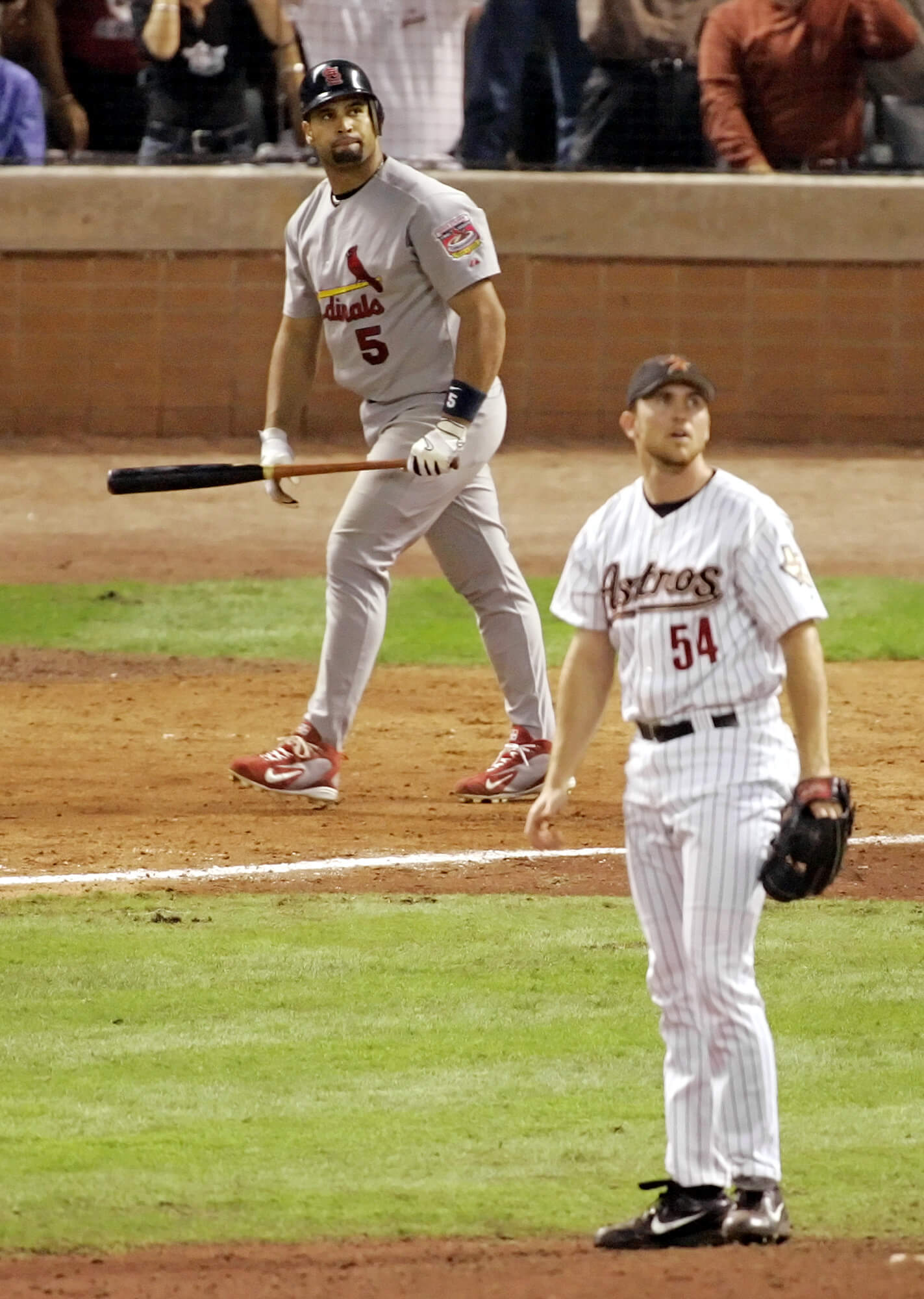
Brad Lidge watches Albert Pujols’ three-run, ninth-inning homer in Game 5 of the 2005 NLCS. (Harry Cabluck / Associated Press)
This was not, Lidge told Kerkering, an apples-to-apples comparison. This was not a hanging slider. Kerkering had fielded a total of 10 balls in his previous 150 big-league outings and converted all of them into outs. “The chances of it coming down to that again are very, very unlikely,” Lidge said. They spoke for about 30 minutes.
“I know it’s tough, and I know you’re in the moment, and I know the hardest thing is that you feel like you let your teammates down,” Lidge said. “But, in reality, they’ve got your back. It’s not just your teammates, but also the Phillies from the past. That’s what I wanted him to know, really. ‘Hey, we’ve all got your backs.’ I felt like he should know that right away.”
This resonated with Kerkering, who also heard from Mike Schmidt. “For those guys specifically,” Kerkering said, “they don’t know me. The fact that they wanted to reach out, it made it more special.”
No one told Lidge to call. He asked the Phillies for the reliever’s number. He wanted Kerkering to know: There will be another chance.
Kerkering entered 2025 with the promise of a future closer. But his walk rate spiked. He allowed too many home runs. He posted a 3.30 ERA in 60 innings. “I had a s— year last year,” Kerkering said. “I don’t like how it went.” He’s now behind two righties, Jhoan Duran and Brad Keller, on the team’s bullpen depth chart.
Kerkering turns 25 this April. He has pitched in 136 regular-season games; it’s the most appearances for a Phillies pitcher before his 25th birthday in the last 50 years. (Larry Christenson appeared in 148 games from 1973-78.) Lidge did not make his big-league debut until after his 25th birthday. As he watched Kerkering’s emotional postgame interview on Oct. 9, he remembered how difficult it was to put that type of disappointment into words.
“Sometimes, when you’re somebody who cares a lot, it’s actually tougher because you feel like you really let people down,” Lidge said. “You want to be someone reliable out there. He’s respectful, but he also is confident in himself, and I think that’s all you can ask a player to be.”

Orion Kerkering, 24, has a 2.79 ERA in 136 career appearances for the Phillies. (Hunter Martin / Getty Images)
He waited almost two weeks to watch it. By the time Kerkering scrutinized the final play, he knew what he wanted to do this offseason. But he had to rewatch it before he could move forward.
It was late October and, over the course of a week, he might have replayed it five times. He was looking for specific things. He wanted to see how he reacted after the first bobble. He wanted to remember who was there. He knew Rob Thomson had greeted him at the top of the dugout steps, but he could not recall what the manager said.
He didn’t eat or drink much those first few days afterward. “You’ve seen the Rambo movies where he pours gunpowder on the wound,” he said. “That’s how that first 72 hours felt.” Thomson had told Kerkering they would move forward — together. The Phillies meant it; teams called during the offseason to ask about Kerkering’s availability in a potential trade. The club was not interested.
After the Phillies signed Keller in December, Kerkering heard from general manager Preston Mattingly, Thomson and pitching coach Caleb Cotham. They were clear about where he stands. The Phillies now have more robust right-handed relief, but he remains important.
“I know they want me here,” Kerkering said.
The organization’s view of Kerkering was influenced by that day when he emptied his locker. During those first 72 hours, he thought about how he’d feel if this were the end of his career. He was paid $773,000 last season to live every kid’s dream. He has pitched in all but two big-league ballparks. He could start his real life if he had to; Kerkering completed his finance degree from the University of South Florida during the 2025 season.
What more could he ask for? He knew.
“Selfishly, I want to play longer,” Kerkering said. “I would look back and say, ‘What could I have done to get better?’ And I’d go more stir crazy about not playing than what happened on that play. That is something I can control.”
As people passed through the home clubhouse at Citizens Bank Park two days after Game 4, Kerkering found the club’s dietitian, Stephanie MacNeill. “I want to be at this number in spring training,” Kerkering told her. “How can I get there?” He met with Morgan Gregory, the Phillies’ director of strength and conditioning and nutrition, and a strength coach, Furey Leva. He had a plan to be in midseason shape before spring training; they helped fill in the gaps.
“Something has to change,” Kerkering said.
It’s what the Phillies had wanted to hear. Kerkering’s rise was so fast — from Low-A Clearwater to the majors in six months during the 2023 season — and he succeeded without the best fitness habits. The 2025 season was a grind, and Kerkering felt it.
He’s grown close to Tanner Banks, a lefty reliever who did not reach the majors until he was 30. They are opposites. The teammates communicated all offseason by texting memes back and forth. Few people, Kerkering said, have been there for him more this offseason than Banks. If Kerkering’s body was struggling a bit, Banks told him he needed to give it more love.
“Start putting some rocket fuel in your race car,” Banks said. “Because to perform at your best, you have to eat right, you have to sleep right, you have to mentally prepare, you have to physically prepare. If one of those pieces is missing or a couple of those pieces are suffering, you’re not getting the most out of your race car.”
To Kerkering, this was the way. He could channel the nightmare into something. He did more cardio and lifting at the gym in South Jersey. He returned home to Venice, Fla., around Thanksgiving and kept going. He weighs about the same as he did at the end of the season — 218 pounds — but it’s a different 218. This was progress.
“Sometimes,” Banks said, “that’s what has to happen to really bring out the best in someone.”
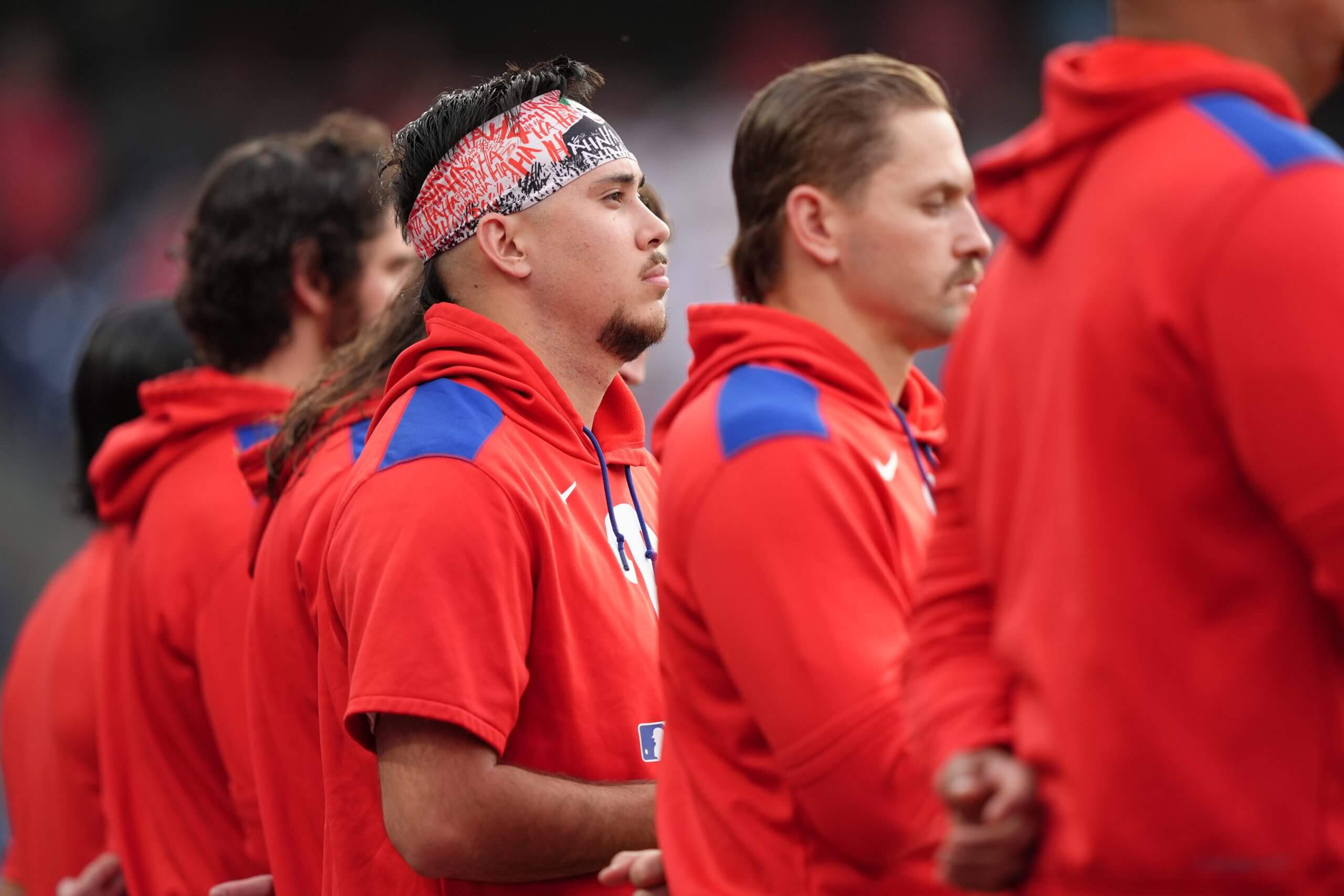
Orion Kerkering stands next to Tanner Banks last season. “Start putting some rocket fuel in your race car,” Banks told Kerkering. (Kyle Ross / Imagn Images)
He watched a football game with his dad in December. The stakes were high; it was the final regular-season game of the NFL season. With a win, either the Baltimore Ravens or the Pittsburgh Steelers would make the playoffs. It came down to a 44-yard field goal attempt by Tyler Loop, a 24-year-old rookie kicker.
Loop missed it.
“Damn,” Kerkering thought. “I’ve been there before.”
He didn’t say it out loud. Kerkering kept the TV on as Ravens teammates consoled Loop. Then-Ravens head coach John Harbaugh put his arm around Loop. They walked together. Kerkering felt it.
“Part of me was wanting to reach out somehow, someway,” Kerkering said. “But the other part of me was like, I know that kid’s got so much other stuff going on.”
Jeff Hoffman, Kerkering’s former teammate and a mentor, sent a message soon after Game 4. They texted a bit. But, a few weeks later, Kerkering did not know what to say to the Toronto Blue Jays reliever after he surrendered a tying home run with one out in the ninth inning of Game 7 of the World Series. Kerkering didn’t want it to sound trite. He’ll see Hoffman this spring. They can have a proper chat then. It was selfish, Kerkering said, but he had become annoyed with how often people around him brought up the error.
“I can tell people were caring about it,” Kerkering said, “but every new conversation I had with someone, it was the same thing.”
It’s a part of him now. Kerkering has been in Clearwater for almost a month. One night in January, he walked along the beach as the sun set and started to tell a story. In 2024, right before the All-Star break, Kerkering’s grandfather went into hospice care. Kerkering hopped on a flight to Florida when the Phillies finished the first half so he could have a few final days with his grandfather.
But a computer outage that snarled airlines nationwide forced Kerkering to change his flight back to Philadelphia. He couldn’t risk being late for work. Once Kerkering boarded the plane, he received the news. His grandfather died. Kerkering had left him five hours earlier than he expected. It hurt. There is enough time to throw it home until there isn’t.
“It’s one of those things that is going to linger on,” Kerkering said. “It’s always in the back of your head, to where it almost feels like a death in your family. That’s how this feels with the play. And I can either accept it and say, ‘Yeah, it sucks,’ and move on from it. Or I can let it affect me.”
This much, he knows.
“I can’t let one little thing,” Kerkering said, “f— this up.”