

PHILADELPHIA — In Philadelphia, baseball has never been just a game. It’s been a language. A routine. A connective thread that runs from neighborhood fields to major-league clubhouses, from afternoon box scores to late-night arguments on stoops and barstools. And for as long as the game has mattered here, the people who have told its story have mattered just as much.
Baseball journalism in Philadelphia has always carried weight because the city demands it. This is a place that doesn’t accept surface-level explanations. Fans want to know why something happened, what it means, and who’s accountable. That expectation shaped generations of writers who understood that covering baseball here required more than recounting nine innings. It required context, memory, and backbone.
For decades, Phillies fans grew up with voices that treated the game seriously — not reverently, but honestly. Writers didn’t just chronicle wins and losses; they explained roster decisions, labor fights, front-office philosophies, and the emotional toll of a 162-game season played under relentless scrutiny. They understood that baseball in this city was civic property. If you were going to cover it, you had to earn the right.
That tradition matters because baseball itself demands time and patience. It unfolds slowly. It reveals truths over months, not moments. You don’t understand a team — or a season — through highlights alone. You understand it by being there every day, noticing patterns, listening when the same question keeps resurfacing, recognizing when a clubhouse tone shifts before the standings do.
That kind of coverage doesn’t happen accidentally. It requires beat writers who show up in Clearwater in February and are still asking hard questions in September. It requires editors who value continuity over clicks. And it requires institutions willing to invest in journalism that treats baseball as more than content.
Which is why what has happened at The Washington Post over the last few days should resonate loudly in Philadelphia.
The Post’s decision to eliminate its sports section as part of sweeping layoffs isn’t just a business story. It’s a warning. For decades, that paper set a national standard for how sports — especially baseball — could be covered with depth, intelligence, and independence. Its writers showed that baseball writing could be lyrical and rigorous, emotional and analytical. That approach influenced newsrooms far beyond Washington, including here.
Sports sections like that weren’t luxuries. They were training grounds. They produced reporters who learned how to cover power, money, labor, race, and institutions through the prism of sport. Baseball was often the classroom. Lose that, and you don’t just lose volume of coverage — you lose expertise.
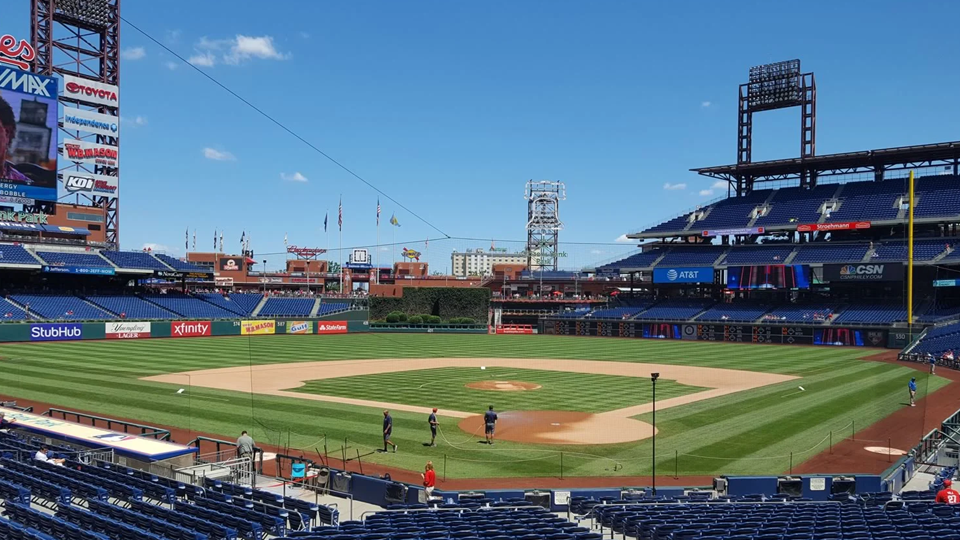
Philadelphia knows this cycle well. Shrinking newsrooms. Fewer dedicated beats. Less time to report, more pressure to publish. When experienced writers disappear, what goes with them is institutional memory — the ability to explain how today’s Phillies fit into a longer arc that stretches from Shibe Park to Veterans Stadium to Citizens Bank Park. The games still get played, but the story loses dimension.
And when that kind of coverage shrinks, it isn’t only big-league beats that suffer — it’s the local baseball ecosystem too, because the first stories to vanish are often the ones from high-school fields, neighborhood leagues, and community diamonds.
I write this as someone who has spent years in Phillies clubhouses and press boxes, watching firsthand how coverage changes when resources disappear. When there’s no one left to ask the second question — or the uncomfortable one — the public doesn’t just lose information. It loses understanding. Baseball becomes something you watch, not something you know.
That loss matters in a city like Philadelphia because baseball here has always extended beyond the major-league club. It lives on high-school diamonds, college fields, neighborhood leagues, and summer nights at local parks. Journalism has long been the connective tissue — the thing that links a kid playing catch today to the generations who played before him.
When institutions step away from that responsibility, it signals something larger: a retreat from the idea that sports journalism is a public service. That it helps citizens understand the institutions they care about. That it preserves memory in a city and a sport built on it.
In Philadelphia, baseball has always been something you inherit — passed down through stories, arguments, and summers that blur together. When fewer people are left to tell those stories with care and context, the loss isn’t abstract. It’s felt in what we remember, what we debate, and what we hand to the next generation.
Baseball will keep being played.
The question is whether anyone will still be there to explain why it mattered.
Recent Philly | Phillies Baseball News
Why baseball journalism matters in Philadelphia — and why what’s happening at The Washington Post should hit home here (Feb 5)
How Nick Castellanos went from symbol of resurgence for the Phillies to odd man out (Feb 4)
The truck that brings spring: Inside the 1,058-mile Phillies caravan to Clearwater (Feb 3)
COLLEGE BASEBALL: La Salle returns with a roster ranked to compete — and numbers to back it up (Feb 2)
NL East Power Rankings: Why the Phillies remain the team to catch (Feb 1)
COLLEGE BASEBALL: Villanova leans on returning core, leadership as Mulvey enters 10th season (Jan 31)
Phillies add veteran utilityman Dylan Moore on minor-league deal (Jan 31)
COLLEGE BASEBALL: “Unfinished business”: David Miller returns to La Salle to finish what was taken away (Jan 30)
The World Baseball Classic should be baseball’s loudest invitation to youth (Jan 29)
How a century of Temple baseball ended not with a final pitch, but a budget line (Jan 28)
Pokrovsky, returning bats power Penn’s push in Ivy League race (Jan 28)
From expectation to execution: Saint Joseph’s enters 2026 with something to prove (Jan 27)
Bader or García? Phillies chose flexibility over familiarity in reshaping their 2026 outfield (Jan 26)
History deserves another hearing: Why the Hall should revisit the Negro Leagues (Jan 25)
From credibility to bedlam: The free agent trio that reshaped the Phillies this century (Jan 24)
Crawford headlines Phillies’ non-roster invites, enters spring with chance to claim outfield role (Jan 23)
Mets close the gap on paper, but are the Phillies still the NL East’s team to beat? (Jan 22)
Familiar faces return, but Phillies & Thomson say this isn’t simply ‘running it back’ (Jan 21)
After Bichette miss and Realmuto signing, Dombrowski says Phillies are content with roster (Jan 20)
The quiet disappearance of the baseball scorecard around youth baseball and why it matters (Jan 19)
College baseball’s new paradox Is playing out in Philadelphia (Jan 19)
With Bichette gone and Realmuto back, do the Phillies make a run at Bellinger? (Jan 18)
Phillies re-sign J.T. Realmuto on three-Year, $45 million deal, closing a key winter question (Jan 16)
Tucker deal intensifies Bichette market, complicating Phillies’ plans (Jan 16)
As talks stall, Realmuto’s historical place among Phillies catchers come into focus (Jan 15)
Ranger Suárez heads to the Red Sox, ending one of the most unlikely Phillies careers of the modern era (Jan 14)
Strong Bichette meeting adds new layer to Phillies’ Realmuto standoff (Jan 13)
When your child ages out of Little League, the game still needs you (Jan 12)
Harper vs. Manfred was the opening bout, because baseball’s CBA fight is coming (Jan 12)
Phillies News from the Philadelphia Baseball Review
Support the Mission. Fuel the Movement.
You’re not just funding journalism — you’re backing the future of youth baseball in Philly.