
So much has changed since our last Minnesota Twins roster projection, although most of it has happened behind the scenes.
After three years as the ownership group’s executive chair, Joe Pohlad was pushed out by his family and replaced by his older brother, Tom Pohlad, who has already made a habit of saying the Twins must have a competitive 2026 season to win back fans without actually giving the front office the resources to add impact talent.
And the person in charge of that front office for the past nine years, Derek Falvey, is gone after “mutually parting ways” in a breakup that suggests he grew frustrated with the ever-shrinking payroll. Jeremy Zoll is at the helm now, but it’s not clear he has the time or spending room to make big moves before camp opens next week.
First baseman Josh Bell, catcher Victor Caratini and reliever Taylor Rogers are the only notable roster additions for one of the MLB offseason’s least-active teams, and the Twins’ payroll sits around $105 million — down $30 million from last year and $60 million from 2023.
More roster reinforcements are needed, and the existing roster has several logjams in need of clearing from a day-to-day functionality standpoint. In the meantime, here’s our projection of what the Twins’ Opening Day roster would look like if the season started today instead of on March 26.
Catchers (2)
In: Ryan Jeffers, Victor Caratini
Others on the 40-man roster: Alex Jackson
Gleeman: Christian Vázquez becoming a free agent forced the Twins to switch up their catcher plan after three years of Jeffers and Vázquez sharing time. They moved quickly to make a minor trade for a journeyman backup in Jackson, but then reconsidered that two months later and signed Caratini to the team’s first multiyear contract since Carlos Correa.
Keeping three catchers on a roster with 13 position players is highly unlikely, so something has to give here. Jackson is owed $1.35 million and the Twins parted with Triple-A infielder Payton Eeles to get him, but are there other teams interested in trading for Jackson, a 30-year-old career .153 hitter? Caratini is the better backup option and he’s guaranteed $14 million over the next two seasons, so he’s here to stay.
It’s also possible the Twins could consider trading Jeffers, an impending free agent, but there have been few rumblings on that front. I’d expect Jeffers to be the primary catcher, starting around 100 games, with Caratini taking the rest and also seeing time at first base and designated hitter. Jackson will be traded or waived, and could be stashed in St. Paul if no other team wants to take on his modest salary.
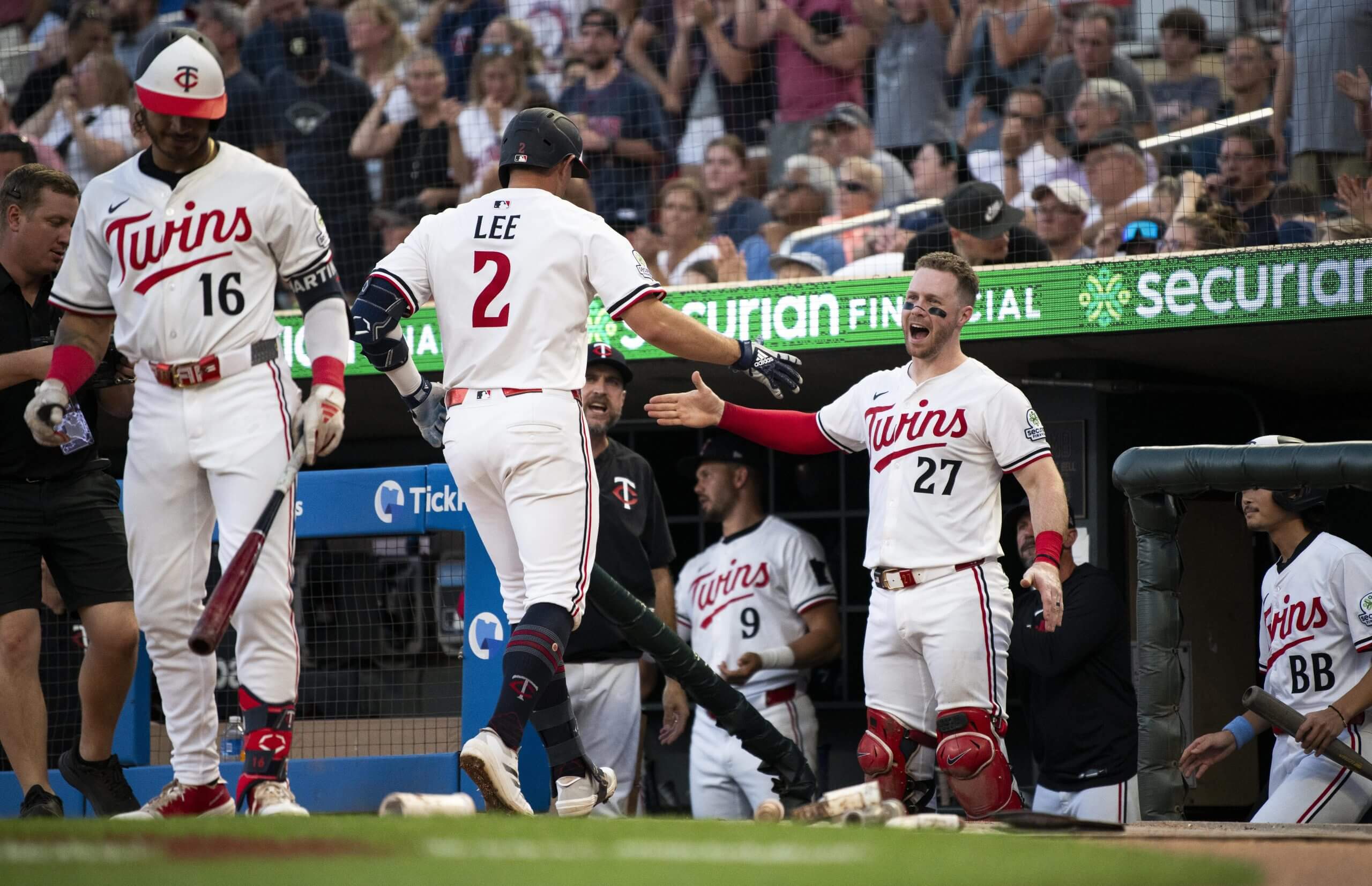
It seems likely Ryan Jeffers, right, sticks in Minnesota as the Twins’ primary catcher. (Stephen Maturen / Getty Images)
Hayes: Besides starting pitching and center field, catcher projects to be the team’s strongest position group. FanGraphs projects Twins catchers to produce 3.3 WAR, which ranks 12th in the majors.
Jeffers’ bat is clearly a big driver here, but Caratini’s offense represents an upgrade over Vázquez. Over the past two seasons in Houston, Caratini produced a 105 OPS+, well above his career mark of 90. Caratini said he altered his pregame routine when he played for Milwaukee from 2022-23 and then honed it while working with former Houston Astros hitting coach Alex Cintrón the past two years.
I agree that there’s little chance the Twins carry three catchers into the season, which makes me at least consider the possibility that the club could still trade Jeffers. The Twins completed a trade the day before the 2022 season opened, shipping Rogers, who had one year left before free agency, to San Diego. While there’s been minimal rumblings on the Jeffers front, you can’t totally rule out any possibilities when he’s headed for the open market come November.
Infielders (6)
In: Josh Bell, Luke Keaschall, Brooks Lee, Royce Lewis, Kody Clemens, Ryan Kreidler
Others on the 40-man roster: Tristan Gray, Eric Wagaman
Hayes: The area of the roster receiving the most scrutiny is the bullpen, but you can make the argument that how Lee handles shortstop is the biggest question facing the Twins. Of the 33 players in the league with at least 500 innings at shortstop last season, Lee ranked 20th with minus-one Outs Above Average, 25 OAA behind MLB leader Bobby Witt Jr.
The Twins asked Lee to work on agility and lateral movement this offseason to improve his range and ability to track down the ball. Lee also must hit better after producing a disappointing .636 OPS through two seasons and 189 games in a Twins uniform.
And if Lee gets hurt, who do the Twins turn to? Orlando Arcia, who was signed to a minor-league deal, could be the stopgap until prospect Kaelen Culpepper, MLB’s No. 82 prospect according to The Athletic’s Keith Law, proves ready. But quality depth at shortstop looks thin in the post-Correa Era.
Gleeman: We’re a long way from the days of the Twins stockpiling veteran depth with Kyle Farmer, Michael A. Taylor and Willi Castro in bench roles. Now they’ve seemingly got Arcia, Kreidler and Gray in a three-way competition for the utility infielder job, and it’s not clear any of the three is an MLB-caliber option.
And having a competent backup infielder is especially important given the injury histories of Lee, Lewis and Keaschall, as well as the aforementioned questions surrounding Lee on both sides of the ball. Quality depth is usually the first aspect of a roster to suffer when resources shrink, and it’s apparent that’s the case with the 2026 Twins.
Outfielders (5)
In: Byron Buxton, Trevor Larnach, Matt Wallner, Austin Martin, James Outman
Others on the 40-man roster: Alan Roden, Emmanuel Rodriguez, Gabriel Gonzalez, Hendry Mendez
Hayes: With a glut of left-handed-hitting outfielders on the 40-man roster, and Walker Jenkins and Rodriguez at Triple A knocking on the door of the big leagues, it’s hard to see a place for Larnach on Opening Day.
Given their limited financial resources, it was a minor surprise to see the Twins offer Larnach a contract earlier this offseason rather than reallocate the resources to another area of need. But with him on the roster, you have to think the Twins feel they can trade Larnach at some point soon.
Gleeman: One domino effect of keeping Larnach is that there might not be room for Roden, who at 26 has nothing left to prove at Triple A and was acquired at the deadline in the Louis Varland trade in part because the Twins thought he was MLB-ready
It’s possible they could keep Roden as the backup center fielder over Outman, another Triple-A player acquired at last year’s deadline, but either way, finding regular at-bats for Roden would be tricky without clearing the lefty logjam. Outman is out of minor-league options, so he’d have to be exposed on the waiver wire if he doesn’t make the Opening Day roster.
Setting aside the level of talent involved, the outfield is a prime example of how the pieces the Twins have assembled don’t fit together especially well. In addition to the overstocking of lefty corner bats, there’s a shortage of righty corner bats to pair with them and no proven backup for the oft-injured Buxton in center field.
Starting pitchers (5)
In: Pablo López, Joe Ryan, Bailey Ober, Simeon Woods Richardson, Taj Bradley
Others on the 40-man roster: Mick Abel, Andrew Morris, Kendry Rojas
Gleeman: López, Ryan and Ober are locked into the top three rotation spots, and we’ve filled in the remaining two with the next-most experienced options: Woods Richardson and Bradley. But other rotation options include Abel, Zebby Matthews and David Festa, with one or more of the young-ish starters perhaps shifting to the wide-open bullpen. In other words, don’t get hung up on starter/reliever labels yet.
It’s also worth noting that López and Ober were both hurt for much of last season, and Ryan faded in the second half after being a first-time All-Star. There are questions about even the strongest aspects of the roster, although if the Twins are going to be competitive in 2026, the rotation will have to be a major strength.
Hayes: This group is the backbone of the whole operation. López and Ryan are legit front-line starters, and it’s astonishing both are still here after the Twins traded all but Minnie and Paul at the deadline. Their presence, along with the rest of this deep, talented group, should give Twins fans a modicum of hope that not all is lost — even if it’s clear the club faces an uphill battle with its limited financial resources and suspect bullpen.
FanGraphs projects the Twins’ rotation as the 11th-best in MLB, and that’s with Ober predicted to post a 4.28 ERA in 138 innings, a figure significantly higher than any of the tall righty’s pre-2025 numbers.
Following last season, there are bound to be questions about what Ober can deliver, and rightfully so. Ober hopes to answer those queries by rebounding from a dreadful 2025 campaign — a quest he began in October (and resumed in January) by traveling to Florida to improve the mobility of his hip and rid himself of the bad pitching mechanics he picked up when pitching through discomfort a season ago.
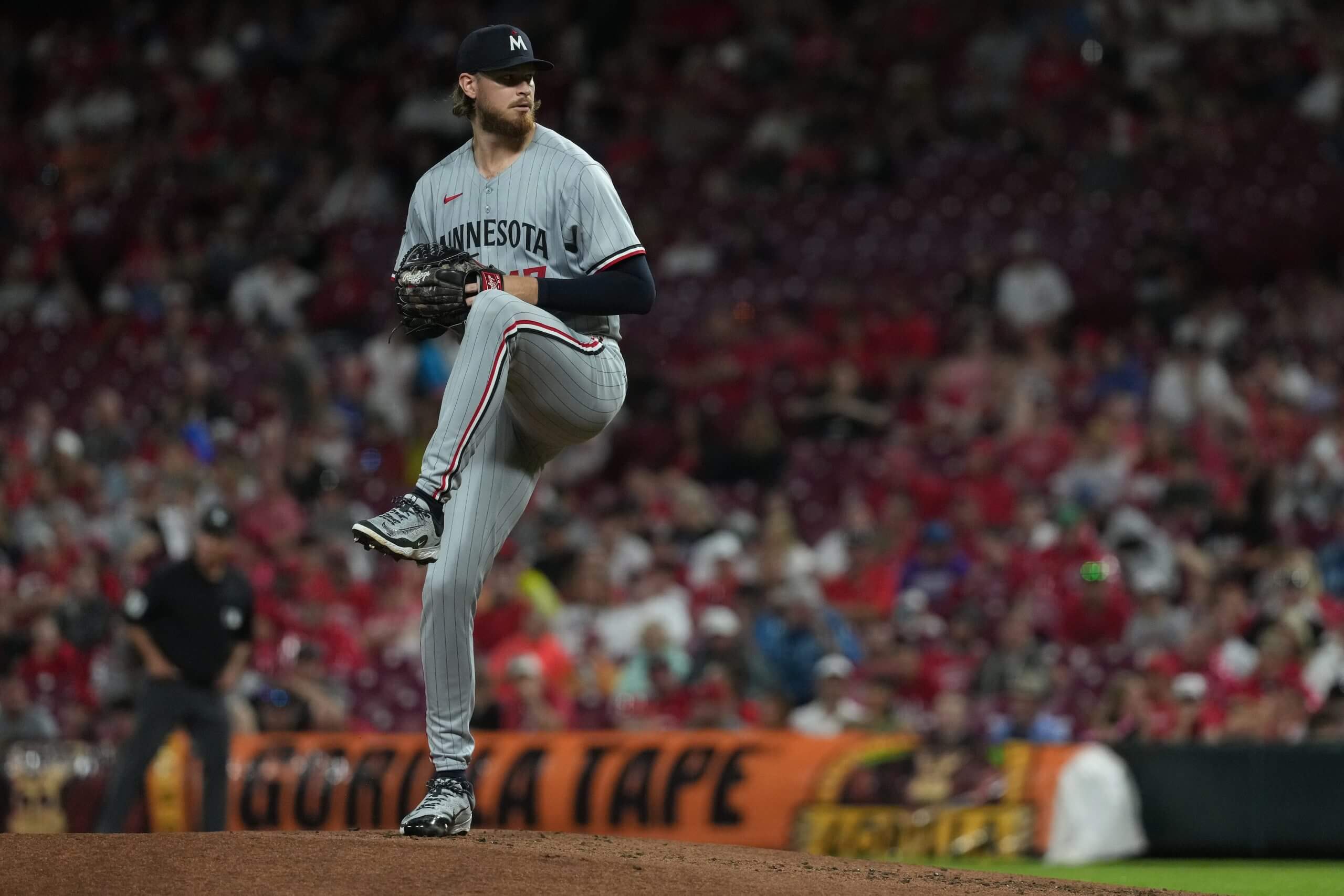
Bailey Ober got into bad mechanical habits while pitching around discomfort last season and has spent this winter working out the kinks. (Jason Mowry / Getty Images)
Relief pitchers (8)
In: Taylor Rogers, Cole Sands, Justin Topa, Kody Funderburk, Eric Orze, Travis Adams, David Festa, Zebby Matthews
Others on the 40-man roster: Connor Prielipp, John Klein, Marco Raya, Jackson Kowar
Gleeman: Reuniting with the 35-year-old Rogers for $2 million is the Twins’ lone reliever move of note and the remaining free-agent market has been thoroughly picked over, suggesting they plan to rebuild the bullpen internally and cheaply. Which young-ish starters win the final two rotation spots, and which are shifted to the bullpen or the minors, could be the Twins’ biggest storyline of spring training.
Even starter prospects who have yet to debut in the majors, such as Prielipp, Klein and Raya, could be viewed as bullpen options due to abundant rotation depth. It’s a common approach to bullpen building that could pay off down the road, but for April and May, it’s difficult not to think the Twins are at least one good veteran reliever — preferably right-handed — short of a competent bullpen.
Hayes: Concerns about the inexperienced relief corps aren’t unfounded. FanGraphs projects the Twins’ bullpen to rank 20th out of 30 teams. And to even reach that modest projection, many young pitchers will need to step up unless the Twins can add an arm or two.
Transitioning young arms to the bullpen is a massive challenge. It can be messy, and it takes time for pitchers to adapt, especially when they hit a physical wall. Yes, most of these guys have thrown a ton of innings in a season as a starter. But those totals were accomplished by throwing every fifth day and never pitching three days in a row in August when general soreness kicks in. We saw it with Varland last year and Griffin Jax in 2022.
Knowing they could use more help, the Twins are trying to add to the group. But getting enough before Opening Day might not be realistic.