
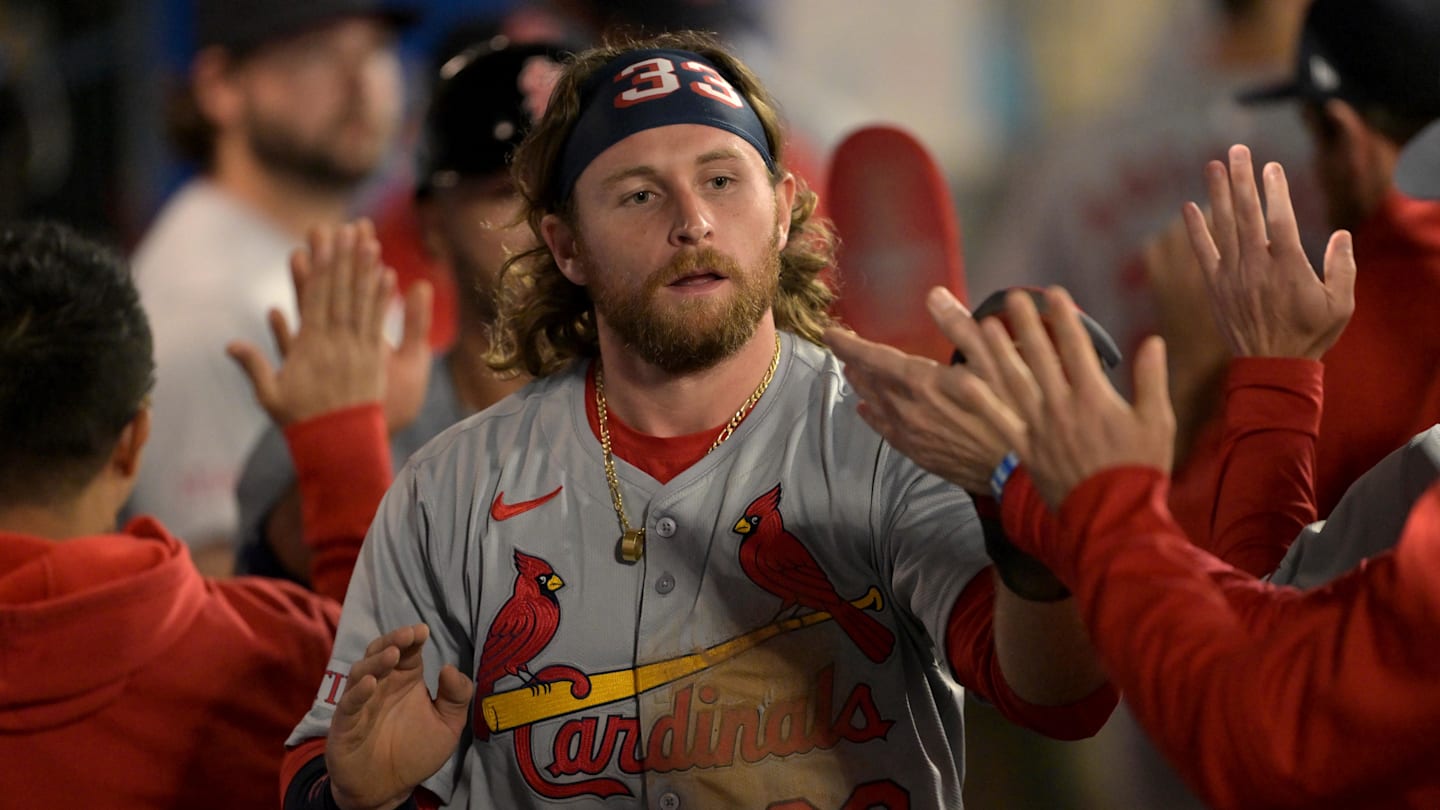
The St. Louis Cardinals accomplished their offseason objectives. Now, they’re facing a completely different set of challenges.
Earlier this week, the Cardinals traded All-Star second baseman Brendan Donovan to the Seattle Mariners. Donovan was the fourth and final All-Star on the Cardinals’ list of castaways, following Sonny Gray and Willson Contreras, who went to the Boston Red Sox, and Nolan Arenado, who went to the Arizona Diamondbacks.
According to Jeff Jones of the Belleville News-Democrat, the Cardinals’ projected payroll has fallen below the $100 million mark for the first time since 2010. And that anecdote, which illustrates a historic level of budget-slashing, doesn’t even tell the full story.
If you like our content, choose Sports Illustrated as a preferred source on Google.
Cardinals will struggle to hold fan interest this year
May 19, 2025; St. Louis, Missouri, USA; St. Louis Cardinals shortstop Masyn Winn (0) is congratulated by right fielder Alec Burleson (41) after scoring against the Detroit Tigers during the fifth inning at Busch Stadium. Mandatory Credit: Jeff Curry-Imagn Images | Jeff Curry-Imagn Images
Per Spotrac, the Cardinals have only $37.7 million in guaranteed contracts on the books for this season, and another $13.9 million in projected payroll for pre-arbitration players. Some of that could change by the end of spring training, but barring a last-minute signing the Cardinals are set to pay about $52 million for the players they’ll actually be putting on the field.
Meanwhile, St. Louis will pay a total of $44.56 million to Arenado, Gray. and Contreras while they compete for other teams. Their dead-money payroll is 86% of the size of the payroll for their current players.
Rebuilding teams having small payrolls is nothing new. But the Cardinals also seem to be battening down the hatches for what they know is going to be a trying financial year
Attendance was already trending in the wrong direction over the last couple of seasons in St. Louis, and knowing that the team isn’t necessarily trying to compete for the playoffs will only discourage fans from showing up to the stadium.
Perhaps just as consequentially, the Cardinals’ television deal, which was supposed to be worth $60 million in partnership with the failing Main Street Sports, will now pay the club roughly $20 million in the newly announced direct-to-consumer model operated by the league, per Jones.
It’s been a point of pride, historically, that the Cardinals have never acted like a typical small-market team. They may get back to that point soon, but for now, they’re operating on a shoestring budget.
More MLB: Cardinals’ Plan to Address Outfield Revealed by MLB Insiders