
The Atlanta system is constantly thin, as they promote prospects aggressively, including AJ Smith-Shawver (graduated) and Didier Fuentes (still barely eligible), and their recent draft classes haven’t panned out well. The strength of the system right now is pitching, mostly guys who project as relievers, but at least three or four who should be some sort of starter.
(Note: Tools are graded on a 20-80 scouting scale; ages as of July 1, 2026. EV = exit velocity.)
Height: 6-2 | Weight: 195 | Bats: L | Throws: L | Age: 19
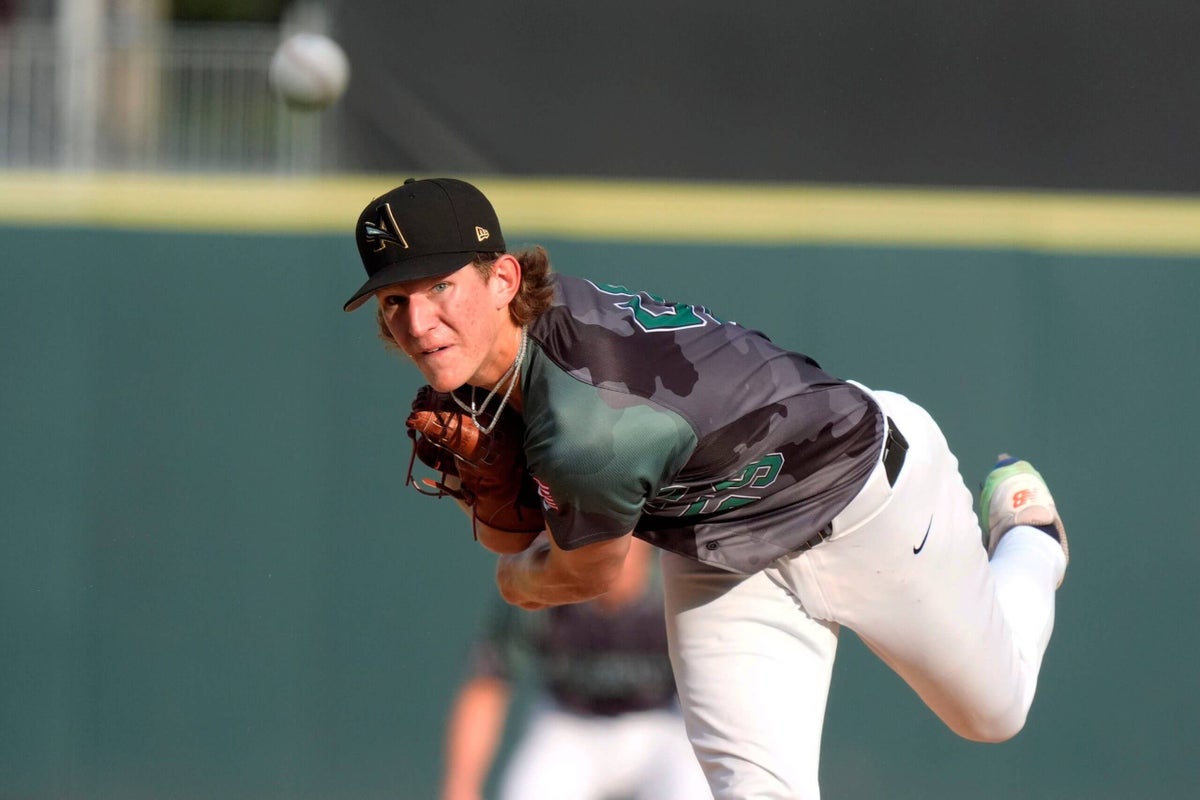
Atlanta’s 2024 first-round pick is now their best prospect. The cousin of late NL MVP Ken Caminiti continued to show premium stuff in his pro debut while throwing strikes and limiting hard contact in Low A. Caminiti sits 92-95 mph already from a low three-quarters slot with a plus changeup that hitters whiffed on half the time they swung at it. His breaking ball is now more of a sweeper, missing some bats in the zone but not generating a lot of chase. That pitch grades out as a 55 or 60 on paper, and I’ve had scouts come in anywhere from average to plus, but right now it plays more as average with hitters. The low slot helps the sweeper play up against lefties, and he comes slightly across his body due to where he lands on the mound, which helps everything look better against lefties. On the season, he allowed just a .184/.283/.207 line to left-handed batters, with just two doubles and no other extra-base hits, while righties hit .251/.328/.371.
Caminiti is an excellent athlete who was a two-way player in high school, and getting him a little more on line to the plate would improve his results against righties while also letting that athleticism show more in the delivery and command. He’s also passed the biggest test for high school pitchers, surviving the first year in pro ball without injury. If that continues, he’ll be one of the top lefties in the minors by next spring.
Height: 6-2 | Weight: 185 | Bats: R | Throws: R | Age: 23
I’ve always loved Ritchie’s delivery and thought there was plenty of projection there when Atlanta took him with its second pick in 2022, but he returned from Tommy John surgery with a big arsenal of mostly average to above-average pitches, without a clear out-pitch to get him past No. 4 starter-ish upside. He will show 98 mph on the four-seamer, but prefers the mid-90s sinker, which boosted him to ground-ball rates over 50 percent at both stops after Atlanta promoted him out of High A.
Over the course of the season, he added weapons to the arsenal, so he’s now working with a four- and two-seamer, slider, curveball and changeup. The curveball had the highest whiff rate of all of his pitches at 35 percent, which is solid but means he doesn’t have a real plus pitch. His path to becoming more than just a decent fourth starter is to become a command-and-control guy, which he certainly could do with that easy, repeatable delivery. He walked 10.4 percent of batters he faced in Double A, then 11.1 percent in Triple A, both rates being too high for this style of pitcher. I want to buy in, and he is definitely a big leaguer, but the current package isn’t quite enough to get him to the top 100.
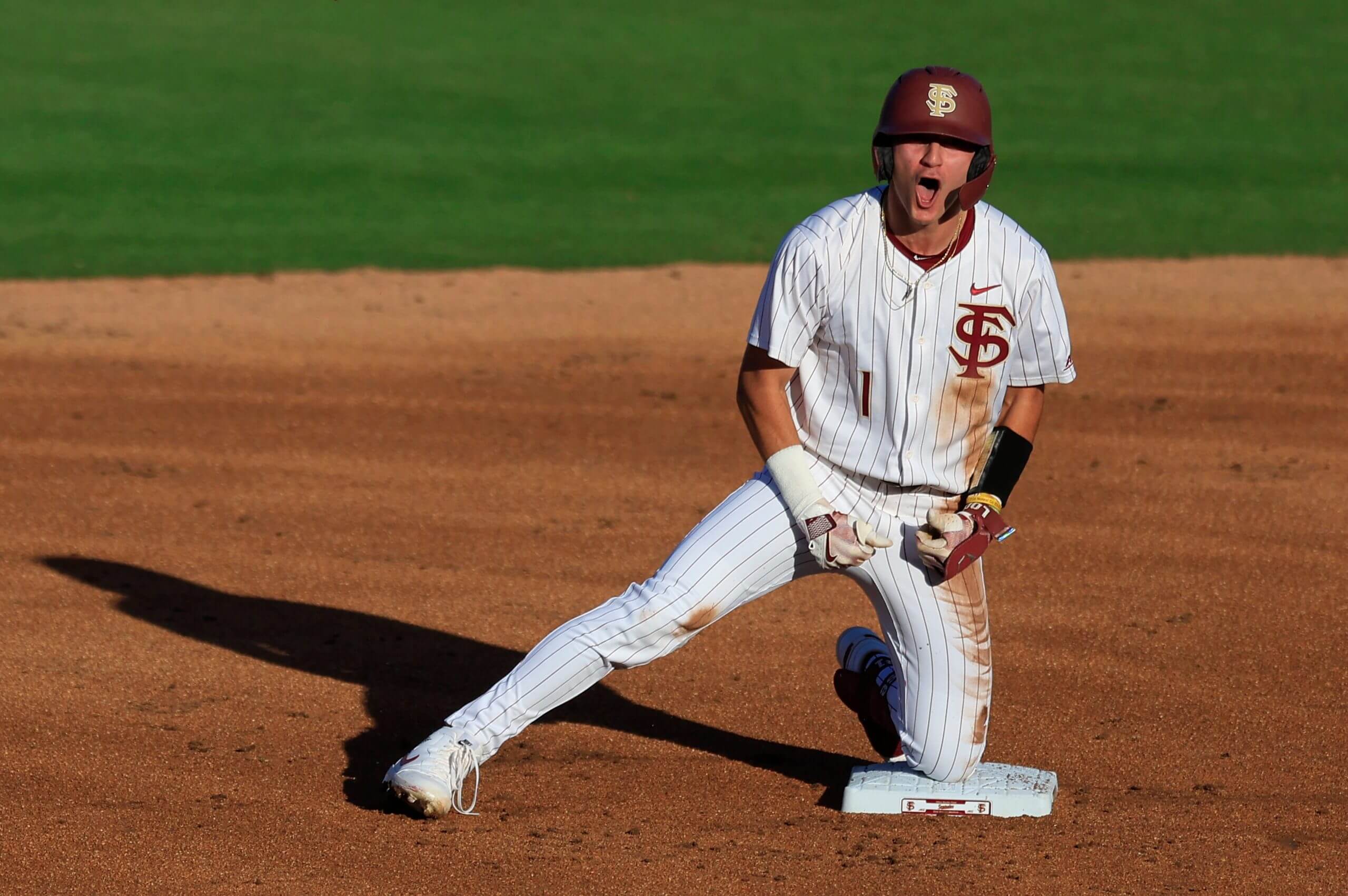
Alex Lodise won the NCAA’s Dick Howser award for the 2025 season. (Corey Perrine / Florida Times-Union / USA Today Network)
3. Alex Lodise, SSHeight: 6-1 | Weight: 190 | Bats: R | Throws: R | Age: 22
Lodise was Atlanta’s second-round pick last year, but the top-ranked prospect on my board from their draft class. He’s a shortstop right now with an outside shot to stick there — he has the hands for it, but perhaps not enough range. He started swinging harder last year to produce more power, which worked, as he went from nine homers the year before to 17 in his draft year. He does chase stuff out of the zone too much, with a particular vulnerability to sliders down and away. He has a clear path to becoming a regular if he stays at shortstop, and could still be a low-OBP, 15-20-homer regular at second base if he cuts down on that chase.
4. John Gil, SSHeight: 6-1 | Weight: 175 | Bats: R | Throws: R | Age: 20
Gil signed out of the Dominican Republic for just $110,000 in January 2023 and hit for contact without much impact for his first two years in the system. He moved to Low A last year and hit .258/.352/.378 with 50 steals in 64 attempts, showing plus speed and a chance to stick at shortstop if he can slow himself down. He’s still a contact-oriented hitter, getting a little bit stronger from 2024 and improving his results as the 2025 season went on. After he broke his nose on a slide in early July, he returned from rehab to hit .342/.434/.568 for 31 games, including hitting five of his seven homers on the season, to earn a late call-up to Double A. He’s physically capable of playing short but can get too flashy or just too quick, losing consistency on the routine plays. I have talked to scouts who think he’s a utility infielder at best, given the lack of power and possibility of moving off short, but I lean toward everyday player, even if he isn’t a shortstop.
5. Luke Sinnard, RHPHeight: 6-8 | Weight: 250 | Bats: R | Throws: R | Age: 23
Sinnard returned from Tommy John surgery to make his pro debut in 2025, working 92-96 and touching 98 with a hard slider, a two-plane curveball and a plus splitter that must look like it’s coming out of the guy given his 6-foot-8 frame and slot just above three-quarters. He throws a ton of strikes and gets huge induced vertical break on the four-seamer, up to 21 inches in the Arizona Fall League. He’s definitely a starter and certainly the first guy I’d call up from this system if there’s a need, especially given how good he was in his first year back.
6. Tate Southisene, SSHeight: 5-11 | Weight: 180 | Bats: R | Throws: R | Age: 19
Atlanta’s 2025 first-round pick was something of a surprise selection, as Southisene’s best tools are his speed and his makeup, and I think most teams saw him as a second-rounder or later. He was a shortstop in high school and probably starts there in pro ball, more likely moving to center field (since he’s a plus runner) or second or third in time. He has a good swing for contact, but struggled with offspeed stuff at showcases, and his contact quality wasn’t great, projecting to maybe 45 power in the end. Atlanta must see more in the hit tool than the rest of us did to take him in the first round.
7. Didier Fuentes, RHPHeight: 6-0 | Weight: 170 | Bats: R | Throws: R | Age: 21
Fuentes got the obligatory “Too Early MLB Call-up” last year, making one Triple-A start and then going into the big-league rotation, where he gave up 23 hits in 13 innings and posted a 13.85 ERA. He was mostly 94-96 in the majors and topped out at 98.3, showing a sweeper and curveball that had both good spin and above-average break. He barely used his splitter in the majors or minors. He hasn’t had any platoon split in the last two years, however, doing it primarily with his fastball. That seems unsustainable, but that’s a sample of about 300 PA where lefties just don’t hit his heater. I think he’s a starter, maybe a mid-rotation guy, just not right now. He ended the year on the IL with shoulder inflammation.
8. Briggs McKenzie, LHPHeight: 6-2 | Weight: 190 | Bats: L | Throws: L | Age: 19
McKenzie is a real bulldog on the mound, sitting 90-92 with plenty of projection, showing an above-average breaking ball and a changeup that’s too hard and close to his fastball in velocity. He can flash 94-95 without pitching there, giving us some glimpse of where he might sit once he fills out his frame. I don’t love the delivery. His arm path is very long, making it tough to repeat. The stuff is going to be good enough for the rotation, almost certainly, so his future role will probably come down to health and command.
9. Garrett Baumann, RHPHeight: 6-8 | Weight: 245 | Bats: L | Throws: R | Age: 21
Baumann is 6-8 and hits 100 mph, but he’s still not missing enough bats, with whiff rates under 30 percent on his main three pitches. He’s been using a split-change more as his third pitch, and it’s a viable weapon against lefties, although he doesn’t get the kind of bottom to it that you’d expect from his height and a release point that’s close to three-quarters. Atlanta has tried to tweak some of his pitches to find something to miss more bats. If they don’t, he does throw enough strikes to be a fifth starter, and he’s held up for 42 starts the last two years, so there’s some floor here to work with.
10. Owen Carey, OFHeight: 6-0 | Weight: 185 | Bats: L | Throws: L | Age: 19
Carey was Atlanta’s 15th-round pick in 2024 out of a New Hampshire high school that is also the alma mater of former Giants closer Brian Wilson, who is its only big leaguer to date. Carey was young for the class, only turning 19 last July in his first full season in the minors. He hit .258/.330/.345 in Low A while showing excellent instincts on both sides of the ball, even though he hasn’t begun to fill out. He’s a center fielder now despite being an average runner, as he gets good reads on balls and his routes help mitigate his lack of speed. He showed impressive pitch recognition for a teenager, rarely missing fastballs and faring much better against breaking stuff than I would have guessed. He struck out only 15.6 percent of the time last year, and he could cut that further if he didn’t expand so dramatically with two strikes. There’s clear projection here for above-average power, at which point we’re talking about an everyday player somewhere in the outfield. Of course, since no good deed goes unpunished, Atlanta let the scout who signed Carey go shortly after the 2024 draft.
11. Owen Murphy, RHPHeight: 6-1 | Weight: 190 | Bats: R | Throws: R | Age: 22
Murphy returned from 2024 Tommy John surgery last summer and pitched well in A-ball, but still didn’t show the stuff he’ll need to be a big-league starter. He was sitting 90.5, as he did before the surgery, getting minor-league hitters to whiff on the pitch when he throws it at the top of the zone, with an average slider and no real third pitch; even in a tiny sample of 110 total batters, he still showed a wide platoon split. He does throw strikes and is completely unafraid to attack hitters even with average stuff. If he gets something for lefties, he could be a fifth starter, even sitting in the low 90s.
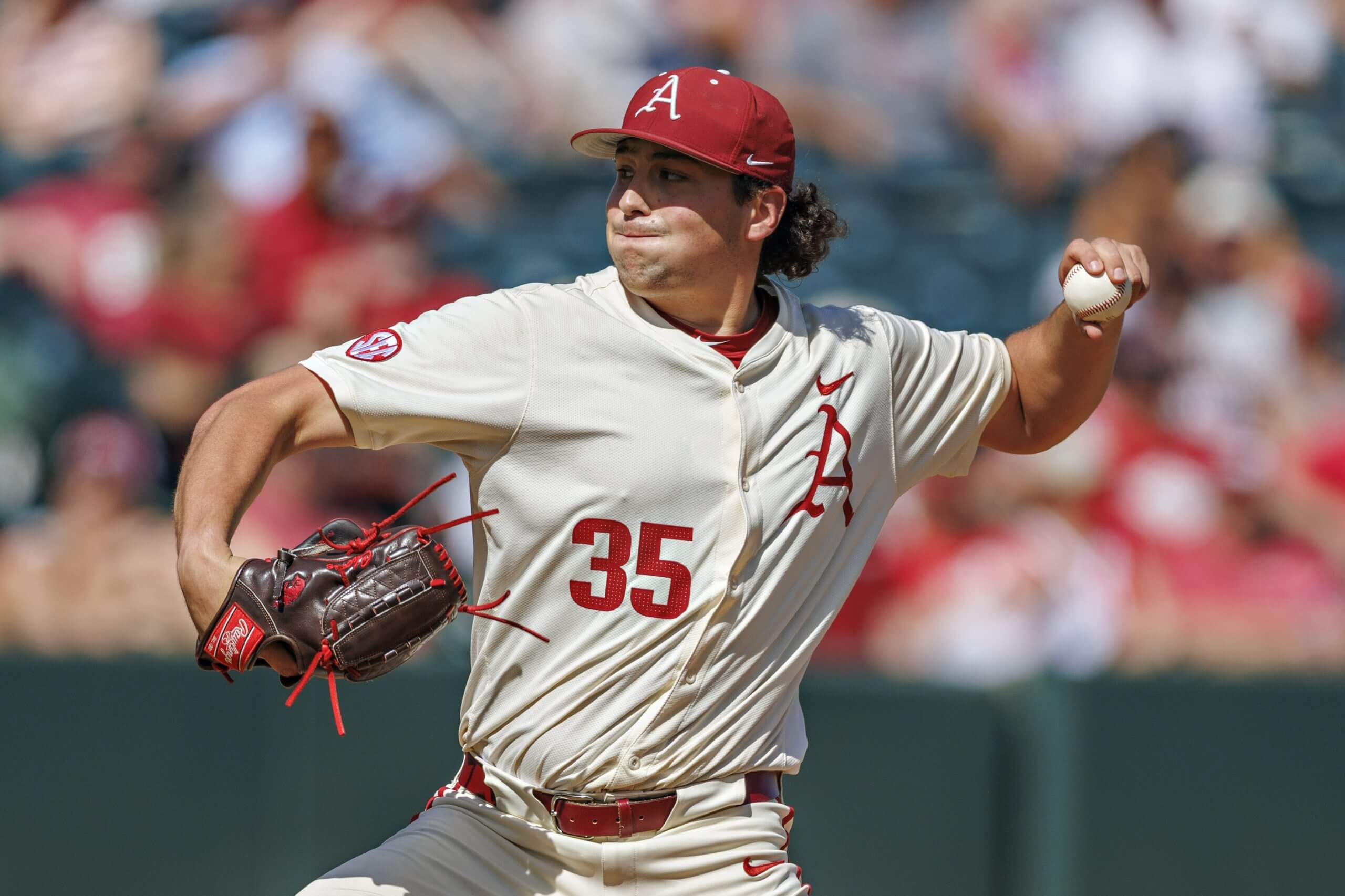
Landon Beidelschies pitched for Arkansas last season. (Wesley Hitt / Getty Images)
12. Landon Beidelschies, LHPHeight: 6-3 | Weight: 230 | Bats: L | Throws: L | Age: 22
Beidelschies, a sixth-round pick last season, was up to 97 at Arkansas, and he shows a slider that should dominate lefties. For some reason, the Hogs also had him throwing it a ton to right-handed hitters, and they appreciated that very much. He has a 45 changeup, enough to at least send him out as a starter and see if a traditional pitching plan, with the slider for left-handed batters and changeup for righties, leads to better results. He could be a steal in the sixth round.
13. Lucas Braun, RHPHeight: 6-0 | Weight: 185 | Bats: R | Throws: R | Age: 24
Braun’s fastball is a flat four-seamer at 92-93, yet he continues to succeed at every stop. He’s got an above-average slider and at least an average changeup for lefties, so he threw his fastball just 39 percent of the time last season. He’s cleaned up his delivery to be less cross-body, so he’s more on line to the plate now and pitches well to both sides, although this probably cost him some deception. He’s homer-prone and likely to stay that way, which is probably the main thing keeping him from projecting as a starter. In his short time in Triple A, hitters had no issues putting his stuff in play. He should continue to start for now, although the odds of him staying there in the majors have dropped significantly, and I bet he’ll surface as a swingman or sixth starter this year rather than a full rotation member.
14. Isaiah Drake, OFHeight: 6-0 | Weight: 180 | Bats: L | Throws: R | Age: 20
Drake is a plus runner who made huge strides (no pun intended) as a hitter last year, cutting his strikeout rate from 35.5 percent to 22.6 percent year over year while repeating Low A, then moving up to High A for a month and cutting it further to 17.7. He struggled to recognize anything the year before last, even whiffing 39 percent of the time on fastballs, the pitches you’re supposed to hit even if you can’t hit anything else. That came way down to 22 percent last year, however. Atlanta’s fifth-round pick in 2023, Drake looked like he might never get out of A-ball after the 2024 season, but now he has at least a fourth outfielder future given his speed and defense in center — assuming he keeps up this improved approach.
15. Jhancarlos Lara, RHPHeight: 6-3 | Weight: 190 | Bats: R | Throws: R | Age: 23
Lara is the pitching equivalent of a ghost pepper: All heat, no flavor. He throws very hard, averaging 98.6 on his four-seamer in Triple A last year with good life on it. He hit as high as 101 in the Arizona Fall League, but he doesn’t throw strikes and has limited feel to pitch. Last season, Atlanta had him in the Double-A rotation to start the year, then promoted him to Triple A and made him a short reliever for three months, then stuck him in the rotation there for the final seven weeks of the season. He didn’t throw strikes or keep runs off the board in either role, with a higher ERA as a starter but a 21 percent walk rate in relief. He’s a physical guy and has that intimidating reliever look. I think he’d intimidate hitters more if they thought he could find the strike zone.
16. Conor Essenburg, OFHeight: 6-2 | Weight: 200 | Bats: R | Throws: L | Age: 19
Essenburg’s claim to fame so far is that he homered off a 99-mph pitch from lefty Jack Bauer, who hit 102 last spring as a high schooler before Bauer headed off to Mississippi State. Atlanta took Essenburg in the fifth round in last year’s draft out of an Illinois high school. He was a two-way guy in high school, but is exclusively a hitter now, with power and good bat speed along with a questionable approach that might cause him some trouble if he goes right to Low A. He’s an intriguing upside play, just someone who probably will require patience given where he is right now as a hitter.
17. Carter Holton, LHPHeight: 5-11 | Weight: 191 | Bats: L | Throws: L | Age: 23
Holton was Atlanta’s second-round pick out of Vanderbilt in 2024, when they knew he was probably hurt. He did undergo Tommy John surgery after one pro appearance, missing all of 2025. He’s a four-pitch guy who has had reverse splits in the past because his changeup is his best weapon, while his breaking stuff is good enough to keep lefties in check and allow him to start. We’ll see in March where his velocity is.
18. Cade Kuehler, RHPHeight: 6-0 | Weight: 215 | Bats: R | Throws: R | Age: 24
Kuehler also had Tommy John surgery in the summer of 2024, the culmination of about two years of on-and-off arm trouble. He has a very short, violent arm action that does give him deception, working with a four-seamer in the low 90s and a solid-average slider. He’s probably a reliever, but let’s see where his stuff is once he’s fully healthy and Atlanta gets to try to expand his repertoire.
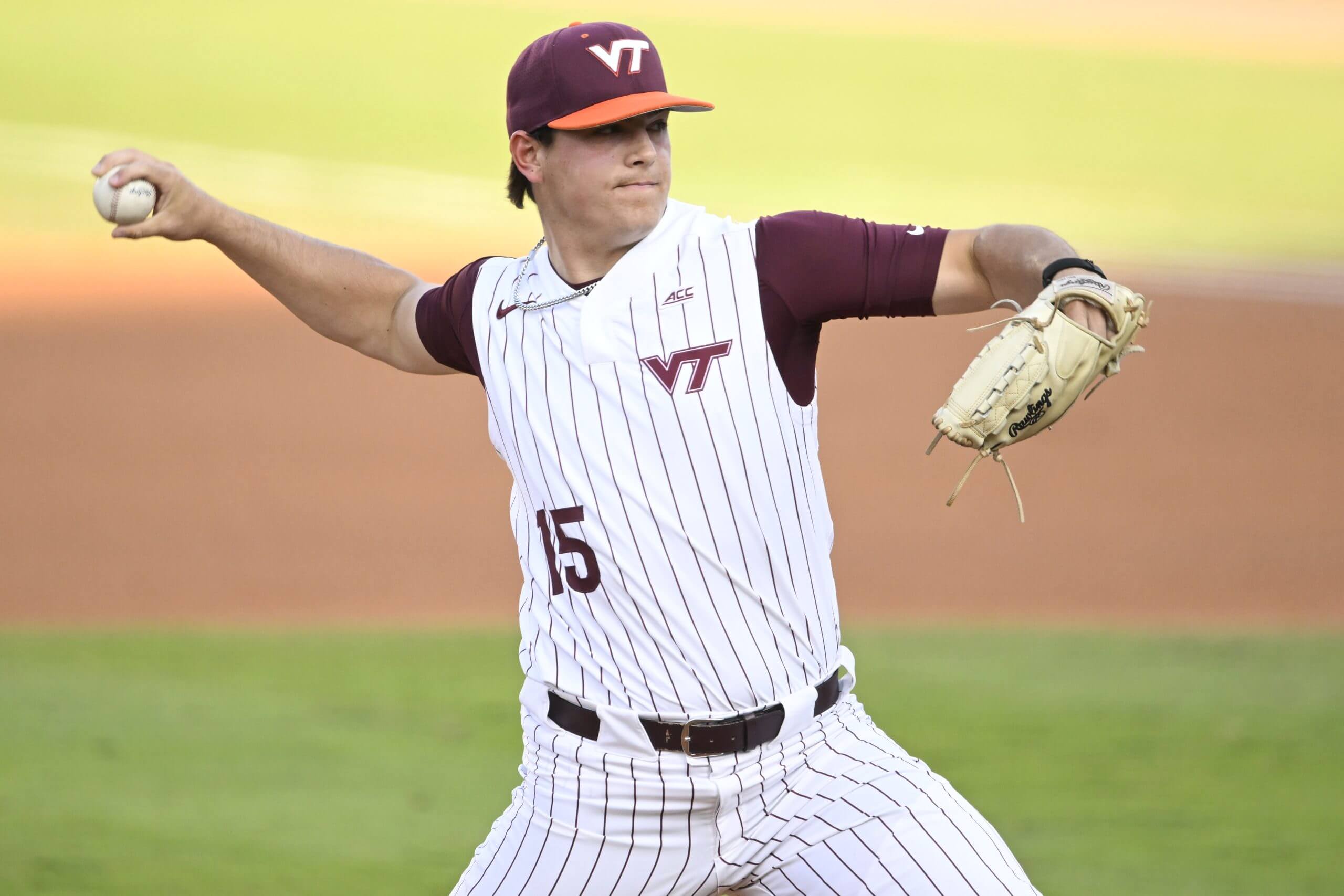
Drue Hackenberg, who pitched collegiately at Virginia Tech, has three older brothers who also played pro sports (one who played baseball, one who played football and one who played soccer). (Eakin Howard / Getty Images)
19. Drue Hackenberg, RHPHeight: 6-2 | Weight: 220 | Bats: R | Throws: R | Age: 24
Hackenberg, a 2023 second-round pick, wasn’t in ideal shape when he arrived at spring training last year. Then he pulled an oblique that limited him to 74 innings on the year (including rehab). He posted a 6.81 ERA and walked 54, almost all in Double A — a huge letdown from a promising 2024 season that saw him end the year in Triple A and be in line for a call-up. His stuff backed up, so his fastball couldn’t miss bats, and he leaned more on his breaking stuff to get outs, which only sort of worked because he wasn’t landing them for enough strikes. It was a lost year, but since the injury wasn’t arm-related, it’s reasonable to hope for a return to his 2024 form this year.
20. Eric Hartman, OF/2BHeight: 6-1 | Weight: 185 | Bats: L | Throws: R | Age: 20
Atlanta’s last pick in 2024 out of a high school in Alberta, Canada, Hartman is a plus runner who played center and second last year in Low A, splitting time with Isaiah Drake in the outfield while maintaining some versatility. His swing is somewhat flat, almost slashing, with plenty of bat speed to get to good velocity, while his offspeed recognition lags well behind the rest of his game. He could be a solid utility player given his speed and ability to handle two spots up the middle. I just want to point out that South Park debuted in 1997, nine years before Eric Hartman was born. You will never convince me this is a coincidence.
2026 impact
It’s Atlanta, so every pitcher is in play for a call-up at some point. I believe Caminiti debuts this year, although I think Sinnard is the most likely to come up and contribute positive value in the short term.
The fallen
Atlanta was in the penalty box for several years after former GM John Coppolella was forced to resign due to multiple violations of MLB’s rules around international free agency. That forced them to play some catch-up once they were allowed to sign the big-ticket players there again. It’s been a rough re-entry. Their 2022 class was headlined by Diego Benitez ($2.5 million) and Douglas Glod ($1.2 million). Benitez finished last season still in the Florida Complex League, and Glod struck out 35 percent of the time in Low A, both at age 20. Turns out the best player in that class for Atlanta was a Colombian right-hander they signed for $75,000: Didier Fuentes.
Sleeper
I am excited to see what Atlanta does with Beidelschies, who should have had a better season at Arkansas and probably lost some money because of how they used him.