
There was a moment, not that long ago, when the sweeper felt unavoidable. Every broadcast featured it. Every Pitching Ninja clip highlighted it. Every development staff wanted one more guy who could rip a Frisbee-like breaking ball that darted horizontally and embarrassed hitters. The pitch existed before, of course, but the league finally figured out how to define it, measure it, and teach it.
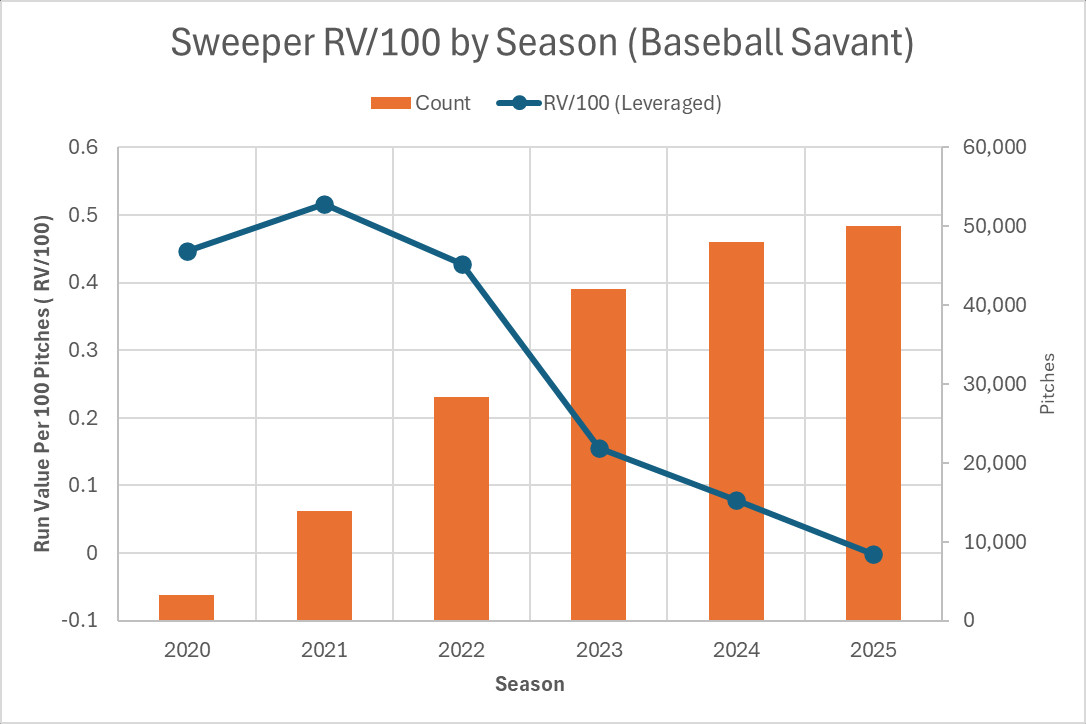
According to The Athletic, pitchers had been throwing slider-like pitches with sweep for years. The breakthrough came when teams identified the specific properties that made a sweeper effective and used that information to scout and develop arms who could do what was needed to produce those results. Once that door opened, the flood followed. From 2020 through 2023, the league added roughly 10,000 sweepers each season. It was the hot new pitch type, and everyone wanted in.
Then, hitters did what hitters always do. They adapted. As sweepers proliferated, they became less exotic, and thus less deceptive. The league’s batting average against the pitch climbed from .183 in 2020 to .215 by 2025. Slugging jumped more dramatically, from .280 to .364. Hitters chased less often and swung more frequently when the pitch actually entered the zone. What was once a deception-driven pitch became something batters could recognize earlier and square up more consistently.
When a pitch goes from rare to common, the advantage flips. Hitters see it in bullpens. They see it on video. They see it on highly specialized Trajekt pitching machines. They see it in games multiple times a week. Training catches up. The sweeper did not suddenly get worse. The league just got better at hitting it.
This is where Stuff+ comes into play. Stuff+ is designed to answer a deceptively simple question for teams: “What inherent qualities make a pitch good?” Velocity, movement, release traits, and shape are all baked in. The challenge is that baseball never stops moving. What worked in 2020 does not necessarily work in 2026.
That forced a difficult decision. How much old data should inform what we think makes a pitch effective today? How relevant is the early sweeper boom to the current environment, where hitters are actively hunting the pitch?
To address that, Stuff+ removed 2020 and 2021 from its training data and added 2025. The goal shifted from being a historical artifact to answering a more practical question. What makes a pitch good right now? That reduces its usefulness for comparing across eras, but it strengthens its predictive value, which is where Stuff+ shines, anyway. In small samples, it can tell scouts, teams, and fantasy players a lot about pitch quality before the results stabilize.
The update by the engineers of Stuff+ brought with it a reckoning. As batters improved against sweepers, the pitch type itself lost Stuff+. Some pitchers took a hit as the model adjusted to the new reality.
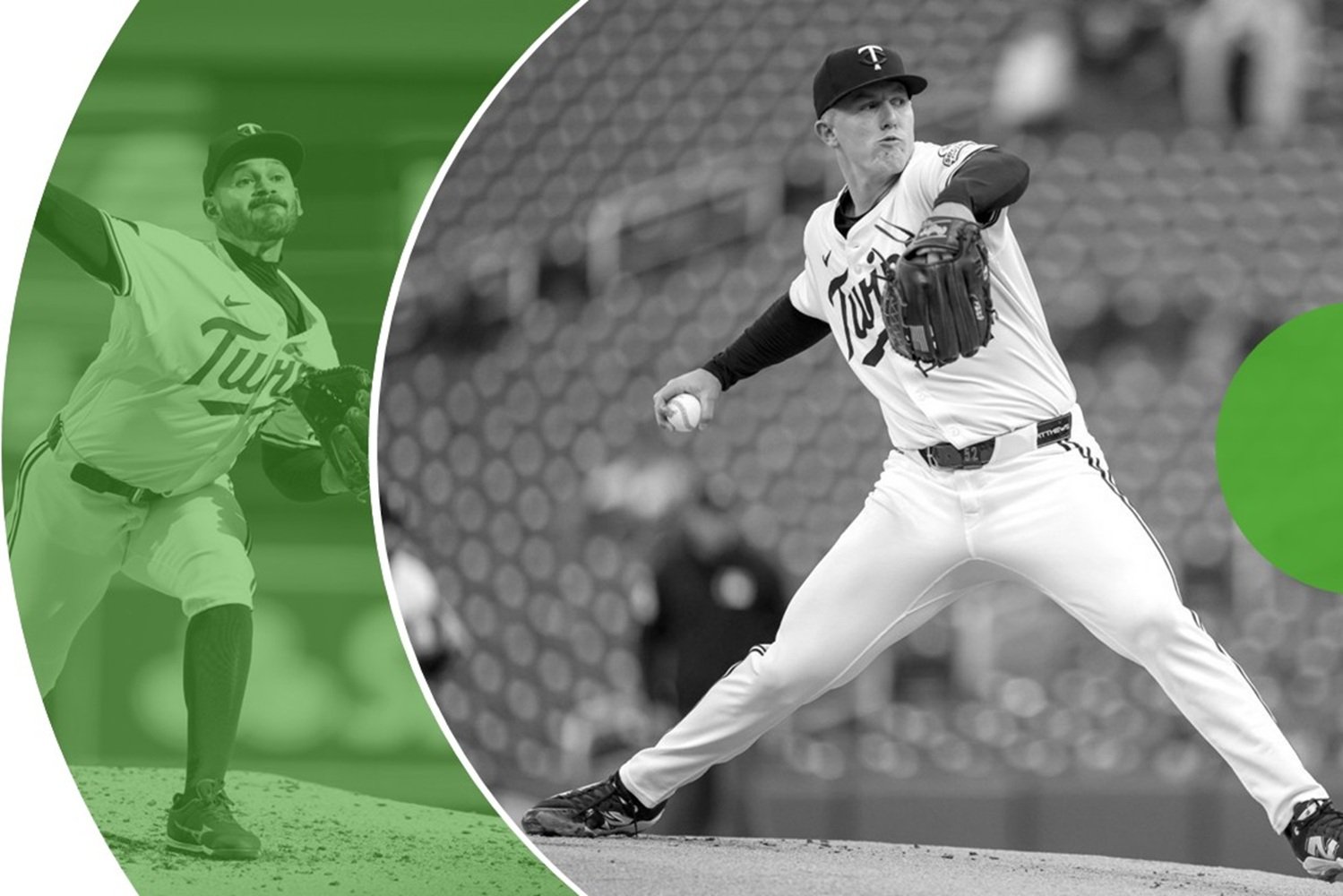
Zebby Matthews was one of them. He tied for the third-largest Stuff+ drop following the update, falling from a 106 to a 101. Only Luis Severino and Aaron Civale saw larger declines. On paper, that looks concerning. In practice, it’s more complicated.
Matthews still leaned heavily on the pitch, throwing his sweeper 25.1% of the time in 2025, just a slight dip from 25.9% the year before. The results, however, were dramatically better. Opponents slugged .252 against the pitch last season, down from .462 during his rookie year. Contact quality declined as well, with average exit velocity dropping from 90.2 to 87.5 mph.
Part of that improvement came from added life. Matthews generated an additional 70 rpm of spin, giving the pitch more late action. Within his arsenal, the sweeper remained his best bat-missing weapon. It posted a 38.5% whiff rate on swings and successfully put a hitter away in two-strike counts 24.3% of the time, both of which were the top results for his pitch mix. Even as the league cooled on sweepers overall, Matthews found a way to refine his version and stay ahead of the curve.
Pablo López‘s sweeper arc is a slightly different story. When the Twins acquired him before the 2023 season, one of the first changes they made was adding a sweeper. The early returns were excellent. In its first season, hitters managed just a .210 wOBA against the pitch, with a 36.5% whiff rate. It gave López another look that complemented his fastball and changeup beautifully.
Last season was more complicated. Injuries likely influenced his approach and execution, but the sweeper clearly changed. López held batters to a .163 wOBA with the pitch, his lowest mark for any offering, but the swing-and-miss wasn’t the same. His whiff rate dropped to 30.1%, the lowest since he introduced the pitch. Hitters were making more contact, even if that contact did not always turn into damage.
That tension captures where the sweeper sits in 2026. It can still work. It can still produce weak contact, because it has lots of horizontal movement, which traditionally does better at limiting damage. But it no longer consistently fools hitters the way it once did, and because it often has less vertical depth than a traditional slider or a hard curve, it doesn’t miss as many bats. Vertical movement is better at producing whiffs.
The league is already adjusting. The kick-change is gaining momentum, offering deception through velocity separation and late movement rather than a sweeping horizontal break. That’s an innovation that benefits pitchers most when they face opposite-handed batters, rather than same-handed ones, but teams can adjust to the changing pitch design-and-adjustment cycle by sacrificing the platoon advantage to chase exoticism and deception in key matchups. Even when it comes to same-handed batters, though, the sweeper might be overtaken by another tack soon. Something else will follow. It always does.
The story of the sweeper is a reminder that no pitch remains king forever. As hitters learn, pitchers must evolve. The question now is, which pitch will be next to explode across the league, and how long will it take hitters to catch up this time?
How will Matthews and López change their approach in 2026? Leave a comment and start the discussion.