
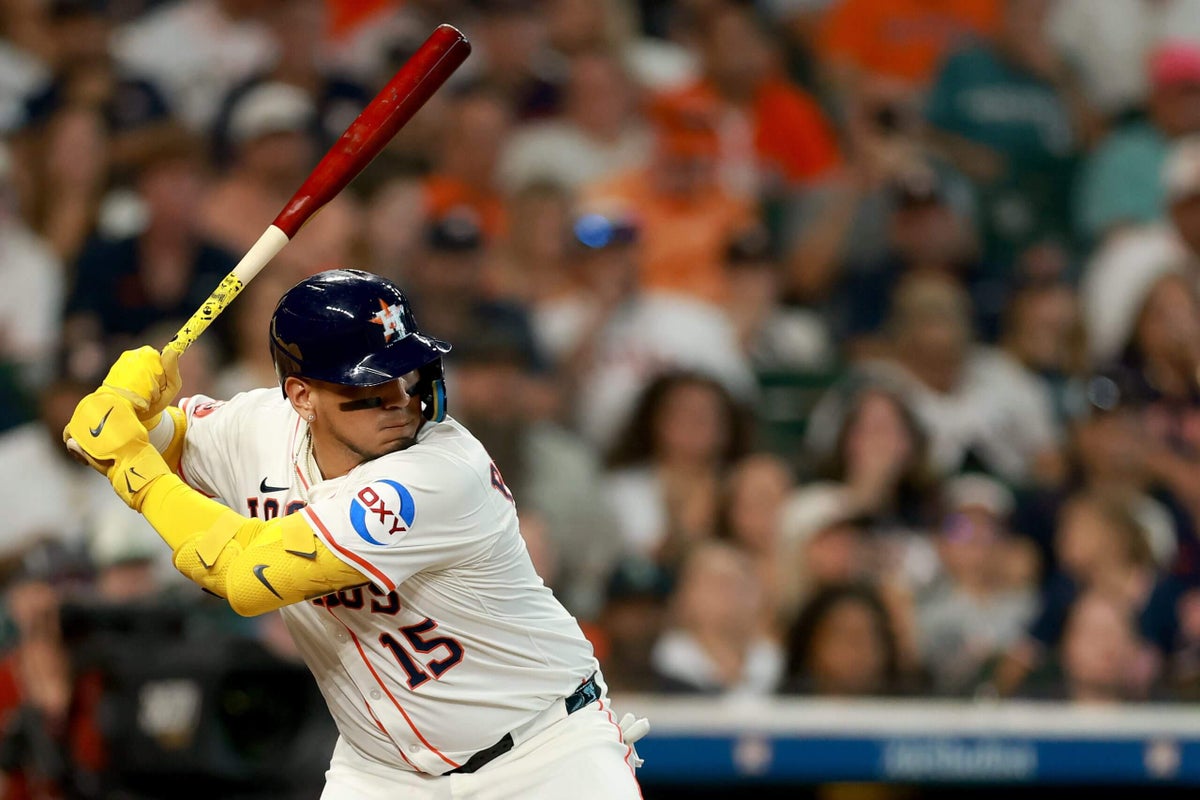
HOUSTON — One phone call can change the calculus, but the Houston Astros appear intent on bringing their infield surplus to spring training. Whether it lasts for the entire six-week stay in West Palm Beach, Fla., is a legitimate question.
Team and league sources continue to question the feasibility of carrying both Christian Walker and Isaac Paredes on the same roster. Both are still trade candidates on a club still searching for a left-handed hitter to balance its lineup. Moving one of Walker or Paredes to procure one is becoming more realistic.
“Right now, both of them are still part of our roster and we have plans for both of them to play,” general manager Dana Brown said on Tuesday. “Right now, our plan is for both of them to be there.”
Beginning both of those sentences with qualifiers only accentuates how awkward the scene will be next week as Houston’s entire team gathers. Neither Paredes nor Walker has addressed the situation, which, if unresolved, would cut into their playing time.
Manager Joe Espada said he’s spoken to both players throughout the winter and conveyed one message.
“This is going to play out and let’s just get to spring training and prepare ourselves to win,” Espada said. “I don’t want this to become a distraction. I think this is going to play itself out. But, right now, they understand where we’re at and they understand we need all of us to be together to accomplish our goal. I want our focus to be on that.”
Reality may be more rocky. Paredes is a reigning American League All-Star, one of the only patient hitters in a lineup full of free-swingers and equipped with a pull-prone offensive profile that is perfect for Daikin Park. Walker will be the third-highest-paid player on Houston’s luxury tax payroll in 2026.
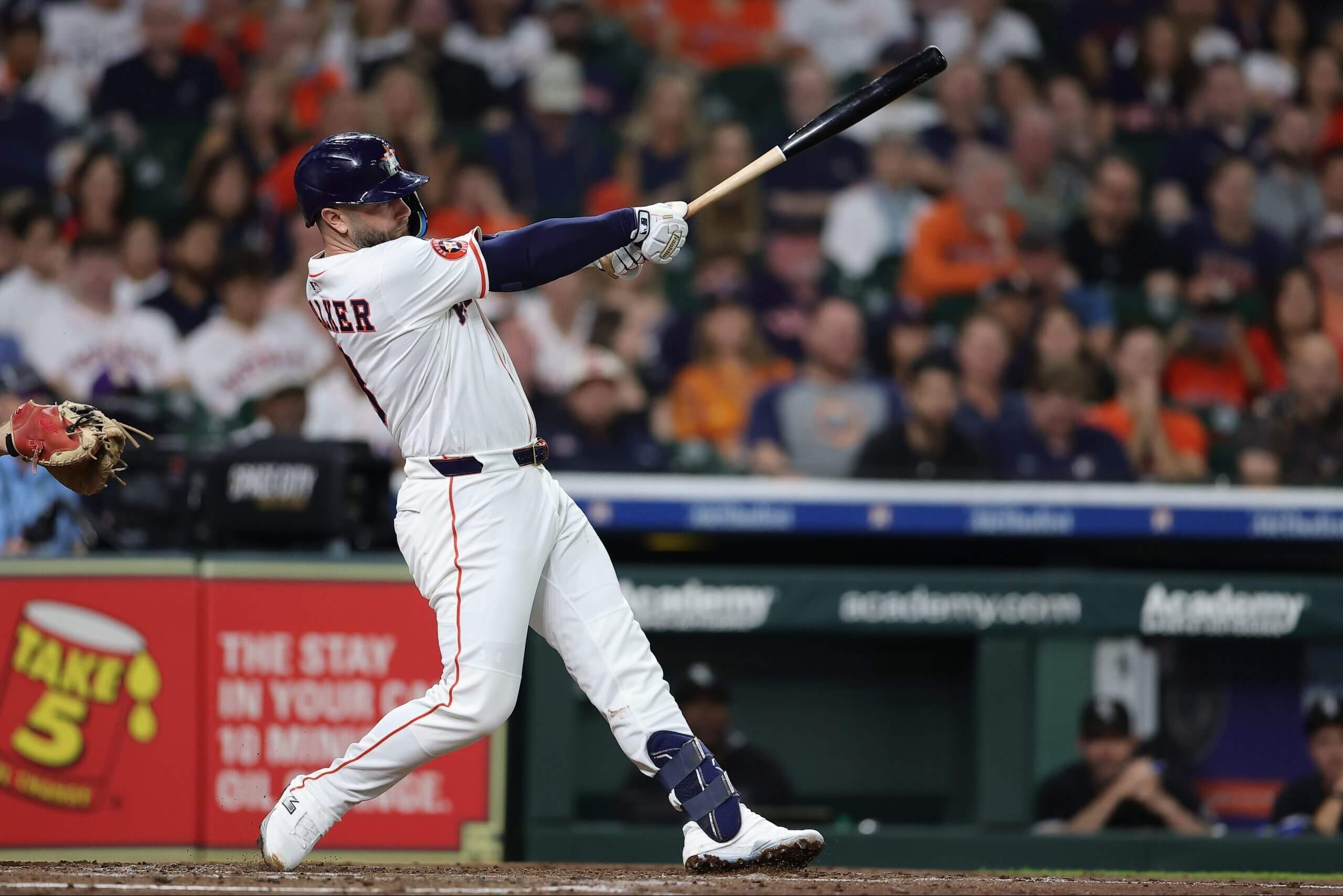
After a disappointing first half of the season, Christian Walker hit .250/.312/.488 in the second half, clubbing 15 homers and 12 doubles. (Alex Slitz / Getty Images)
If Houston opens the season with both players on its roster — and all the other infielders are healthy — conversations surrounding each day’s lineup decisions will be incessant. Playing Walker and Paredes together will come at the expense of either the face of the franchise (Jose Altuve) or the team’s most feared hitter (Yordan Alvarez).
Questions are obvious — and discourse will seep into the clubhouse, regardless of what players may say publicly. Professional athletes preach blocking out the noise, but doing so to this extent will be difficult.
Both Walker and Paredes are considered consummate professionals, but they are prideful players with a certain expectation for their roles. Parallels between this situation and Ryan Pressly’s reaction to Josh Hader’s arrival — which led to a fractured relationship with Brown — are difficult to ignore.
Last September, after being benched for a crucial September game against the Seattle Mariners, Walker said, “I expect to play every day.”
Walker is making $20 million this season and whacked a team-leading 27 home runs in 2025. After the All-Star break last year, he sported a .799 OPS. No Astro with at least 100 plate appearances had a higher one. It isn’t as if Walker has become unplayable.
Yet, seven days before spring training, the most optimal version of Houston’s lineup may not include him.
Scenarios exist in which both Walker and Paredes can coexist on the roster. Espada could be more flexible with the designated hitter spot in his lineup. Altuve could play more in left field, opening second base for Paredes.
Both scenarios would contradict Espada’s comments throughout the offseason, including a reiteration on Tuesday that “Yordan, I would like to give him most of his at-bats as a DH, and I will do everything in my power to keep him in the DH spot.”
Minutes earlier, Brown claimed, “I feel like there’s enough playing time in the DH slot and the ability to move some guys around.”
“If we can trade a guy to potentially get a left-handed bat or something like that, we’ll consider it, but I think right now we have a really good infield,” Brown continued. “We do have the depth. But we have a long season of 162 (games), we have some veterans that we want to give some breaks during the course of the season. To have this depth is good because last season we ran into some injuries.”
Brown gives Espada autonomy on all lineup decisions, so the skipper’s words carry more cachet in this discussion. A significant injury to one of the other infielders is the most straightforward way to clear this surplus, but Houston shouldn’t construct its roster anticipating such a fate.
Espada said Paredes will field some spring training ground balls at second base, a position few in the industry believe he is capable of handling defensively. Walker has no defensive versatility away from first base, where, it should be noted, he is a better defender than Paredes.
After Altuve’s worst offensive season since 2013, Espada shared some regrets. Injuries around the roster forced the manager to play Altuve 155 games, far more than he would’ve envisioned for a player who will turn 36 in May.
“If we didn’t have the amount of injuries and I could’ve given Jose some extra days off his feet, we’re talking about an .820 OPS. We’re talking about 30 home runs,” Espada said of Altuve, who instead finished 2025 with a .771 OPS and 26 home runs.
“For me, based on what we went through, through all those injuries, that’s a really good year. The numbers were not there, but my job is going (to be) to help Jose have the right amount of time to be off his feet so we can have the best version of Altuve any time he’s on the field.”
Viewed through this prism, keeping both Paredes and Walker on the roster makes sense, but this is a fine line for Espada to toe. Altuve is in pursuit of 3,000 hits, and to get there, he needs at-bats. Altuve’s agent, Scott Boras, said his last contract extension was orchestrated, in part, with the milestone in mind.
Altuve isn’t going to become a part-time player, but expecting him to play 155 games again feels far-fetched. More time at designated hitter will help, though that is contingent on Alvarez’s ability to play left field — and Espada’s willingness to put him there. All of Altuve’s on-field value to the Astros remains tied to his bat.
For Houston’s 2026 lineup to thrive, a bounce-back is needed.
Perhaps there is precedent for one. After a 2021 season he deemed inadequate, Altuve acknowledged a flaw in his approach. He sold out for power and pulled the baseball at a higher rate than any season of his storied career. Altuve spent that offseason tinkering with his swing and reported to spring training with a refreshed outlook.
In both 2022 and 2023, Altuve pared his pull rate by at least 3 percent. He hit .300 in 2022 and .311 in 2023 and finished both seasons with an OPS higher than .900. Altuve made the All-Star team in 2022, and, if not for a fractured thumb, would’ve done it again in 2023.
Jose Altuve’s pull tendencies
YearOPSAVGPull RateHR
2021
.839
.278
49.7%
31
2022
.921
.300
46.9%
28
2023
.915
.311
45.2%
17
2024
.790
.295
51.3%
20
2025
.771
.265
52.5%
26
Altuve once claimed “a .900 (OPS) is the new .300 for batting average.” A .900 OPS, according to Altuve, is “a good season for me.” Finishing 2024 with a .790 mark and last season at .771 doesn’t qualify. Altuve’s .265 batting average last season was the lowest of any 162-game season in his career.
In both 2024 and 2025, Altuve pulled the baseball at least 51 percent of the time. The only other season with a higher mark? That 2021 season, which forced him to evaluate his approach and realize how pull-happy he’d become. He still hit 26 home runs last season, but perhaps sacrificed his on-base percentage and situational awareness in the process.
He’s authored a Hall of Fame career with elite bat control and the ability to make contact with almost any pitch. It’s never as straightforward as “stop pulling the ball,” but Altuve has at least given a blueprint on how to bounce back.
After tinkering with the idea last season, the Astros plan to give Cam Smith some center field reps in Grapefruit League play. The revelation itself is not surprising — spring training is the ideal time for experimentation — but if Smith can become serviceable in center, it creates more intrigue in Houston’s unsettled outfield.
Smith, fellow rookie Zach Cole, Jesús Sánchez and Jake Meyers will enter spring training as Houston’s four most trusted outfielders — perhaps in name only. The team has made Meyers available in trades all winter and is also fielding interest in Sánchez, who is owed $6.8 million.
Houston already has too many infielders, so it stands to reason any left-handed bat acquired by Brown would be an outfielder. That Brown keeps broadcasting the team’s interest demonstrates, on some level, a lack of faith in Sánchez, who hits left-handed and had a quality major-league track record before arriving in Houston at the trade deadline.
Sánchez is a natural right fielder. So is Smith, who finished as an American League Gold Glove finalist at the position.
It’s clear, though, that Houston’s coaching staff wants to prepare for any and all circumstances within this cloudy outfield picture. Smith’s ability to play center field could open right field for a potential new acquisition, one that may require parting with Meyers to obtain. It would also give Espada more flexibility on days Alvarez or Altuve play left field.
Both Espada and Brown have been bullish on Cole throughout the winter and will give him every opportunity to earn an everyday role in spring training. Cole can play both corner spots, and, on Tuesday, Espada acknowledged he could be in line for at-bats in left field.
Few other absolutes exist within Houston’s outfield.